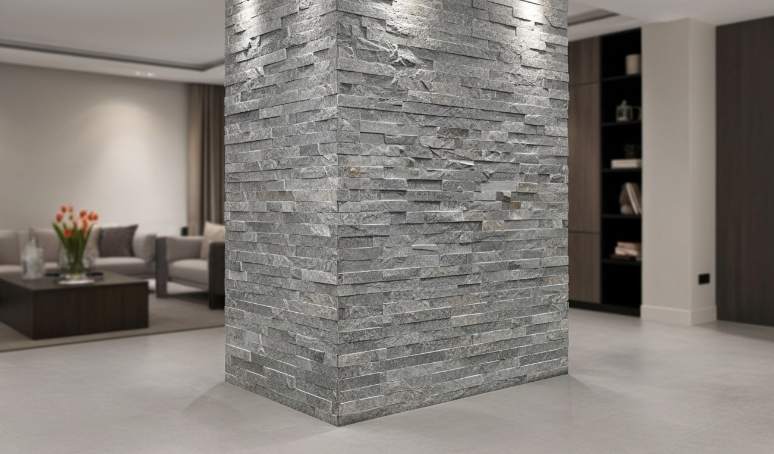
Precision corner miter techniques serve as the primary benchmark for stone installation quality, directly impacting project margins and long-term structural reliability. Improperly executed stone wraps lead to visible seams and crumbling joints that signal a low-budget installation, often resulting in expensive rework or client rejection during final walkthroughs. Achieving a seamless finish on fireplace pillars and external corners requires a rigorous approach to stone geometry, as even minor miscalculations in the cut angle can compromise the visual continuity of the entire architectural feature.
これ guide establishes a technical standard operating procedure for stone ラッピング、現場ベースの 45 度マイターカットの仕組みをカバーし、自然な石積みの外観を実現するプレハブ L コーナーの使用。 90 度以外のカスタム角度の管理、緻密な珪岩に適したダイヤモンドブレードの選択、目に見えるカットラインを除去するために使用される最終ホーニング方法について、具体的なワークフローを詳しく説明します。これらの手順に従うことで、外側のコーナーがしっかりとした手彫りの外観を維持することができます。 プロの建築の耐久性要件を満たしながら石材を使用。
コーナーが悪いと低予算での設置品質が明らかになるのはなぜですか?
精度 石のコーナーリング これは、高級な建築用石積みと、急いでコストを削減する労働力とを区別するための主要な基準として機能します。
コーナーは、仕上げ技術の精度と適切な実行が必要なため、建設における重要な品質指標として機能します。不均一なコーナーや仕上げが不十分なコーナーは、労力や材料の不足を直接的に明らかにします。角が丸くなったり、曲がったり、一貫性がない場合は、取り付けプロセスが急いでいることを示します。コーナー仕上げは労働集約的であり、簡単に隠すことができないため、請負業者が必要な時間を投資したのか、それともコスト削減のために手抜きをしたのかを示す明確な指標となります。
目に見える継ぎ目と露出した原石コア
低予算のインスタレーションでは、石の内部の鋸で切られた端が目に見えるままになることが多く、幻想的な印象を打ち破ることができます。 天然石積み。安価な労働力では通常、カットエッジのホーニングや研磨が省略され、石の表面とはっきりと対照的な、角に沿って鈍く不自然な灰色または白色の縞模様が残ります。
- 精密カット 元帳パネル しっかりと交わる必要があります。角に目に見える隙間や太いグラウト線がある場合は、専用の石材切断装置が不足していることを示しています。
- 高度 プロジェクトは、石材のシームレスな移行を優先します。 顔が連続的にコーナーを包み込むように見えます。
- 露出したコアは、自然の裂け目面の UV 安定性と鉱物質を欠いているため、風化が早くなり、 “製造された” 見て。
パターンの不連続性と視覚的な切れ目
下手な職人技では失敗する 石の自然な流れを維持する textures around a 90-degree angle, making the installation look like a wallpaper application. Inexpensive installations often result in ‘stacked’ seams where the horizontal lines of the stone do not align from one face of the corner to the other. This break in the visual plane destroys the architectural “weight” that natural stone is supposed to provide.
- Experienced installers select specific pieces to mimic a solid boulder’s natural grain.
- Low-quality work uses random off-cuts at the edges, ignoring the color and texture matching required for a professional finish.
- Texture mismatching at the corner instantly signals to designers and high-end clients that the project prioritized speed over aesthetic integrity.
The Use of Field-Mitered Flats Instead of L-Corners
予算に限りのある請負業者は、既成の L 字型コーナーピースに投資するのではなく、現場でフラット パネルを 45 度の角度で手作業で切断してコーナーを作成しようとすることがよくあります。手動の湿式鋸には工場の CNC ダイヤモンド ブレード エッジの精度が欠けているため、フィールドマイターコーナーでは欠けや不均一な隙間が発生しやすくなります。
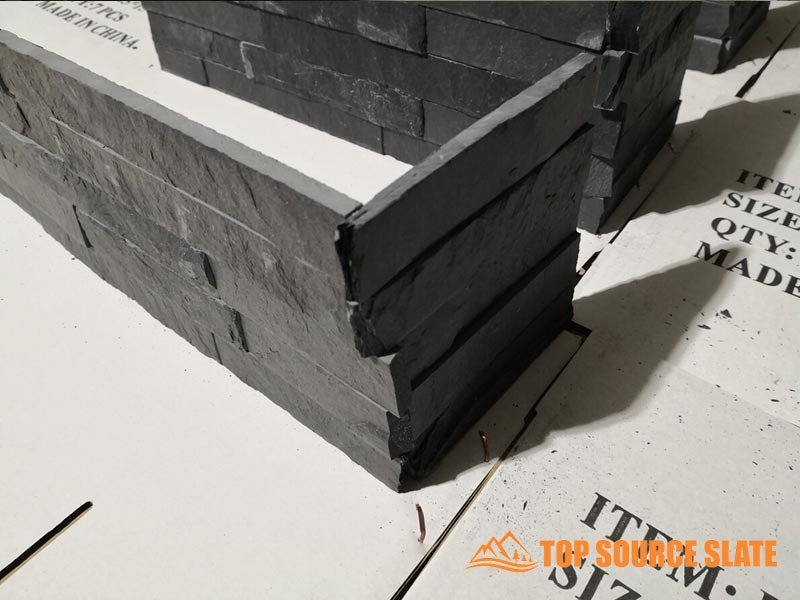
- 工場製のL字コーナーを使用することで、 石の自然な 表面はエッジの周りに続き、フルベッド深さの石の構造的な外観を提供します。
- 現場での手動切断では、隙間のないしっかりとした接合を確保するために必要なわずかなオーバーカット (45.3 ~ 45.5 度) を達成できないことがよくあります。
- 手作業によるコーナーカットに頼ると、次のようなリスクが大幅に高まります。 交通量の多い商業施設での石の移動 または住宅地。
接着剤のにじみと構造的脆弱性
Corners are high-impact zones that require specialized bonding; poor installations often show messy adhesive residue or structural instability. Low-budget teams often over-apply standard thin-set, which can seep through corner gaps and permanently stain the 天然石 surface. This residue is difficult to remove without damaging the stone’s natural cleft.
- Proper installation uses high-strength epoxy resin specifically formulated for natural stone to prevent panels from pulling away at the joints.
- Inadequate support at the corner leads to ‘lippage,’ where one panel sits higher than the other, creating a sharp and dangerous edge.
- Standard thin-set lacks the lateral bond strength required to hold mitered edges together over long-term freeze-thaw cycles.
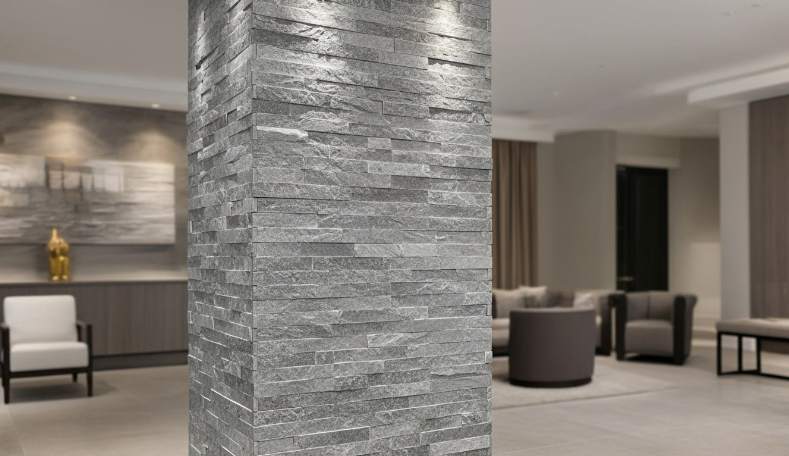
現場での留め継ぎ切断: 45 度の自然なエッジのための高精度のヒント
現場でプロレベルの石角を実現するには、標準的な大工仕事のロジックから、次のことを考慮した精密な製造の考え方への転換が必要です 天然石の密度と不規則性 表面のテクスチャ。
精密な石材加工に必須の設備
クリーンな 45 度の角度 天然台帳石 適切な機械的セットアップから始めてください。アラスカ グレーやシエラ ブルー モデルのような硬い珪岩を扱う場合は、連続リム ダイヤモンド ブレードを備えた高品質の湿式鋸、特にセグメント高さ 15 mm の鋸を使用することをお勧めします。連続リム スレートや大理石によく見られるマイクロチッピングを防ぎます。15mm の高さにより、24 インチ パネルの全長にわたってエッジの安定性が維持されます。
Vibration serves as the primary enemy of a clean miter. Secure the panels using specialized stone jigs or heavy-duty clamps to eliminate movement during the pass. Using a digital angle gauge to verify the blade tilt ensures that the first cut matches the last, preventing the “ドリフト” that often ruins bulk installations.
The 45.5-Degree Overcut Technique
Experienced installers avoid cutting at a perfect 45-degree angle. By setting the saw to 45.5 degrees, you ensure that the “true edge”—the visible front face of the stone—makes contact first. This creates a tight, seamless appearance on the exterior while leaving a microscopic interior cavity at the back of the joint.
| 仕様 | Standard Field Cut | Precision B2B Standard |
|---|---|---|
| Cutting Angle | Exact 45.0° (Risk of rear-collision) | 45.3° to 45.5° Overcut |
| Blade Selection | 標準セグメントダイヤモンド | 15mm 分割セグメントまたは連続 |
| ジョイントボンディング | シリコンまたは標準コーキング | カラーマッチしたナイフグレードのエポキシ |
| 冷却方法 | 断続的な散水 | 一定の高流量水潤滑 |
この内部キャビティは、高強度エポキシ樹脂に必要なスペースを提供します。この逃げ角がないと、接着剤によって強制的に接着されてしまう可能性があります。 硬化プロセス中にパネルが離れる、目に見えるものを作成します “段差のある” ギャップ。鋭い前端に圧力を集中させることで、接合部は構造的に結合し、視覚的に一体化した状態が維持されます。
不規則な石の厚さと質感の管理
天然石パネル 私たちのように “ラフシリーズ” 深さが異なるため、留め継ぎの位置合わせが複雑になります。必ず裏面にカットラインをマークしてください。 保護するパネル 傷による自然な顔。カットを行う前に、2 つの合わせパネルの最も厚い点を揃えて、角の周りの輪郭が連続していることを確認します。
- 接着剤を塗布する前にすべてのコーナーピースをドライフィットして確認します。 “爆発” または厚さが不一致です。
- スレートや大理石の壊れやすい端を保護するために、刃が石から出るときに鋸の送り速度を大幅に遅くします。
- 堆積物を除去するために一定の水流を維持します。堆積すると刃が鈍くなり、砥石が過熱する可能性があります。
エッジの仕上げと接合部の補強
カット自体は作業の90%に過ぎません。マイターをカットしたら、200 グリットのダイヤモンド サンディング パッドを使用して未加工のエッジを磨きます。これにより、微細なバリが除去され、2 つのパネル間の移行がスムーズになり、 “柔らかい” 施工後に角が欠けにくい形状です。
最終的な接着には、組み立て前にカットエッジに同色の pH 中性のストーンシーラーを使用します。これにより、水分が原石のコアに浸透するのを防ぎます。実際の接合部にはナイフグレードのエポキシを推奨します。これは、工場で管理された既成 L コーナーの品質を模倣する永久的な耐候性の接着を提供し、設置物が極端な凍結融解サイクルにも剥離することなく耐えることを保証します。
プレミアム台帳パネルの工場直接価格設定
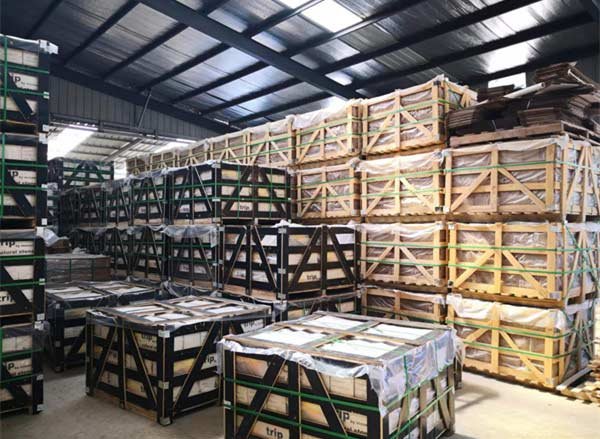
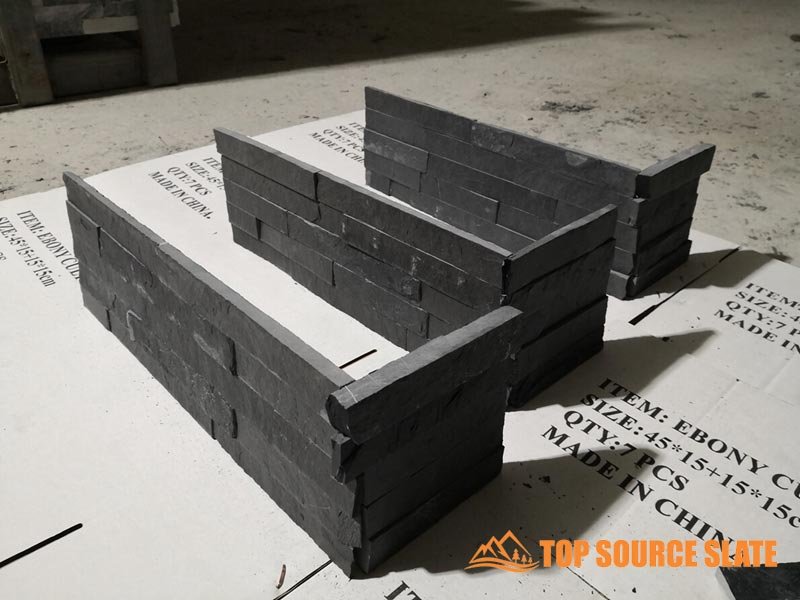
The Pre-fab Advantage: Why L-Corners Look More Like Natural Boulders
Pre-fabricated L-corners replace fragile manual miter joints with a monolithic stone appearance that maintains structural integrity and texture continuity across every wall transition.
Seamless Visual Continuity and Wrap-Around Texture
Manual miter joints often fail to hide the internal aggregate of the stone, creating a vertical line that screams “veneer.” Prefabricated L-corners solve this by providing a continuous stone face that physically wraps around the corner. This design hides the panel thickness and ensures the natural cleft and texture remain uninterrupted from one face to the next. We eliminate the “saw-cut” 隅の部分が伝統的な石積みに見られる堅くて重い石のブロックの形状を模倣しているため、見た目は全体的に異なります。
- L 字型のピースがコーナーを包み込み、基板とパネルのエッジを隠します。
- 製造プロセスでは、90 度の変化全体にわたって自然な分割面のテクスチャが維持されます。
- シームレスなラップアラウンド面により、内部の石のコアや骨材の露出を防ぎます。
工場精度の 90 度ジオメトリ
Achieving a perfect 90-degree angle on a job site with a handheld wet saw is nearly impossible over a large-scale project. We use automated infrared cutting tools to maintain exact dimensions, ensuring that every L-corner piece interlocks without gaps. This precision allows for predictable alignment across multi-story commercial facades or large residential fireplace pillars. To prevent corner separation over time, our factory-controlled bonding uses high-strength epoxy resins specifically formulated for the mineral composition of natural slate and quartzite.
| 特徴 | Manual Site-Cut Miter | Pre-fab L-Corner (CNC) |
|---|---|---|
| Angle Precision | Variable (Human Error) | Fixed 90° (Infrared Guided) |
| インストール速度 | Slow (Manual Cutting) | Rapid (Ready to Install) |
| 構造結合 | Site-applied adhesive | Industrial-grade Epoxy Resin |
| 廃棄物要因 | High (Edge Crumbling) | Near Zero |
Consistency in Color and Material Grading
The most common aesthetic failure in stone installation is a color mismatch between the flat wall panels and the corner units. We mitigate this by sorting raw materials at the quarry level, ensuring that corner pieces come from the same mineral vein as the flat panels. This “同一バッチ採石の一貫性” prevents the disjointed, patchwork appearance that occurs when contractors source materials separately. Every 2026 production batch undergoes a three-stage quality check to confirm hue uniformity remains at 95% or higher across the entire series.
- Quarry-vein matching ensures corner mineral patterns flow into the flat wall sections.
- A three-stage check confirms shading remains uniform across the 2026 product line.
- Unified batch sourcing prevents the “パッチワーク” look of mismatched stone.
Reduction of On-Site Waste and Labor Errors
Site-cutting fragile quartzite or slate into 45-degree miters inevitably leads to edge crumbling and high material waste. Ready-to-install L-corners lower the technical skill required to achieve a luxury finish while drastically shortening the construction timeline. The interlocking Z-shape system integrates directly with our corners, maintaining a grout-free aesthetic that looks like professional hand-laid masonry but installs in a fraction of the time.
- Contractors save labor hours by eliminating manual miter cuts on every course.
- Pre-fab units prevent breakage associated with cutting fragile stone types.
- The Z-shape interlocking system ensures a seamless, professional finish without visible vertical gaps.
How to Handle Non-90 Degree Angles in Custom Fireplace Shapes?
Precise custom angles require intentional over-cutting at 45.3 degrees and CNC-grade diamond blades to eliminate visible gaps in non-standard fireplace architecture.
Miter Cutting Techniques for Precise Custom Joints
Achieving tight seams on hexagonal or non-90 degree fireplace corners requires specific angular adjustments beyond standard 45-degree cuts. Most installers find that a perfect 45-degree cut leaves zero margin for substrate irregularities. We recommend setting your saw to a slightly aggressive angle of 45.3 to 46 degrees. This “back-cutting” technique ensures the outer stone points meet tightly while leaving a small internal void for high-strength epoxy resin.
Dry-fitting every stone panel is the only way to verify that custom angles align with the fireplace’s unique geometry. Since 天然石 varies in thickness and texture, you must check the face alignment before applying any adhesive. To maintain grain and texture continuity, cut the matching corner pieces from the same stone panel to wrap around the custom angle seamlessly。
| Parameter | Standard 90° Corner | Custom Non-90° Angle |
|---|---|---|
| Miter Cut Angle | 45.0° Standard | 45.3° to 45.5° (Back-cut) |
| Blade Selection | Continuous Rim Diamond | Split-Segment Diamond (15mm) |
| Bonding Agent | Polymer-modified Mortar | Color-matched Knife-grade Epoxy |
Essential Equipment for Stone Angle Adjustments
Professional-grade tools are necessary to maintain the integrity of 天然石 during complex angle fabrication. We utilize wet saws equipped with infrared guides to execute precise dimension cuts on ledger stone panels. These guides eliminate the guesswork when transitioning from a straight cut to a complex miter.
- Use ultra-fine-toothed diamond blades to minimize chipping on delicate materials like Alaska Gray or Midnight Slate during steep angle cuts.
- Apply blue painter’s tape along the cut line to clearly mark paths and protect the stone surface from vibration-induced micro-cracking.
- Maintain high water flow to manage heat and prevent the blade from glazing when cutting hard quartzite.
Modifying Ledger Panels for Non-Standard Fireplace Shapes
Adapting the Z-shape interlocking system for hexagonal or curved designs requires strategic panel modification. Our standard Z型パネル are engineered for 90-degree transitions, so you must cut flat panels into custom-angled wedges for fireplaces that deviate from standard architecture. This allows the stone to “turn” the corner while keeping the interlocking mechanism functional.
Bond these custom mitered edges using high-strength epoxy resin formulated for 2026 stone standards to ensure permanent adhesion. On-site adjustment of the interlocking Z-tabs ensures a seamless appearance across custom-angled transitions, preventing the “段差のある” gaps common in lower-quality installations.
Edge Finishing for Custom Angles
Manual refinement of raw stone edges is required when factory corners are modified for custom shapes. Polishing and honing the raw edges of mitered stone ensures they match the factory finish of our Flat or Pencil series panels. Use a progressive grit system, starting at 60 grit for material removal and finishing at 400 grit for a smooth, matte hone.
After the mechanical finish, apply a pH-neutral 天然石 sealer to the newly exposed cut faces. This prevents moisture penetration and staining while maintaining color consistency across the joint. For minor hairline gaps in complex joints, mix color-matched stone dust with resin to mask the seam and create a unified architectural look.
Finishing the Edge: Polishing and Honing the Raw Stone Cut
Technical refinement of the stone edge dictates the final visual grade and safety profile, bridging the gap between raw quarry extraction and architectural-grade cladding.
Precision Refinement with Infrared Cutting Technology
We utilize advanced infrared cutting equipment to establish precise, straight lines before any surface refinement begins. This high-precision phase eliminates structural irregularities in the natural slate or marble, ensuring panels interlock without the visible gaps typically found in lower-tier products. By achieving these dimensional standards in the factory, we reduce the need for aggressive site-side modifications that often lead to edge chipping or structural compromise.
- Advanced infrared tools create clean lines that allow Z-shape and S-shape panels to interlock seamlessly.
- Initial raw cuts prepare the stone for specific grit treatments by removing surface tension.
- Precision factory cutting preserves the integrity of the 天然石の edge, preventing crumbling during transit.
Progressive Grit Sequences for Honed and Polished Finishes
Achieving a specific architectural texture requires a systematic grit sequence. Honing involves a mechanical process using a grit range from 60 to 400 to remove surface scratches while creating a smooth, matte finish—a preferred choice for 2026 モダンなデザイン. For high-gloss requirements, our technicians continue the sequence beyond honing to produce a reflective surface that deepens the 石の自然な color saturation.
Technicians monitor mechanical pressure and heat levels throughout this process to prevent micro-fracturing along the stone’s perimeter. This controlled material removal ensures that even hard quartzite maintains a crisp, professional edge without the “rounding” effect caused by amateur polishing techniques.
Maintaining Edge Integrity with pH-Neutral Solutions
Post-cut chemical management is vital for long-term stone health. We strictly use pH-neutral formulations during the polishing phase to prevent surface etching or color degradation. Using acid-based cleaners at this stage would ruin the natural mineral structure of materials like quartzite or marble, leading to premature fading or staining. Proper sealing after the final polish prevents moisture penetration, which is critical for high-traffic commercial applications.
- We avoid acid-based cleaners to maintain the natural hue and mineral stability of the stone.
- High-strength epoxy resin ensures the bond between the stone and the backing remains permanent after edge refinement.
- Final sealing stages protect the polished surface from oils and environmental debris.
Balancing Aesthetic Texture with 2026 Safety Standards
Current design trends influence edge texture as much as aesthetics. Satin and matte finishes have seen increased adoption because they provide superior slip resistance in vertical installations exposed to moisture or high humidity. In luxury lobbies, the honed edges of our Pencil Series create a sophisticated, linear flow that minimizes harsh light reflections, providing a softer visual experience than high-gloss alternatives.
Regular maintenance using only soft brushes and clean water keeps these refined edges free of debris. This simple care routine protects the stone’s surface integrity without the need for harsh chemicals that could strip the factory-applied finish or damage the interlocking joints.
結論
Mastering fireplace corner transitions ensures a seamless wrap that reflects the quality of high-end masonry work. Integrating pre-fabricated L-corners or executing precision site cuts eliminates visible gaps and maintains the structural integrity of the natural 石のパネル. These technical details transform a standard installation into a durable architectural focal point that holds its aesthetic value for years.
Explore our inventory of 自然の積み石 and matching corner solutions to simplify your next professional installation. Reach out to our team to request samples or to secure same-batch consistency for your upcoming large-scale projects.
よくある質問
How to miter cut stacked stone without the edges crumbling?
To prevent crumbling, always use a professional-grade wet saw equipped with a fresh, continuous rim diamond blade. Ensure the stone is fully supported by the saw’s sliding table to minimize vibration. Apply a strip of painter’s tape over the cut line before starting to help hold the stone fibers together, and move the stone through the blade at a slow, consistent speed—never force it. Back-buttering the edge with a small amount of thin-set before cutting can also provide extra structural integrity for particularly brittle pieces.
Do I need corner pieces for my fireplace pillar?
While you can technically miter-cut flat pieces to form a corner, using pre-manufactured L-shaped corner pieces is highly recommended for a professional-grade installation. Corners are critical quality indicators; using dedicated corner pieces ensures a seamless, structural look that hides the thickness of the stone and avoids the “layered” appearance of a raw cut. This creates the illusion of full-depth stone blocks, providing a much higher aesthetic value and increasing the durability of the pillar edges.
How to hide the cut line on an outside corner?
The most effective way to hide a cut line is to use a color-matched stone epoxy or polyester resin mixed with a small amount of “stone dust” (crushed remnants of the same material). Apply this mixture into the seam of the miter. Once it begins to set, use a diamond hand-polishing pad to lightly buff the edge. This process blends the texture and color of the joint with the natural face of the stone, effectively erasing the visible transition line.
Best blade for mitering hard natural quartzite stone?
For hard natural quartzite, you must use a premium continuous rim diamond blade specifically engineered for hard stone or porcelain. Avoid segmented blades, as the gaps between segments cause “hammering” which will shatter the brittle quartzite. A thin-kerf blade is preferable because it removes less material and generates less heat, resulting in a much cleaner, chip-free mitered edge. Always use a high-volume water feed to keep the blade cool and clear away slurry.
How to fix a gap in a stone corner joint?
に fix gaps in stone corners, use a high-quality, color-matched sanded caulk or a stone-specific filler. For the best visual results, mix a clear stone epoxy with pigment or stone dust until the color matches the darkest veins of the stone. Press the filler into the gap, then use a small stiff brush or a piece of the stone itself to “stipple” the surface while it is still wet. This creates a natural texture that breaks up light reflections, making the gap repair indistinguishable from the surrounding masonry.