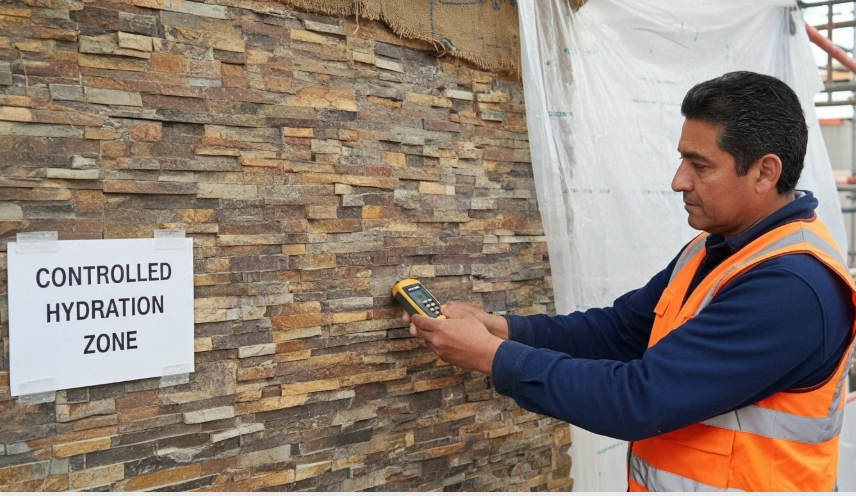
Uitbloeiingen beheren & vlekken zijn een primaire vereiste voor het handhaven van de normen voor projectoverdracht en het vermijden van dure herbewerkingskosten. Wanneer witte minerale afzettingen op een pas afgewerkte gevel verschijnen, duiden ze op vochtproblemen die kunnen leiden tot structureel verval en juridische geschillen over de afwerking. Het negeren van deze signalen in een vroeg stadium van de bouwfase veroorzaakt vaak permanente schade aan het oppervlak en heeft een negatieve invloed op het bedrijfsresultaat en de professionele reputatie van een aannemer.
Deze gids biedt een technisch protocol voor het identificeren van de chemie achter mineraalmigratie en het voorkomen van opbouw tijdens de eerste uithardingscyclus van 28 dagen. We onderzoeken de rol van hard water bij de verkleuring van het oppervlak en bieden specifieke methoden voor het verwijderen van mortel zonder het stenen oppervlak te etsen. Door deze stappen te volgen, kunnen teams vochtrijke omgevingen beheren om schimmel te voorkomen en ervoor te zorgen dat stenen installaties aan de buitenkant voldoen aan de duurzaamheidsspecificaties op de lange termijn.
Wat is het witte poeder op mijn stenen muur? (De chemie van uitbloeiingen)
Uitbloeiing is een natuurlijke chemische indicator dat vocht door het metselwerksysteem migreert, waarbij oplosbare zouten in de ondergrond worden opgelost en deze tijdens verdamping als kristallen op het steenoppervlak worden afgezet.
Hoe oplosbare zouten een wit residu vormen
Uitbloeiing treedt op wanneer in water oplosbare zouten, voornamelijk calcium, kalium of natrium, oplossen nadat vocht de wandstructuur binnendringt. Hoewel natuursteen zelf vaak chemisch stabiel is, zorgt de poreuze aard van zowel de steen als de mortel ervoor dat deze opgeloste mineralen naar de buitenzijde kunnen reizen. Gegevens uit de sector bevestigen dat steunmaterialen en mortelverbindingen de belangrijkste bronnen van deze zouten zijn, en niet de stenen panelen zelf.
- Mineralen lossen onmiddellijk op bij contact met water dat in het wandsysteem infiltreert.
- De interne poriënstructuur van het metselwerk fungeert als kanaal voor de migratie van mineralen.
- Het identificeren van de zoutbron is de eerste stap in een langetermijnsanering.
De rol van vocht en capillaire werking
Water serves as the vehicle for mineral transport. Rainwater, ground moisture, or even internal condensation seeps into the installation through microscopic gaps or porous substrates. Capillary action then pushes this salt-saturated water toward the surface. As the liquid reaches the air-exposed face of the stone, the water evaporates, leaving behind the characteristic white, chalky powder.
This process remains active as long as two conditions are met: a supply of soluble salts and a recurring moisture source. Without addressing the water pathway, surface cleaning provides only a temporary aesthetic fix while the underlying chemical cycle continues.
Selecting Low-Alkali Materials for Prevention
Professionele installateurs voorkomen uitbloeiingen door vanaf het begin materialen te specificeren die de beschikbaarheid van zout beperken. Wij adviseren het gebruik van laag-alkali-portlandcement voor zowel de ondergrond als de hechtlagen. Dit vermindert de concentratie van zouten die beschikbaar zijn voor oplossing. Door de focus te verleggen naar het beheersen van waterinfiltratie door middel van geïntegreerd ontwerp, minimaliseren we de paden waardoor vocht de zoutzware mortellagen kan bereiken.
Ook de inkoop van natuursteen van hoge kwaliteit speelt een rol. Gestapelde stenen panelen met een lagere minerale reactiviteit – gebruikelijk bij premium leisteen en kwartsiet – verminderen het risico dat de steen bijdraagt aan het residu. Deze proactieve materiaalkeuze is veel kosteneffectiever dan chemische sanering nadat de muur voltooid is.
Environmental Factors and Surface Evaporation
External conditions like humidity and temperature influence the severity of efflorescence. Cool, damp weather leads to slow evaporation, which allows more salts to reach the surface before they crystallize. This often makes efflorescence more visible during winter or in shaded exterior applications.
To combat these environmental triggers, exterior applications require proper flashing and moisture barriers. Applying a breathable, high-quality sealer to the stone face is also effective. A silane-siloxane based sealer reduces the stone’s permeability to liquid water while remaining vapor-permeable, ensuring internal moisture can escape without trapping salts behind the panel face and causing sub-florescence.
Why Does Moisture Trapped Behind the Stone Cause Staining?
Moisture acts as the primary transport mechanism for mineral salts and organic spores, converting internal substrate dampness into permanent surface discoloration through capillary migration.
Capillary Action and Mineral Migration
Natural stone panels feature an inherent porosity that facilitates capillary action, essentially pulling water through the material like a wick. When moisture enters the wall assembly from the substrate or through unsealed joints, it migrates toward the drier exterior face. During this transit, the water dissolves soluble salts and alkalis found within the setting mortar or the stone’s own mineral composition.
Wanneer het water het oppervlak bereikt en verdampt, laat het deze mineralen achter. Door dit proces ontstaat het witte, kalkachtige residu dat bekend staat als uitbloeiingen. Continue cycli van bevochtigen en drogen concentreren deze minerale afzettingen, waardoor tijdelijk oppervlaktestof verandert in hardnekkige kristallijne strepen die de textuur van de steen binnendringen en de visuele integriteit van de installatie aantasten.
Organische groei in vochtige holtes
Stagnerend vocht dat achter stenen panelen zit, creëert een vochtige micro-omgeving die biologische kolonisatie bevordert. Donkergroene of zwarte vlekken zijn vaak het gevolg van schimmels, algen of korstmossen die gedijen in de vochtige ruimte tussen de ondergrond en het steenfineer. Dit komt vooral veel voor bij buitentoepassingen waar slechte ventilatie de steen verhindert “ademhaling” en vocht afgeven.
Organische sporen gebruiken het opgesloten vocht om wortel te schieten in de poriën van de steen. Zonder een hoogwaardige vochtbarrière of goede luchtstroom behouden deze organismen hun groeicycli, wat leidt tot diepgewortelde verkleuring. Professionele installateurs geven in 2026 prioriteit aan vochtbeheersystemen om de beschikbaarheid van water te elimineren die deze organismen nodig hebben om te overleven.
Substraat chemische reacties
Water serves as a catalyst for chemical interactions between the stone and the underlying mounting materials. Iron-rich stones, such as specific slate varieties, often oxidize when exposed to prolonged moisture, causing rust-colored orange or brown stains to bleed through to the surface. This oxidation is a permanent chemical change that simple cleaning cannot easily reverse.
- Leaching from non-compatible waterproofing membranes can introduce external dyes into the stone.
- Contaminated water sources during the mixing phase often deposit minerals that react with the stone’s chemistry.
- pH-neutral impregnating sealers block the microscopic pathways that transport these staining agents.
Hydrostatic Pressure and Drainage Failure
Ontoereikende drainagesystemen zorgen ervoor dat hydrostatische druk kan worden opgebouwd, waardoor vloeibaar water door de stenen structuur wordt geperst in plaats van dat het wegstroomt. The absence of proper flashing or weep holes leads to water pooling behind the ledger panels. Deze geforceerde penetratie voert vuil, sediment en morteldeeltjes in de steen, waardoor grijze of modderige verkleuring ontstaat.
Door steen over een speciale drainagemat of regenschermsysteem te plaatsen, wordt ervoor gezorgd dat vocht snel uit de muur kan ontsnappen. Deze preventieve maatregel beschermt de steen tegen diepgewortelde sedimentvlekken die door schrobben van het oppervlak zelden worden opgelost. Een goede engineering tijdens de installatiefase blijft de meest effectieve verdediging tegen door vocht veroorzaakte esthetische schade.
Premium fabrieksmatig gestapelde stenen grootboekpanelen
Hoe kunt u uitbloeiingen voorkomen tijdens de eerste 28 dagen van uitharding?
Het voorkomen van uitbloeiingen is afhankelijk van strikte vochtcontrole en chemische stabilisatie tijdens de initiële hydratatiefase om de zoutmigratie bij de bron te stoppen.
Het beheer van de eerste 28 dagen van een steeninstallatie bepaalt de visuele integriteit van de muur op lange termijn. Tijdens deze kritische periode ondergaat de mortel een complex chemisch hydratatieproces. Als vocht te snel of ongelijkmatig verdampt, transporteert het oplosbare zouten naar het oppervlak van de natuursteen, waardoor het kalkachtige witte residu achterblijft dat bekend staat als primaire uitbloeiingen. Succesvolle preventie vereist een technische benadering van het vasthouden van vocht in plaats van reactief reinigen nadat de zouten al zijn gekristalliseerd.
Implementeer de juiste natte uithardingstechnieken
Wet curing maintains consistent moisture levels within the substrate to manage the movement of minerals. Field experts use wet burlap or plastic sheeting to cover the installation, ensuring the surface stays damp throughout the initial curing phase. This controlled environment promotes even hydration and prevents the rapid drying cycles that draw salts through the stone’s pores.
| Prevention Strategy | Technical Action | Industry Benefit |
|---|---|---|
| Moisture Management | Wet burlap or plastic sheeting cover | Prevents rapid salt-wicking evaporation |
| Chemical Bonding | Low-alkali cement + Fly ash additives | Binds free lime within the mortar mix |
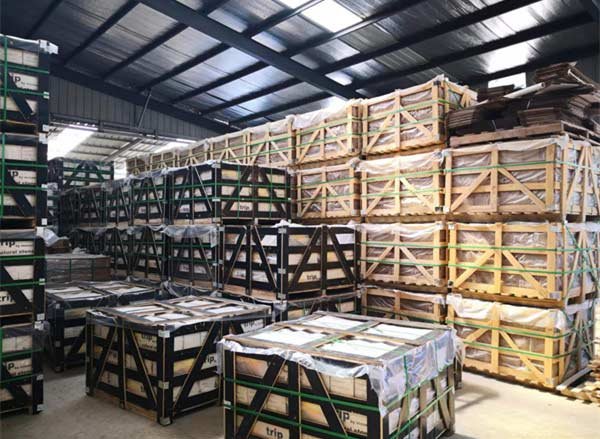
| Site Logistics | Palletized storage above soil level | Stops ground moisture absorption |
Optimize Mortar Mix and Water-to-Cement Ratios
Controlling the chemical composition of the mortar mix reduces the availability of free lime and excess water. Installers should reduce the water-to-cement ratio to the minimum required for workability. This limits the transport medium available for salts. Incorporating supplementary cementitious materials like fly ash binds free lime during the chemical reaction, while specifying low-alkali cements designed for high-end natural stone further minimizes risk.
- Mix mortar with the lowest possible water volume to limit mineral transport.
- Use fly ash to convert soluble calcium hydroxide into stable compounds.
- Select Type S mortar with low-alkali Portland cement for ledger stone applications.
Protect Materials from Ground Moisture and Weather
Door te voorkomen dat extern water het steensysteem binnendringt voordat het volledig is uitgehard, wordt de uitbloeiingscyclus gestopt voordat deze begint. Logistiek op de bouwplaats is belangrijk; wij raden aan om alle natuursteenpanelen op pallets te bewaren, om te voorkomen dat ze vocht uit de bodem afvoeren. Bedek onafgewerkte metselwerkmuren aan het einde van elke werkdag met waterdichte zeilen om te beschermen tegen onverwachte regen, en zorg ervoor dat er achter de panelen voldoende gootstukken aanwezig zijn om water weg te leiden van de uithardende mortel.
Respecteer de volledige hydratatietijdlijn van 28 dagen
Het overhaasten van het bouwschema leidt vaak tot vroegtijdige afdichting, waardoor vocht en zouten in de muur blijven zitten. Wij adviseren minimaal 28 dagen te wachten voordat u steenkitten aanbrengt. Hierdoor kan het substraat de maximale dichtheid bereiken en op natuurlijke wijze ontgassen. Controleer tijdens deze periode het oppervlak op eventueel opkomend wit poeder en maak het onmiddellijk schoon met een droge borstel om diepgewortelde kristallisatie te voorkomen. Eindinspecties mogen pas plaatsvinden nadat de structurele betonnen of metselwerkrug volledig is bezonken.
Is uw waterbron het probleem? Waarom hard water de steenafwerking beïnvloedt
Minerale afzettingen in hard water fungeren als een aanhoudend esthetisch masker en transformeren levendige natuurlijke texturen in doffe, vertroebelde oppervlakken door de ophoping van calcium- en magnesiumaanslag.
Mineral Accumulation and Surface Clouding
Hard water contains high concentrations of calcium and magnesium that settle into the intricate textures of natural stone panels. When mineral-rich water evaporates on the surface, it leaves behind white, chalky deposits known as scale. These minerals fill the natural pores of the stone, effectively masking the vibrant colors and unique textures of materials like slate and quartzite.
Regular exposure to untreated water creates a stubborn film that obscures the stone’s authentic finish. For B2B importers and distributors, recognizing this issue is vital, as end-users often mistake mineral clouding for stone fading. In reality, the high-quality minerals in Top Source Stone products, such as our California Gold or Arctic Golden series, remain UV stable; the “fading” is simply a layer of mineral buildup that requires proper maintenance to clear.
Chemical Etching on Porous Stone Varieties
Het mineraalgehalte in hard water reageert anders, afhankelijk van de chemie van de steen. Marmer- en kalksteenseries zijn bijzonder gevoelig voor etsen wanneer mineralen zich hechten aan de calciumcarbonaatstructuur van de steen. Dit is meer dan een oppervlaktevlek; het is een fysieke verandering in het oppervlak van de steen die tot blijvende dofheid kan leiden.
- De panelen uit de Rough Series bieden aanzienlijk meer oppervlak voor de aanhechting van mineralen, waardoor het schoonmaken moeilijk wordt zodra kalkaanslag zich vastzet.
- Voor het etsen op gepolijste of geslepen oppervlakken is vaak professioneel slijpen nodig om de originele afwerking te herstellen.
- Poreuze stenen zoals zandsteen kunnen mineraalrijk water dieper in het substraat absorberen, wat leidt tot interne kristallisatie.
Preventieve zorg en onderhoud voor 2026
Effectief steenbeheer in 2026 richt zich op proactieve afdichting en gespecialiseerde hulpmiddelen om schade door hard water te beperken. Het aanbrengen van een hoogwaardige, ademende sealer creëert een barrière die voorkomt dat mineralen het oppervlak van de steen binnendringen, terwijl inwendig vocht kan ontsnappen. Dit is vooral van cruciaal belang voor buitentoepassingen in gebieden met een hoog zoutgehalte of een hoge luchtvochtigheid waar de waterkwaliteit fluctueert.
We recommend a simple maintenance protocol: use a squeegee after water exposure to remove moisture before it evaporates and leaves deposits. For routine cleaning, use pH-neutral stone cleaners specifically formulated to current industry standards. These cleaners break down light mineral build-up without damaging the stone’s integrity or stripping the protective sealant, ensuring the “Grote 10” inventory colors like Glacier White or Midnight Slate retain their architectural impact for years.
How to Safely Remove Mortar Stains Without Damaging the Stone Face?
Modern masonry protocols prioritize immediate wet-cleaning and alkaline-based chemical remediation over traditional aggressive acids to preserve the structural integrity and aesthetic of natural stone panels.
Onmiddellijke verwijdering van natte mortel tijdens installatie
Effectief opruimen begint op het moment dat de steen de ondergrond raakt. Als u zelfs maar een paar uur wacht, kunnen cementbindmiddelen de microscopisch kleine poriën van natuursteen binnendringen, wat vaak leidt tot een permanente waas die moeilijk te herstellen is zonder agressieve chemicaliën. Installateurs moeten een schone, vochtige spons gebruiken om overtollige mortel weg te vegen voordat deze uithardt. Het is essentieel om het spoelwater regelmatig te vervangen; het gebruik van verzadigd water smeert slechts een dunne film cement over het stenen oppervlak, die pas zichtbaar wordt nadat de muur is opgedroogd.
- Veeg natte mortel onmiddellijk weg met een schone spons en gewoon water voordat de mortel begint uit te harden.
- Ververs het spoelwater regelmatig om te voorkomen dat er een dunne film cement over het steenoppervlak verspreidt.
- Gebruik een borstel met zachte haren om gestructureerde gebieden in de Rough Series zachtjes te bewegen zonder het natuurlijke gezicht te krassen.
Veilige alkalische reinigers voor opgedroogde resten
Als de mortel al is uitgehard, geven de industriestandaarden nu de voorkeur aan alkalische oplossingen als primaire verdediging. Traditionele zout- of zoutzuren worden steeds vaker vermeden omdat ze permanente minerale oxidatie (roest) kunnen veroorzaken in bepaalde leisteen of kwartsiet en onomkeerbare etsing in andere kunnen veroorzaken. Gespecialiseerde alkalische metselreinigers breken de cementgebonden verbinding af zonder heftig te reageren met de minerale samenstelling van de steen.
| Reinigingsmethode | Doelmateriaal | Beste use case |
|---|---|---|
| Natte sponsdoek | Allemaal natuursteen | Tijdens installatie (Vooruitharden) |
| Alkalische gels | Kwartsiet, leisteen, zandsteen | Uitgeharde mortelnevel & residu |
| Komprespasta | Poreuze kalksteen, marmer | Diepgewortelde deeltjes |
For vertical ledger stone applications, gel-based formulas are superior to liquid cleaners. These high-viscosity products stay on the vertical face longer, increasing chemical dwell time to effectively dissolve the mortar bond while preventing aggressive runoff from damaging the landscaping or lower wall sections. Always rinse the stone thoroughly with water after application to ensure the surface is neutralized.
Specialized Poultice Methods for Deep Stains
Bij een kompresbenadering wordt gebruik gemaakt van capillaire werking om ingebakken morteldeeltjes uit de microscopisch kleine poriën van de steen te trekken. Dit is de voorkeursmethode voor hoogwaardige architectonische projecten waarbij het schrobben van het oppervlak de natuurlijke patina van de steen kan veranderen. Door een steenveilig reinigingsmiddel met een absorberend poeder – bijvoorbeeld diatomeeënaarde – te mengen tot een dikke pasta, creëer je een gerichte behandeling voor hardnekkige vlekken.
- Meng een steenveilig reinigingsmiddel met een absorberend poeder tot een dikke pasta voor hardnekkige vlekken.
- Breng de pasta rechtstreeks op de vlek aan en bedek deze met plastic om het droogproces te vertragen.
- Verwijder de gedroogde pasta zodra deze de verontreinigingen heeft geabsorbeerd en reinig het gebied vervolgens met een pH-neutrale oplossing.
Essentiële tests en materiaalspecifieke voorzorgsmaatregelen
Chemische reacties variëren aanzienlijk op basis van mineralogie. Stenen op calciumbasis, waaronder marmer en kalksteen, reageren onmiddellijk op zure reinigingsmiddelen, wat resulteert in een permanente etsing waarvoor professioneel slijpen nodig is om te herstellen. Zelfs bij niet-zure reinigingsmiddelen is testen een verplichte stap. Breng het product aan op een klein, onopvallend gebied of op een restje van de huidige batch om te verifiëren dat de chemie geen verkleuring veroorzaakt of de epoxyharsen die worden gebruikt in Top Source Stone-paneelassemblages verzwakt.
- Test elk reinigingsproduct op een klein, onopvallend plekje of op een stuk steen voordat u het op grote schaal aanbrengt.
- Vermijd alle zure reinigingsmiddelen op calciumhoudende stenen zoals marmer en kalksteen om etsen van het oppervlak te voorkomen.
- Consult Top Source Stone for a list of approved proprietary cleaners that protect the high-strength epoxy resin used in panel assembly.
Why Acidic Cleaners are Often the Enemy of Natural Stone Beauty?
Acidic cleaning agents trigger irreversible mineral depletion and structural degradation in natural stone, effectively stripping the aesthetic and financial value from a premium architectural installation.
The Chemical Process of Acid Etching
Natuurstenen zoals marmer, kalksteen en specifieke kwartsietaders bevatten calciumcarbonaat en andere reactieve mineralen. Wanneer een zure substantie in contact komt met deze mineralen, vindt er een chemische reactie plaats die het steenoppervlak oplost. Dit proces, ook wel etsen genoemd, creëert doffe, troebele plekken die fundamenteel verschillen van een eenvoudige oppervlaktevlek. Etsen vertegenwoordigt fysieke schade aan de structuur van de steen in plaats van een laag vuil.
- Zuren lossen de minerale bindmiddelen in kalkhoudende stenen snel op.
- Zichtbare erosie en bewolkt “ets merken” kan binnen enkele minuten na contact verschijnen.
- Gangbare huishoudelijke zuren, waaronder azijn of citroensap, zijn agressief genoeg om permanente littekens op het oppervlak te veroorzaken.
Afbraak van beschermende steenafdichters
High-performance sealants protect stacked stone panels by filling the pores and creating a hydrophobic barrier. Harsh acidic cleaners break down the molecular bonds of these sealers, rendering them useless. Once the sealer is stripped, the stone becomes highly vulnerable to moisture infiltration, deep-set organic staining, and the recurrence of efflorescence.
- Acidic chemicals compromise the integrity of the protective sealant layer.
- Exposed pores allow water and contaminants to penetrate the stone substrate.
- Maintenance standards in 2026 dictate re-sealing every 12 to 18 months to mitigate environmental damage.
Standardizing pH-Neutral Cleaning Protocols
Professional stone care relies on pH-neutral solutions that lift surface debris without altering the stone’s chemistry. These cleaners preserve the natural luster and color depth of materials like our Alaska Gray or Midnight Slate series. Routine maintenance using water and a soft-bristled brush provides the safest and most effective way to keep the stone clean while protecting the factory-grade finish.
- pH-neutral cleaners remove dirt without reacting with the mineral composition of the stone.
- Standardized cleaning protocols prevent the gradual dulling of polished or honed surfaces.
- Gentle mechanical agitation with soft brushes replaces the need for aggressive chemical intervention.
Risks to High-Strength Epoxy Adhesives
The structural integrity of stacked stone panels often depends on high-strength epoxy resins that bond individual stone pieces to the substrate. Concentrated acid exposure can weaken these chemical bonds. If the adhesive degrades, individual stone pieces may loosen or detach, creating a safety hazard and a costly repair scenario.
- Strong acids can cause the epoxy resin used in panel manufacturing to become brittle or delaminate.
- Compromised adhesives lead to “stone fallout” on vertical wall applications.
- Alkaline-safe degreasers serve as a safer alternative for removing oils without affecting the adhesive bond.
Preventing Algae and Mold in High-Moisture Exterior Applications
Effective biological prevention on natural stone facades requires a shift from reactive cleaning to integrated moisture management systems that combine structural drainage with nanotechnology-based surface protection.
Moisture Management and Drainage Infrastructure
Biological growth thrives where water stagnates. Preventing algae and mold starts at the substrate level by installing high-quality moisture-resistant barriers and flashing systems. These components direct liquid water away from the wall assembly, ensuring that the stone panels do not remain saturated after rain events. Modern building codes for 2026 emphasize water-managed drainage planes that facilitate rapid drying behind the veneer.
Proper drainage at the base of the exterior facade prevents rising damp, a common cause of localized humidity zones that encourage spore germination. We recommend integrating ventilation gaps to allow natural airflow. This airflow dries out the stone and the underlying substrate, neutralizing the damp environment required for mold colonies to take root in textured natural surfaces.
| Protection Layer | Standard Market Approach | Top Source Stone System |
|---|---|---|
| Sealing Technology | Standard topical silicone sealants | Nanotechnology-based hydrophobic penetrants |
| Joint Engineering | Traditional butt-joints (gaps likely) | CNC Diamond-blade Z-Shape interlocking |
| Vochtbestendigheid | Basic UV protection | ASTM-tested Freeze-Thaw & High Salinity Resistance |
Hydrophobic Sealants and Surface Protection
Advanced sealants create a chemical barrier that reduces water absorption, which is the primary fuel for organic growth. Nanotechnology-based hydrophobic sealants penetrate deep into the stone pores without blocking the material’s natural breathability. This is vital for natural slate and quartzite; if moisture becomes trapped behind a non-breathable sealer, it can cause stone spalling during freeze-thaw cycles.
- Apply sealants formulated for high-strength epoxy compatibility to ensure no reaction with the panel assembly.
- Maintain a consistent moisture-repellent surface by reapplying protective coatings based on environmental exposure.
- Use breathable sealants to prevent internal moisture accumulation within the wall cavity.
Maintenance Protocols and Soft Washing Techniques
Routine maintenance prevents organic spores from taking root in the deep textures of rough or pencil-style stone panels. We recommend establishing a seasonal schedule using soft washing techniques rather than high-pressure power washing. Excessive pressure often damages the interlocking Z-shape joints or weakens the epoxy bond between individual stones.
Use pH-neutral stone cleaners to remove surface debris. Acidic solutions degrade the natural finish of the stone and often leave it more porous, which actually encourages future algae growth. For localized spots, a soft-bristled brush and clean water will disrupt early-stage colonies before they spread across the facade. Regular removal of organic matter, such as fallen leaves or proximity to dense shrubbery, further limits the moisture traps that lead to mold development.
Conclusie
Managing moisture and adhering to proper curing protocols prevents efflorescence while maintaining the natural beauty of slate and quartzite panels. Choosing pH-neutral cleaners over acidic alternatives protects the stone face from damage during the maintenance process. These practices ensure that exterior walls remain durable and visually consistent for long-term commercial use.
Evaluate your current installation and cleaning workflows to confirm they meet these technical requirements for natural stone. Reach out to our team for a detailed material catalog or to discuss batch-specific inventory for upcoming large-scale developments.
Veelgestelde vragen
Why is there a white powdery residue on my new stone wall?
This residue is known as efflorescence. It occurs when soluble salts within the mortar or backing materials are carried to the surface by moisture migration. As the water evaporates, it leaves the salt deposits behind. This is often a sign of excessive moisture within the wall system and can be minimized by using low-alkali portland cement and improving water drainage.
How to remove dried mortar from the face of a textured stone?
To remove dried mortar, first carefully scrape away large chunks using a wooden or plastic scraper to avoid scratching the stone. Apply a specialized masonry cleaner or a diluted muriatic acid solution (if the stone is acid-resistant), scrub with a stiff nylon brush, and rinse thoroughly with clean water. Always test a small, inconspicuous area first to ensure the stone does not discolor.
Is vinegar safe for cleaning natural stacked stone panels?
No, vinegar is not recommended for natural stone. The acetic acid in vinegar can etch and dull the surface of many natural stones, particularly those containing calcium carbonate like limestone, marble, or travertine. For safe maintenance, use a pH-neutral stone cleaner and a soft brush to protect the integrity and finish of the panels.
How to prevent mold and algae on exterior stone walls?
Prevention starts with moisture control. Ensure the wall has proper drainage, eliminate standing water, and trim back overhanging vegetation to increase sunlight and airflow. Applying a high-quality, breathable silane/siloxane-based sealer can significantly reduce water absorption into the stone, making the surface less hospitable to organic growth.
Can I power wash a stone wall to remove white stains?
While power washing can remove surface stains, it should be done with extreme caution. High pressure can damage mortar joints and force water deep into the stone, which may actually worsen efflorescence later. Use a low-pressure setting (below 1,000 PSI) and a wide fan tip, or ideally, use a stiff brush and a dedicated efflorescence remover for a safer and more effective result.