
Die Beschaffung von **Hauptplatinen** im Großhandel bricht häufig bei einer Bruchrate von 20 % zusammen und es kommt zu Ausschussware, die durch sichtbare Schäden verursacht wird “Reißverschluss” Nähte. Die Auswahl nicht standardmäßiger Furniere führt zu hohen Kosten für Ports und nicht übereinstimmenden Farbchargen, was direkt zu einer Aushöhlung der B2B-Margen führt.
Wir lösen diese Ineffizienzen mit einem ASTM C170-konformen 6″x24″ modulares System und eine für den 17,5-Tonnen-US-Hafen optimierte Ladestrategie. Unsere epoxidgebundenen Z-förmigen Platten gewährleisten Farbkonsistenz und strukturelle Integrität der Chargen, reduzieren Restbestände und beschleunigen gleichzeitig die professionelle Installation.
Entwicklung des Steins: Vom losen Gestein zu ineinandergreifenden Platten
Modular Steinplatten ersetzte handgesetztes Mauerwerk durch die Verbindung von Naturstein mit hochfesten Trägern, was die Installationszeit verkürzte und gleichzeitig den Bedarf an schweren Strukturfundamenten eliminierte.
The Shift from Hand-Set Masonry to Modular Systems
Traditional masonry involves setting individual stones in mortar one by one. This process is slow and requires highly specialized labor to ensure the wall remains plumb and aesthetically balanced. Because full-thickness stone carries immense weight, these projects often require expensive structural footings to prevent the wall from sinking or shearing over time.
- Unit Weight: 8–12 lbs/sqft (approximately 30–40kg/m2).
- Substrate Compatibility: Standard cement backer boards or masonry block.
- Material Composition: 100% natural slate, quartzite, or granite.
- Installation Speed: Factory-assembled panels install 3-4 times faster than loose rock.
Wholesalers benefit from this modular shift through predictable inventory and lower damage rates. Instead of shipping loose, irregular stone, Top Source Stone palletizes uniform 6″x24″ units that maximize container volume and simplify job-site calculations for large-scale commercial cladding.
Precision Engineering with Seamless Z-Shape Panels
Modern Hauptscheiben use a notched Z-shape design to solve the “Reißverschluss” seam problem common in rectangular veneers. This geometry allows panels to interlock like puzzle pieces, hiding vertical joints and maintaining a continuous dry-stack appearance across wide spans. This system relies on high-strength glue bonds that resist thermal expansion and moisture better than traditional cement-only bonds.
- Interlock Geometry: Seamless Z-shape and S-shape configurations.
- Haftvermittler: High-strength glued system engineered for climate resistance.
- Quality Metrics: Meets ASTM C170 (Compressive Strength) and ASTM C97 (Absorption) baselines.
- Edge Options: Optional matching L-corners to eliminate on-site miter cutting.
Direct quarry sourcing ensures batch color consistency, a critical factor for B2B distributors. By controlling the raw material from the start, we prevent the patchy, mismatched appearance that occurs when retailers mix shipments from different quarries. This technical control protects dealer margins by reducing client rejections and site rework.
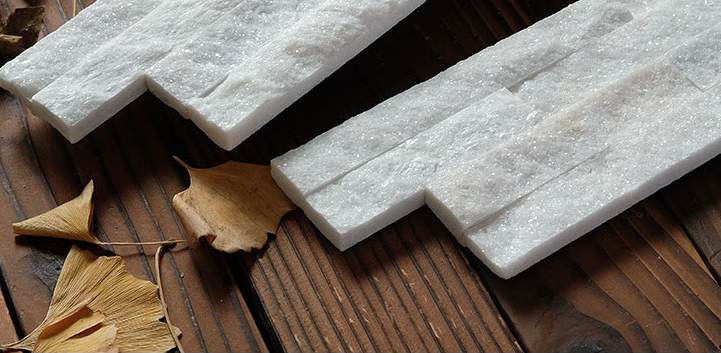
Z-Shape vs. S-Shape Designs: Reducing Visible Seams
Interlocking Z and S shapes hide vertical joints to create a monolithic look, provided installers stagger panels and use factory-sorted batches for color consistency.
Visual Mechanics of Z-Shape and S-Shape Edges
Standard rectangular ledger panels often fail aesthetically by revealing a “Netz” of vertical seams, known in the industry as the zipper effect. Z-shape and S-shape geometries solve this by mimicking the irregular break patterns found in natural stone. These puzzle-like edges allow one 6″x24″ panel to nest into the next, effectively hiding the transition line from the human eye.
The angularity of a Z-shape provides a hard interlock that excels with rugged materials like slate or split-face quartzite. S-shape joints offer softer transitions, which we typically use for honed or marble finishes where a fluid visual flow is required. Success depends on horizontal staggering; installers must avoid repeating the same seam pattern across the facade to maintain the illusion of hand-set stone.
- Standard Dimensions: 6″ x24″ (approx. 150mm x 600mm)
- Target Gap: Under 2mm visible seam line
- Visual Logic: Geometric interlock masks vertical grout lines
Seamless Z-Shape Precision and Infrared Cutting
Precision in manufacturing determines whether a “nahtlos” design actually works on-site. We utilize infrared cutting equipment to maintain exact 6″x24″ tolerances. If a panel is off by even 1/16th of an inch, the cumulative error creates lippage and shadow lines that destroy the monolithic appearance. High-strength glue systems ensure these complex Z-patterns remain rigid during the 17.5-ton US port-optimized shipping process.
Beyond the cut, batch color consistency is the primary safeguard against “lückenhaft” walls. Large-scale B2B projects require high-level sorting protocols to ensure that panels within the same shipment share compatible geological tones. We provide pre-shipment visual verification via photos and videos so wholesalers can confirm joint alignment and color uniformity before the balance payment is made.
- Core Compliance: ASTM C170 (Compressive Strength) and ASTM C97 (Absorption)
- QC Protocol: Pre-shipment visual verification (Photos/Video)
- Sorting Standard: High-level batch numbering to prevent color discontinuity
- Backing: Industrial high-strength glued system for Z-pattern integrity

Glue vs. Cement Bond: Which Factory Process Lasts Longer?
Factory-applied epoxy resins outperform cement bonds by cutting panel weight to 8-12 lbs/sqft while maintaining critical flexibility in freeze-thaw environments.
Structural Mechanics of Factory Adhesives
Type S mortar serves as the traditional industry baseline with 1,800 psi compressive strength, but it adds significant bulk to the 6×24 panel structure. Rigid cement bonds often struggle with thermal expansion, leading to cracks in exterior applications. Factory-applied adhesives create a cohesive bond that handles temperature swings better than heavy concrete backing.
- Standard Weight: 8–12 lbs/sqft for slim-profile veneers.
- Druckfestigkeit: 1,800 psi (Type S baseline).
- Logistics Capacity: 756–864 m2 per 20GP container.
- Substrate Requirement: ANSI A118.15 polymer-modified thin-set.
Systeme mit Kleberückseite behalten ein dünneres Profil bei, was Ihre Versandeffizienz direkt steigert. Durch die Reduzierung der Eigenlast ermöglichen diese Paneele Großhändlern, das Containervolumen zu maximieren, ohne die Gewichtsgrenzen auf der Straße auf der letzten Meile der Lieferung zu überschreiten.
Standards für hochfeste Epoxidharze
Top Quellstein verwendet ein spezielles Epoxidharzsystem, das zu 100 % aus natürlichem Schiefer und Quarzit besteht. Diese Harze widerstehen dem Eindringen von UV-Strahlung und Feuchtigkeit und verringern so die Delaminierungsrisiken, die bei älteren Klebstofftechnologien auftreten. Die Werksverklebung Der Prozess gewährleistet jeden Stein erfüllt hohe Dichteanforderungen für gewerbliche Haltbarkeit.
- Prüfnormen: Entspricht ASTM C170 (Druck) und ASTM C97 (Absorption).
- Hochleistungsspezifikationen: 55 kg/m2 Kapazität für Paneele der Rough-Serie.
- Qualitätsprotokoll: Visuelle Überprüfung vor dem Versand (Fotos/Videos).
- Material Range: Slate, Quartzite, Sandstone, Granite, and Marble.
We verify glue application across all critical contact points before the product leaves the facility. This prevents the “breakage at the tip” common during sea freight and rough handling at the job site. Choosing an epoxy-bonded system protects your margins by significantly reducing the 15-25% waste rate typical of low-tier cement panels.
Factory-Direct Pricing on Premium Ledger Panels
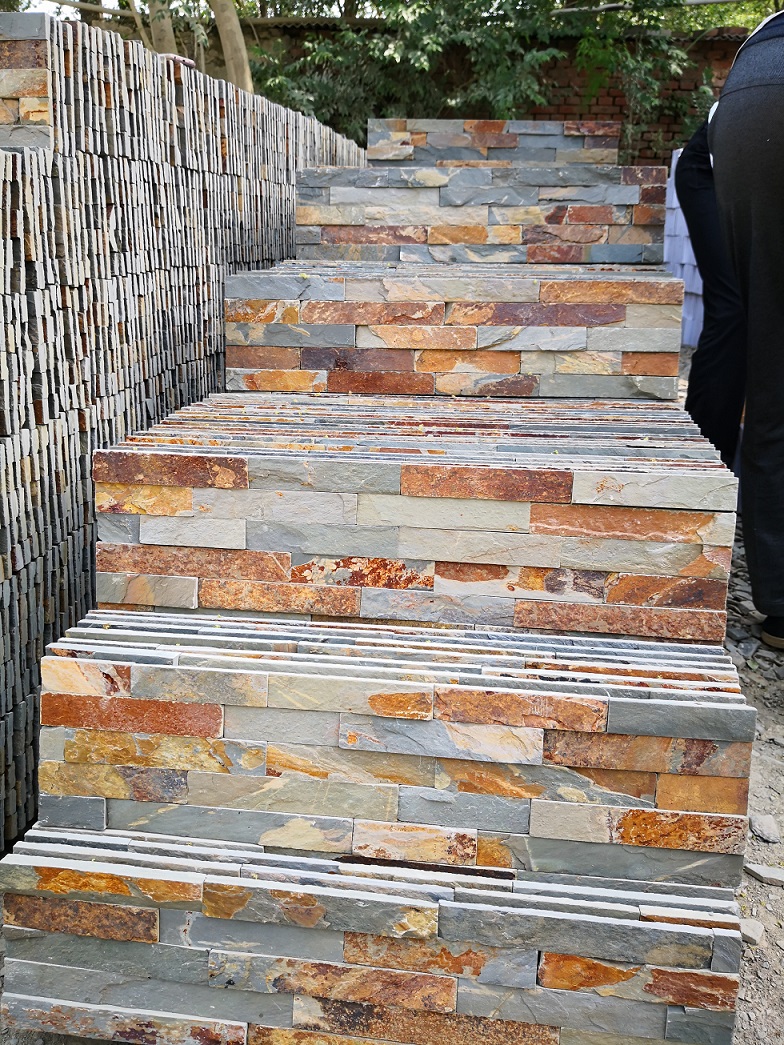
Standardizing the 6″x24″ Panel for Global Inventory Management
The 6″x24″ standard maximizes container utilization for US port weight limits while ensuring seamless, grout-free installation through Z-shape interlocking geometry.
| Technical Metric | 6″ x24″ Spezifikation |
|---|---|
| Nominal Dimension | 150mm x 600mm |
| Durchschnittliches Gewicht | 8–12 lbs/sqft (Material Dependent) |
| US Port Load Limit | 17.5 Tons (Optimized) |
| Container Capacity | 756–864 m2 (20 Pallets) |
| Standard Packing | 7–8 pieces per export carton |
Geometric Efficiency in Architectural Design
The modular 150mm x 600mm format eliminates guesswork for contractors. Uniform dimensions slash cutting waste on large-scale commercial facades and retaining walls, providing a predictable installation rate that manual “hand-set” Stein cannot match.
Our Z-shape interlocking design solves the most common aesthetic failure: visible vertical seams. These panels fit together like puzzle pieces, creating a grout-free finish that remains visually continuous across expansive feature walls or fireplace surrounds.
- Abmessungen: Strict 6″ x24″ modules for easy area calculation.
- Interlock: Seamless Z-shape edges to hide “Reißverschluss” lines.
- Chargenkontrolle: High-level sorting protocols prevent patchy color variations.
Logistical Optimization for US Port Weight Limits
Versand Naturstein requires balancing volume against mass. North American road regulations often impose a strict 17.5-ton threshold at major ports. We optimize our 20GP Containerbeladung to hit this exact limit, ensuring wholesalers avoid heavy-weight penalties while maximizing inventory value.
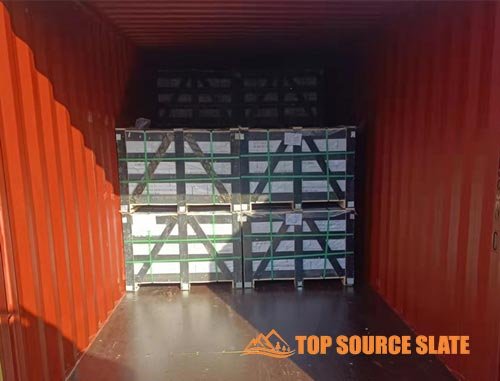
Strategic volume management allows us to pack 20 pallets per container. By using 3-5 ply export cartons containing 7–8 pieces, we maintain structural integrity during transoceanic transit. This system protects dealer margins by minimizing the 15-25% breakage rates typical of poorly packed, non-standard shipments.
- Standard Load: 17.5 Tons for US Port compliance.
- Yield: 756–864 m2 per 20GP container.
- Packaging: 48–60 cartons per pallet to ensure stability.
- HS Codes: Slate (6803.00.90) and Quartzite (6802.93.11) for clear customs classification.
Direct quarry control at our Hebei facility allows us to enforce these standards from the first cut. This provides B2B buyers with 100% transparency through pre-shipment visual verification, ensuring the batch consistency required for high-end architectural specifications.

Reducing “Breakage at the Tip”: Specialized Corner Packaging
Pre-fabricated L-shaped corners and 5-ply cartons eliminate the 20% waste seen with manual miter cutting while staying within 17.5-ton US road weight limits.
Mitigating Edge Fragility and Installation Waste
Manual miter cutting on-site is a margin killer for wholesalers. When installers attempt to cut brittle slate or quartzite at a 45-degree angle without factory precision, material waste frequently hits 10-20%. These stone tips lack structural support and shatter easily under the vibration of a standard wet saw.
Beyond the scrap rate, field-cut corners rarely meet ASTM C270 mortar bond requirements. If the angle is not perfectly flush, the bond weakens. This creates gaps that allow water intrusion, eventually leading to delamination and “Reißverschluss” lines that ruin the visual continuity of a 6×24 Hauptbuchtafel Installation.
Pre-Fabricated L-Shaped Units and 5-Ply Export Cartons
We eliminate the need for risky diagonal cuts by supplying factory-produced L-shaped corner units. We use high-strength epoxy resin to bond these corners permanently, ensuring they stay intact through the entire logistics cycle. Our packaging and loading protocols focus on three technical standards:
- Crating: 3-5 ply reinforced export cartons with internal cushioning to buffer interlocking Z-shape tips.
- Gewichtsoptimierung für US-Hafen: Containers are capped at 17.5 tons per 20GP to prevent pallet compression and stone crushing during road transit.
- Adhesive Specs: Permanent tip bonding via industrial-grade epoxy to prevent detachment during site handling.
Standard containers often hit volume limits before weight limits, but dense stone is the opposite. By restricting payloads to 17.5 tons for North American dealers, we ensure that the bottom pallets in a 20-pallet shipment do not collapse under the weight of the top stack. This logistical control keeps breakage rates under 2%, compared to the 10% average seen in poorly packed bulk lots.
Matching Panels Across Different Batches: The Batch Control Challenge
Standardizing tonal ranges across 500+ square feet requires factory-level grading and batch numbering to prevent visual discontinuity in large-scale architectural cladding.
Geological Variability and the Risk of Visual Discontinuity
Naturstein is a raw geological product. Slate, quartzite, and sandstone change in mineral composition based on the specific depth or vein of the quarry. Without factory intervention, mixing different extraction lots creates a “lückenhaft” wall effect that disrupts the architectural intent and creates visible “Reißverschluss” lines at the seams.
Data suggests that aesthetic uniformity risks increase significantly for any surface area exceeding 500 square feet. Maintaining visual harmony while adhering to structural performance standards requires a level of raw material selection that retail-grade suppliers often skip to reduce costs.
- Surface Threshold: Mismatch risks peak in projects exceeding 500 square feet.
- ASTM C568: Standard for absorption (<3%) must be met without compromising tonal matching.
- Mineral Shifts: Composition changes occur naturally based on quarry location in Hebei.
- Failure Rate: Un-graded alternatives see 2-3 times higher rejection rates on-site.
Batch Color Consistency and Pre-Shipment Visual Verification
Top Quellstein manages color drift at the source. As a direct quarry source factory, we implement sorting protocols at the early extraction stage. We sort raw materials into light, medium, and dark graded lots before the ledger panels are assembled. This ensures that every container delivered to a wholesaler contains a cohesive tonal range.
We eliminate the guesswork of international procurement through transparency. Large B2B orders are fulfilled using stones from the same extraction cycle. This strategy maximizes tonal harmony and protects the margins of our dealers by reducing site-level complaints and material waste.
- Sorting Tiers: Manual grading into Light, Medium, and Dark lots at the Hebei facility.
- Visual Verification: High-resolution photos and videos of the specific batch provided before shipment.
- Inventory Sync: Large orders are locked to a single extraction cycle to ensure consistency.
- Quality Grade: Grade A selection following high-density standards equivalent to ASTM C170.
Wholesalers benefit from this factory-direct control because it removes the middleman risk of mixing inventory from disparate sources. Pre-shipment verification serves as a final quality gate, ensuring the product matches the approved sample before the balance payment is made.
Logistics: How to Fit 10,000+ sq ft into One 20ft Container
Hitting 10,000+ square feet requires 26.5-ton heavy-load approval and thin profiles, while US-port shipments prioritize a road-legal 17.5-ton strategy to maximize regional wholesale margins.
| Logistics Metric | US-Port Optimized | Heavy-Weight Approval |
|---|---|---|
| Target Payload | ~17.5 Tons | 24 – 26.5 Tons |
| Total Face Area | 756 m² (8,137 ft²) | 864 m²+ (9,300 – 10,000+ ft²) |
| Packing Ratio | 7-8 pcs / Carton | 8 pcs / Carton (Flat Profile) |
| Pallet Strategy | 20 Pallets (Standard) | 20 Pallets (High-Density) |
Optimizing Payload Density for Heavy Cladding Materials
Steinplatten are fundamentally weight-constrained. A standard 20ft ISO container provides roughly 1,170 cubic feet of volume, but Naturstein hits the maximum payload limit long before that space is filled. To maximize the square footage per shipment, we focus on material density and the physical geometry of the 6″x24″ modular format.
- HS Codes: We categorize shipments under Slate (6803.00.90) or Quartzite (6802.93.11) to ensure accurate customs clearance and duty calculation.
- Edge Protection: Using 3-5 ply export cartons prevents the fragile corners of natural stone from chipping during high-density stacking.
- Crate Alignment: Longitudinal orientation of crates inside the container minimizes voids. This prevents shifting during intermodal transfers and reduces breakage rates to below 2%.
- Vertical Nesting: Stacking panels vertically within crates protects the face-area from compression damage while allowing for precise calculations of face-area per cubic foot.
US-Port Weight Optimization and Pallet Strategy
Shipping to North America requires a specific balance between container volume and road-legal weight limits. While a container can physically hold more stone, exceeding 17.5 tons often triggers heavy-weight fines or requires specialized tri-axle chassis for road transport, which eats into dealer margins.
- 17.5-Ton Strategy: This loading weight complies with most 2026 North American road regulations, allowing for standard delivery without auxiliary equipment.
- Heavy-Load Options: For regions with higher infrastructure tolerance, we can load up to 26.5 tons. This is the only way to effectively hit the 10,000+ square foot threshold in a single 20GP container.
- Pallet Configuration: A 20-pallet layout maximizes the internal floor area of the container. We load 48 to 60 cartons per pallet depending on whether the stone is a “Rauh” oder “Flat/Pencil” profile.
- Visual Verification: We provide pre-shipment photos and videos of the bracing and crate integrity. This ensures the load is secure before the balance payment is made, protecting B2B buyer cash flow.
This logistical precision allows Top Source Stone to deliver grade-A natural quartzite and slate directly from the quarry to international wholesalers with total transparency. We remove the guesswork by matching the loading strategy to your specific regional port regulations.
Abschließende Gedanken
Low-tier ledger panels carry a hidden cost in the form of 15% to 25% breakage and site rejection rates. Our factory-direct, epoxy-bonded system eliminates these losses by providing structural integrity that survives the 17.5-ton US-port logistics cycle. Standardizing on ASTM-compliant 6″x24″ units protects your margins and ensures your clients never face the “lückenhaft” Wand issues common with un-graded quarry lots.
Request a sample kit of our “Große 10” inventory, including best-sellers like Alaska Gray and Carbon Black, to verify our precision Z-shape fitment. We offer 300 m2 trial orders with pre-shipment visual verification so you can inspect the specific batch before making a balance payment. Contact our wholesale team today to discuss private-label packaging and landed cost optimization for your region.
Häufig gestellte Fragen
What is the standard dimension for natural stone ledger panels?
Spitze Source Stone standardizes modular panels at 6″ x24″ (approximately 150mm x 600mm). This size optimizes container loading weight for US port regulations and handles easily during vertical installation. Thickness varies from 0.75″ to 1.5″ depending on the profile relief.
How many panels are included in a standard wholesale carton?
Standard 6″ x24″ panels ship with 7 to 8 pieces per carton for flat or pencil styles. Rough or high-relief panels use 5 pieces per carton due to their increased weight. We pack 48 to 60 cartons per pallet, optimized for North American road weight limits at 17.5 tons per 20GP container.
Is there a functional difference between ledger panels and stacked stone?
The terms describe the same Natursteinfurnier system. Ledger panel refers to the pre-assembled modular format, while gestapelter Stein describes the grout-free, tight-jointed aesthetic. Suppliers use these interchangeably for vertical cladding applications.
Can installers apply ledger panels directly over interior drywall?
Installers can apply panels to primed drywall for interior projects under 10 feet using polymer-modified thin-set mortar. For exterior applications or interior walls exceeding 10 feet, building codes require cement backer board or masonry substrates to support the weight, which averages 8–13 lbs per square foot.
What tools provide the cleanest cuts for natural stone veneer?
A table-style wet saw with a continuous-rim diamond blade is necessary for straight cuts. For notches and outlets, use an angle grinder with a diamond blade. Wet cutting maintains precision and ensures compliance with OSHA silica dust safety standards.
How do Z-shape panels create a seamless wall appearance?
Z-shape panels use a geometric interlock to hide vertical seams. To achieve a professional finish, level the first course perfectly and stagger panels in a running bond pattern. This layout breaks up grid lines and keeps joint widths under 2mm for a continuous texture.
Are natural stone panels suitable for high-heat areas like fireplaces?
Ja, Naturstein is non-combustible and heat-resistant, making it ideal for fireplace surrounds and chimneys. We recommend heat-rated adhesives and a 1/16″ micro-gap between panels to accommodate minimal thermal expansion.