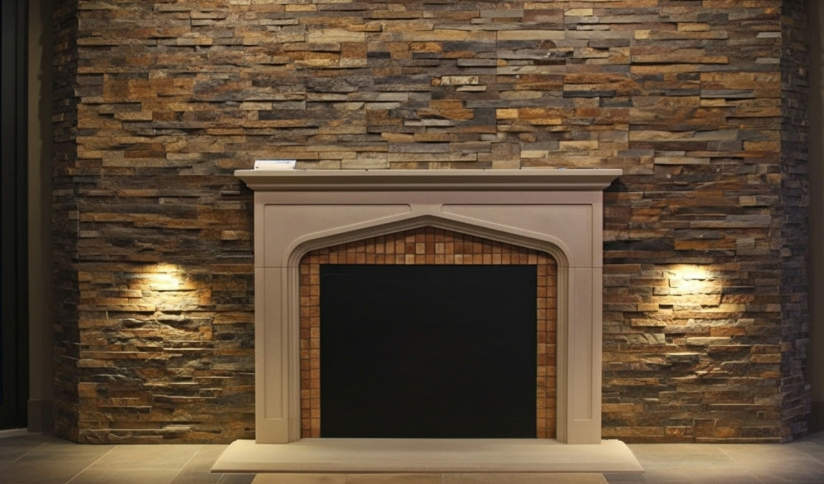
Corner layouts represent a significant spatial challenge in large-scale developments, where poor fireplace positioning can waste square footage and reduce the market value of a unit. Architects and contractors face technical risks when stone finishes are not calculated for non-standard angles, leading to visible seams that suggest a lack of quality control.
This documentation provides the technical protocol for handling 135-degree corner challenges and implementing a center-outward alignment strategy for natural stone panels. We address the specific mechanics of hiding vertical seams, managing light diffraction to avoid shadow traps, and the structural requirements for mounting hardware on uneven stone surfaces.
Why Corner Fireplaces are the Ultimate “Space Savers” in B2B Projects?
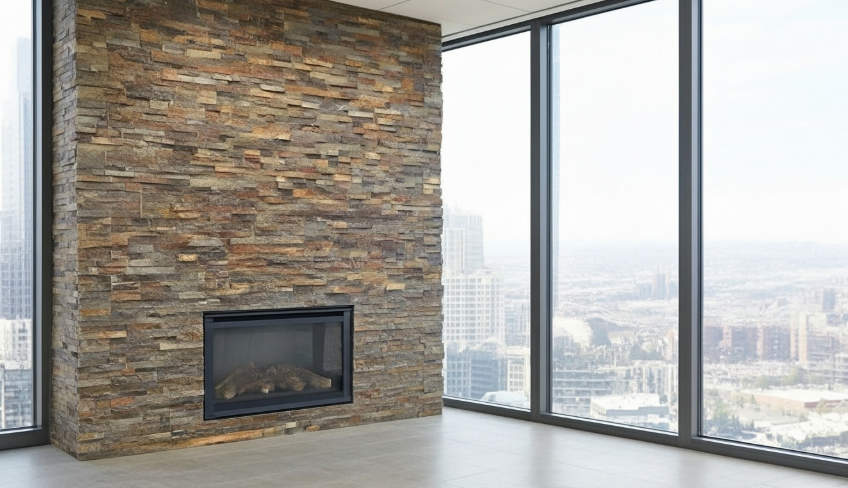
Corner placements transform architectural dead zones into high-value focal points, allowing developers to reclaim primary wall space for functional glazing or storage in high-density urban projects.
Optimizing Floor Plans in High-Density Developments
Modern urban residential and commercial layouts in 2026 demand maximum utility from every square foot. By shifting the fireplace to a corner, architects free up primary wall surfaces for floor-to-ceiling windows or integrated storage systems that high-end tenants expect. This strategic placement creates a natural focal point that does not obstruct the central living or work area.
- Architects use corner placements to prioritize large-scale glazing and natural light on main walls。
- Corner units improve traffic flow in compact B2B environments like boutique hotel rooms or executive suites.
- 天然石 surrounds provide an upscale aesthetic without encroaching on usable floor space.
Structural Advantages of Lightweight Stone Veneers
Traditional masonry often requires expensive footings or structural reinforcement, particularly when positioned in corners where load-bearing requirements are complex. Top Source Stone’s natural 積み上げられた石のパネル offer a 100% natural slate or quartzite finish with a profile weighing only 8 to 12 lbs per square foot. This lightweight engineering allows for installation on standard 内壁 without the need for brick ledges.
- Panel weights between 8 and 13 lbs per square foot make corner installations viable on standard interior framing.
- Reduced weight eliminates the need for structural reinforcement, significantly cutting material and labor costs.
- 天然石 remains non-combustible, ensuring compliance with commercial fire safety standards for fireplace surrounds.
Efficiency in Large-Scale Installation Timelines
In multi-family and commercial builds, speed determines profitability. Our interlocking Z-shape panel system uses CNC diamond-blade precision to create a “男性-女性” connection that camouflages vertical joints. This modular approach eliminates the need for complex on-site miter cutting, which is typically the most time-consuming part of corner fireplace stonework.
- Interlocking designs provide a seamless appearance across corner transitions without visible “段差のある” gaps.
- Pre-fabricated L-shaped corner pieces remove the requirement for specialized on-site stone cutting.
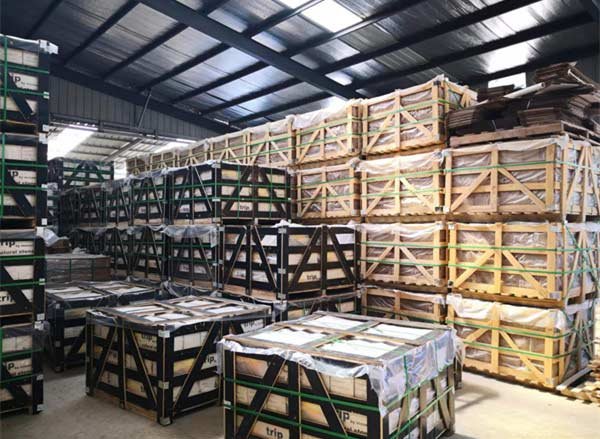
- Precision-cut panels ensure a consistent fit across hundreds of units, maintaining quality control in large-scale projects.
Long-Term Value Retention for Property Owners
Natural stone is an investment in durability. Unlike manufactured “faux” 石 that uses concrete and pigments, 100% natural minerals like quartzite and slate possess inherent UV stability and high salinity resistance. For property managers, this means lower maintenance cycles and a surface that retains its premium texture despite high-traffic exposure.
- 天然石 resists UV fading, preventing the “斑点のある” look often seen in aged manufactured stone.
- High durability results in fewer repair requirements for property managers in commercial B2B settings.
- Real stone surfaces provide a measurable increase in perceived asset value for real estate investors.

Handling the 135-Degree Challenge: Beyond Standard 90-Degree Corners
Achieving architectural continuity on 135-degree fireplace corners requires bypassing pre-fabricated L-units in favor of precision miter cuts and specialized epoxy bonding to prevent joint separation.
Precision Miter Cutting for Non-Standard Angles
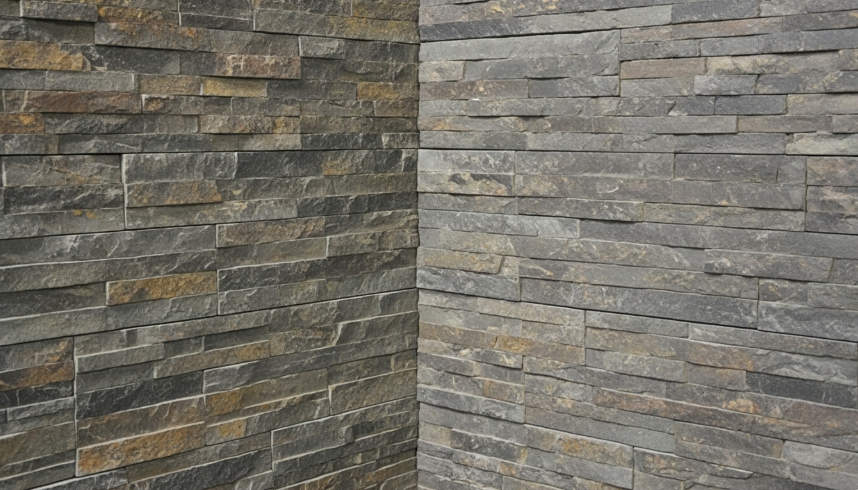
Standard 90-degree pre-fabricated corners dominate the market but fail entirely when encountering the 135-degree geometry of bay-style fireplaces or octagonal pillars. Installers must execute precise 67.5-degree miter cuts on each stone panel using infrared-guided CNC diamond blades to create a clean, professional joint. This technique ensures that the natural cleft of our Alaska Gray or Midnight Slate flows around the corner without the structural gaps typical of forced 90-degree units.
- Dry-fit every panel before applying adhesive to verify that textures align across the angled seam.
- Avoid standard wet saws for these angles; use specialized bridge saws for a straighter, chip-free edge.
- Alternate long and short panels on each side of the 135-degree vertex to break up vertical lines and mimic natural masonry。
Adhesive Strategies for Obtuse Corner Stability
Angles exceeding 90 degrees face unique mechanical stresses. Building vibration and thermal expansion from the fireplace often cause standard thin-set mortar to crack at the mitered point. Using high-strength epoxy resin specifically at the mitered edge creates a unified structural bond that moves with the wall rather than against it. We recommend reinforcing the substrate with cement board to handle the specific weight distribution of these custom angled layouts.
| Corner Specification | Standard 90° Turn | Obtuse 135° Turn |
|---|---|---|
| Fabrication Method | Pre-fabricated L-Corner Units | Custom Miter (67.5° x 2) |
| Installation Speed | Rapid (Click-and-Set) | Skilled Labor Required |
| Joint Bonding | Standard Polymer Mortar | High-Strength Epoxy Resin |
Blending Textures Across 135-Degree Transitions
Maintaining visual flow across an obtuse angle requires meticulous panel selection. We recommend using our Flat Series for 135-degree corners to minimize deep shadows that can make a custom miter joint look like a structural flaw. To hide micro-gaps caused by the 天然石 variance, mix stone dust from the installation cuts with a clear sealer. This creates a color-matched paste that fills the seam and disappears under standard lighting conditions.
- Verify that all stone pieces for the corner originate from the same quarry vein to ensure 95% hue uniformity.
- Apply a final coat of sealer to the mitered joint to protect the exposed natural minerals from moisture and dust accumulation.
- Monitor the installation environment for humidity; excess moisture can interfere with the curing process of high-performance adhesives.
Premium Factory-Direct Stacked Stone Ledger Panels

How to Symmetrically Align Stone Panels from the Center Outward?
Symmetrical alignment eliminates the risk of lopsided visual weight by anchoring the installation to a measured central axis, ensuring that mirrored edge cuts maintain architectural balance across the fireplace face.
Establishing a Central Vertical Reference Line
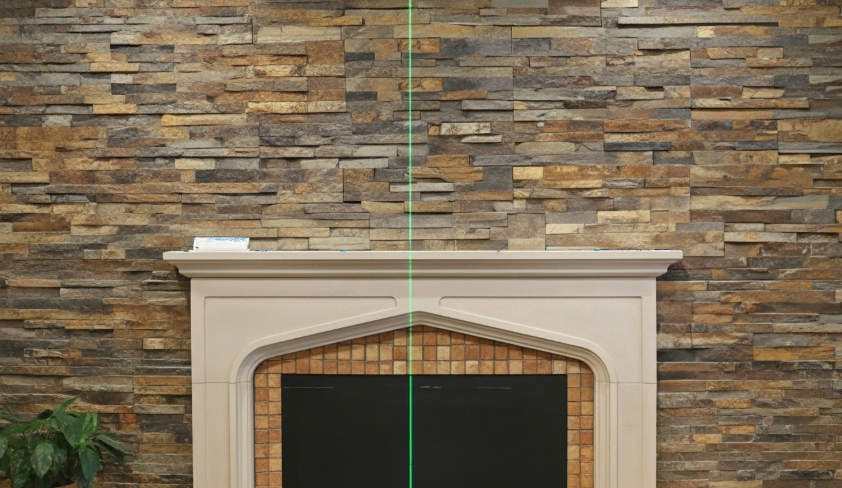
Precise symmetry begins with accurate measurements of the installation surface to define the starting point. We measure the total width of the wall and mark the exact midpoint with a vertical plumb line. Relying on visual estimation often leads to cumulative errors that become glaringly obvious once the stone reaches the ceiling or adjacent corners. By using a laser level, we project a constant reference that guides the placement of the first stone panels, ensuring the verticality of the entire assembly remains true throughout the project.
Before applying adhesive, we dry-lay a row of panels on the floor. This step allows us to visualize how the edges will meet the corners. If a dry-lay reveals sliver-thin cuts at the boundaries, we shift the center line slightly to ensure the end pieces remain substantial and structurally sound. This proactive adjustment prevents the “fragmented” look often seen in amateur installations where planning was neglected.
Executing the Center-to-Edge Installation Sequence
Placing panels from the middle outward ensures that cut pieces at the ends remain uniform in size. We align the first panel directly on the center mark to anchor the visual weight of the wall. This central stone acts as the foundation for the entire course. From this anchor, we work outward toward both the left and right boundaries simultaneously. This dual-direction workflow maintains balance and allows for real-time adjustments if the substrate shows minor irregularities.
| Alignment Strategy | Visual Symmetry | Cutting Logic |
|---|---|---|
| Center-Outward (B2B Standard) | High: Mirrored edges create a balanced focal point. | Uniform: Both left and right end-cuts share identical dimensions. |
| Corner-to-Corner | Low: Visual weight shifts toward the starting side. | Random: The final cut is often an awkward sliver. |
| Random Offset | Moderate: Texture masks some misalignment. | Variable: Requires constant measurement for every row. |
We apply high-strength epoxy adhesive or professional-grade thinset to the substrate to secure the panels immediately upon alignment. For B2B projects involving our Z-shape interlocking series, the “男性-女性” connection system ensures each panel locks into the next, further stabilizing the central anchor point.
Verifying Horizontal Alignment with 2026 Site Standards
Current 2026 construction practices prioritize constant leveling to prevent the “stair-stepping” effect common in interlocking systems. We check the level of every second row to ensure the Z-shaped interlocking joints remain perfectly horizontal. Even a 2mm deviation at the base can translate into a massive gap by the time the stone reaches eye level.
- Adjust for minor substrate variations using shims to keep the courses straight across the entire span.
- Monitor the seams between the natural slate or marble pieces to confirm the stones fit tightly without visible gaps.
- Utilize CNC diamond-blade edges for panels to ensure a consistent fit that eliminates the need for manual grinding on-site.
Managing Symmetrical Edge Cuts and Corner Transitions
Finalizing the installation requires mirrored cuts at the wall ends to preserve the professional appearance. We measure the remaining space at both edges and cut the stone panels to matching dimensions. This attention to detail ensures that the fireplace looks intentional rather than assembled from scraps. If the wall extends around a 90-degree turn, we integrate matching L-shaped corner pieces from our inventory to provide a clean, wrap-around transition that maintains texture and color synchronization.
We use infrared cutting tools or high-performance wet saws for precise edges that mimic the factory finish of the central panels. This level of precision is critical when working with 100% natural minerals like quartzite or slate, where rough edges can detract from the premium aesthetic. By mirroring these final cuts, the installation achieves a symmetrical, architecturally sound finish that meets the highest commercial standards.

Does a Corner Stone Wall Make a Small Room Feel Larger or Smaller?
Strategic corner stone placement expands perceived square footage by drawing the eye to the room’s furthest architectural boundaries while utilizing thin-veneer profiles that preserve actual floor area.
Impact of Stone Texture on Perceived Square Footage
で modern interior design, stone texture depth dictates how the human eye perceives wall boundaries in confined areas. Deep textures, such as those found in our Rough Series, create significant shadow play. This visual weight can make a corner feel as though it is advancing toward the center of the room, which creates a cozy, “wrapped” sensation in larger halls but may feel encroaching in very tight spaces.
Smooth surfaces from our Flat Series or honed marble options provide a clean, architectural backdrop that maintains an open atmosphere. These panels offer the luxury of 天然石 without the aggressive protrusions that consume visual volume.
- Rough Series textures emphasize architectural character but require larger room volumes to avoid a “closing in” effect.
- Consistent 6×24 inch panel sizing helps the eye travel smoothly across the wall surface, which reduces the feeling of clutter compared to small, irregular mosaic tiles。
- Minimalist split-face finishes provide just enough depth to hide substrate imperfections while keeping the wall profile slim.
Color Choice and Light Reflectivity
The stone’s color palette dictates how much light remains in the room, which directly affects the sensation of space. Light-toned stones, like Alaska Gray or Glacier White from our Big 10 Inventory, reflect ambient light. This reflectivity makes small rooms feel airier and more expansive by bouncing light back into the living area rather than absorbing it.
Darker slate or charcoal quartzite, while sophisticated, adds significant depth. Designers must pair these darker tones with strategic lighting to prevent the corner from feeling like a dark void. Because our 天然石パネル are 100% mineral-based, they provide a permanent, fade-resistant finish that keeps the space looking vibrant for decades.
Space-Saving Benefits of Thin Stone Veneer
Modern 天然石積み上げパネル offer the look of full-thickness masonry while occupying minimal physical space. Traditional 4-inch stone blocks can significantly reduce the usable floor area in a small office or apartment. In contrast, our standard panel thicknesses range from 0.75 to 1.5 inches, preserving nearly all usable square footage.
- Slim-profile panels allow installers to add high-value natural materials to small apartments and commercial offices without structural renovations.
- Lightweight construction (8-12 lbs/sqft) eliminates the need for bulky structural footings that would otherwise consume floor space.
- Our CNC diamond-blade precision ensures every panel fits tightly, minimizing the “thickness creep” often seen with hand-cut stones.
Visual Anchoring Through Corner Placement
Strategically placing stone in a corner creates a focal point that can actually expand the room’s perceived dimensions. By drawing the eye upward and into the corners, the installation highlights the full height and width of the architectural layout. This “anchoring” effect gives a small room a sense of permanence and structural strength.
To ensure a professional result, we provide matching L-shaped corner pieces for every model. These pre-fabricated units create a solid, wrap-around look that camouflages the vertical joint. Focusing texture on a single corner prevents the stone from overwhelming the room—a common risk when attempting full four-wall stone installations in compact environments.

Lighting a Corner Fireplace: Avoiding Awkward Shadow Traps
Effective corner fireplace lighting requires balancing directional grazing to accentuate stone texture while neutralizing the “dead zones” and harsh shadows inherent in architectural junctions.
Lighting a corner installation presents unique geometric challenges. Unlike flat wall applications, the intersection of two stone planes can create dark voids or distracting glare if the fixtures are not positioned with precision. Success depends on understanding how light interacts with the specific relief of natural 石のパネル。
Surface Grazing for Texture Enhancement
We recommend positioning recessed ceiling fixtures between 12 and 18 inches away from the stone face to achieve an optimal grazing effect. This specific distance allows light to catch the irregular ridges of our Rough Series panels, which feature thickness variations up to 1.75 inches. By using directional beams rather than wide floodlights, installers can cast intentional shadows that emphasize the 3D characteristics of the natural slate and quartzite.
- Position recessed ceiling fixtures 12 to 18 inches away from the stone face to create a grazing effect.
- Use directional beams to cast light downward across the uneven surfaces of natural slate and quartzite.
- Highlight the 3D characteristics of the stone without washing out the organic color variations.
Balanced Ambient Lighting for Shadow Reduction
Relying on a single overhead light source often creates a triangular “shadow trap” at the corner apex, which can make the fireplace look hollow or disconnected from the rest of the room. To solve this, we suggest integrating lateral light sources. High-intensity downlights placed directly over the corner apex should be avoided as they exaggerate vertical seams and create harsh contrasts.
- Install wall sconces on adjacent walls to provide lateral light that fills in deep shadow pockets.
- Avoid placing high-intensity downlights directly over the apex of the corner fireplace.
- Combine task lighting with dimmable ambient layers to maintain the cozy aesthetic expected in 2026 interior designs.
Fixture Placement Relative to Stone Projections
The physical dimensions of L-shaped corner pieces require specific light angles to ensure the transition between walls remains visually seamless. Aligning fixtures with the center of the 石のパネル promotes symmetry across the corner joint, preventing one side from appearing brighter than the other. For our natural Marble and Slate series, we specify warm-spectrum LEDs in the 2700K to 3000K range to enhance earthy pigments.
- Align fixtures with the center of the stone panels to promote symmetry across the corner joint.
- Select warm-spectrum LEDs (2700K-3000K) to complement the earthy tones of the Marble and Slate series.
- Verify that light angles do not cause glare on the smoother surfaces of the Flat Series or Pencil Series products.
結論
Successful corner fireplace projects rely on balancing architectural symmetry with technical precision at every transition. Utilizing factory-matched L-corners and interlocking panel systems allows installers to maintain a seamless natural texture while navigating non-standard angles or complex layouts. This integrated approach streamlines the construction timeline and provides developers with a consistent, high-end finish across large-scale multi-family projects.
Review our current inventory of natural slate and quartzite ledgestone to select a material that fits your specific project requirements. Contact us to request product samples or a wholesale quote for your next commercial development.
よくある質問
How do you install stone on a 45-degree corner fireplace?
To install stone on a 45-degree corner, you must miter-cut the back of each stone at a 22.5-degree angle where they meet at the point. This creates a clean, professional “birdsmouth” joint. Ensure your substrate is cement backer board reinforced with thinset and fiberglass mesh tape at the corner seam. Apply a high-quality polymer-modified thinset to both the wall and the back of the stone (back-buttering) to ensure a permanent bond that accounts for the unique geometry of the angle.
Do you need special corner pieces for non-90 degree fireplaces?
ほとんど manufactured stone manufacturers only produce 90-degree corner returns. For non-standard angles like a 45-degree fireplace, you typically do not use pre-made corner pieces. Instead, you use “flat” stones and custom-cut them on-site using a wet saw with a diamond blade. This allows for a much tighter fit and a more natural aesthetic than attempting to force a 90-degree piece into a shallow angle.
Where do you start stoning a corner fireplace: center or edges?
You should always start at the corner (the edge) and work your way outward toward the walls or the fireplace opening. The corner is the most visually prominent part of the installation; by starting there, you ensure the mitered joints are perfectly aligned. Once the corner stones are set and leveled, you can run the remaining stones toward the ends where cuts are less noticeable or can be hidden by trim or cabinetry.
Best way to hide the vertical seam in a fireplace corner?
The most effective method is “weaving” the stones or using a precise miter cut. To weave, you alternate which side of the stone overlaps the other on every course, preventing a continuous vertical line. For a seamless look on 45-degree angles, use a color-matched masonry caulking or mix stone dust from your cuts with a small amount of clear epoxy to fill any micro-gaps at the miter joint, blending the two stones into a single cohesive unit.
How to mount a TV on a corner stone fireplace?
Mounting a TV requires securing the bracket directly into the wall studs behind the stone. Use a hammer drill with a masonry bit to drill through the ストーンベニア, then use extra-long lag bolts (usually 4 to 6 inches) to reach the wooden framing. For corner fireplaces, a full-motion articulated arm mount is recommended, as it allows you to pull the TV out and angle it toward the seating area, compensating for the diagonal orientation of the fireplace.