Adhering to how to install stacked stone manufacturer protocols is the primary defense against delamination and structural liability. Improper substrate preparation for heavy 12.5 lb/sqft panels leads to shear failure, forcing contractors to absorb expensive site remediation costs and warranty claims.
We enforce ASTM C270 (Type S) Und ANSI A118.15 standards to ensure zero-delamination results. Utilizing machine-sawn gauged backing (+/- 2mm) Und L-corner efficiency eliminates moisture-trapping voids, reducing on-site labor by 50% while securing a 20-year commercial lifespan.
Substrate Preparation: Drywall, Cement Board, and Masonry
Substrate preparation determines the 20-year lifespan of Naturstein. Use reinforced lath for wood frames and polymer-modified mortars for direct masonry bonding to ensure zero delamination.
| Substrattyp | Required Preparation | Technical Standard |
|---|---|---|
| Wood Framing / Drywall | 2-Layer WRB + Metal Lath + Scratch Coat | ASTM C1063 / E2556 |
| Masonry / Concrete | Sandblast contaminants; direct bond | ANSI A118.4 / A118.15 |
| Top Source Panels | Machine-sawn gauged backing | +/- 2mm Tolerance |
Structural Reinforcement for Drywall and Plywood
Direct adhesion to paper-faced drywall is a primary cause of structural failure. Natursteinplatten weigh between 7 and 12.5 lbs per square foot, a load that standard drywall cannot support without mechanical reinforcement. Wood-framed interior and exterior walls require a multi-layer system to prevent moisture infiltration and shear failure.
- Water-Resistant Barrier: Apply two layers of Grade D WRB (ASTM E2556) to safeguard wood framing against moisture during the mortar curing process.
- Galvanized Metal Lath: Fasten 2.5 lb to 3.4 lb lath into studs every 6 inches vertically to provide a mechanical bond for the weight of the stone.
- Kratzanstrich: Create a 1/2-inch thick bed using Type S mortar. Score the surface horizontally once it is thumb-print hard to improve the physical grip for the final application.
Direct Bond Standards and Gauged Backing Precision
Clean masonry and cement board substrates offer the most efficient installation path by allowing for direct bonding. Surface contaminants act as bond-breakers, so removing all paint, sealers, and form release agents is mandatory for a successful chemical bond with the mortar.
- Schadstoffentfernung: Sandblast or mechanically abrade concrete surfaces to expose the porous aggregate before applying polymer-modified thin-set.
- Gauged Backing: Top Source Stone-Platten utilize a machine-sawn back with a +/- 2mm tolerance. This precision ensures 100% mortar-to-stone contact and eliminates the hollow spots common in hand-split alternatives.
- Adhesive Specification: Use ANSI A118.15 high-performance thin-set for cement board. These mortars manage the weight of high-density quartzite and marble while resisting thermal expansion.
- L-Corner Efficiency: For pillars and wall ends, use prefabricated one-piece corner units. This eliminates manual 45-degree miter cuts and reduces on-site labor costs by 50%.
Mixing Mortar: Why Type S is the Only Choice for B2B Projects
Type S mortar provides the 1,800 PSI compressive strength and lateral bond durability required for heavy-load commercial stone veneers and high-traffic exterior facades.
Structural Compressive Strength and ASTM C270 Standards
Commercial masonry demands a specific balance of rigidity and flexibility that standard thin-sets often fail to provide in thick-bed applications. Type S mortar acts as the structural foundation for heavy 6×24 panels, offering the lateral resistance needed to withstand wind loads and environmental stress. We focus on this standard because it aligns with the strict requirements of 2026 international building codes for high-altitude or high-exposure facades.
- Druckfestigkeit: 1,800 PSI minimum, outperforming Type N for load-bearing applications.
- Flexural Bond: High lime-to-cement ratio allows the wall to accommodate thermal expansion without cracking.
- Code Alignment: Complies with ASTM C270 for stone masonry veneers exceeding 15 feet in height.
- Substrate Integrity: Essential for the scratch coat over galvanized metal lath on wood-framed or steel-stud walls.
Maximizing Bond Area with Machine-Sawn Gauged Backing
Adhesion failure usually starts at the gaps. While hand-split stone creates uneven voids that trap water, our panels use machine-sawn backing to ensure the mortar bed makes full contact. This engineering choice is critical for B2B projects where labor speed and long-term liability are the primary concerns. The flat surface allows the Type S mortar to bond directly with our marine-grade epoxy resin, creating a unified structural unit.
- Gauged Precision: Machine-sawn back with a +/- 2mm tolerance for 100% mortar encapsulation.
- Zero Air Pockets: Eliminates voids where water accumulates, preventing freeze-thaw delamination.
- Installation ROI: Flat backs remove the need for manual leveling, accelerating high-volume commercial installs.
- Chemical Bond: Complements internal Marine-Grade Epoxy Resin for maximum stone-to-panel security.
Wholesalers and project managers must prioritize these technical benchmarks to avoid the common “Reißverschlusseffekt” seen in inferior installations. Using the right mortar is not a suggestion; it is the baseline for 20-30 year performance in the B2B sector.
Der “Back-Buttering” Technique: Ensuring 95% Coverage
Back-buttering with polymer-modified mortar ensures 95% coverage, eliminating moisture-trapping voids that cause stone detachment in extreme freeze-thaw cycles.
Applying a thin, even layer of polymer-modified mortar to the rear of each stone panel before setting is a non-negotiable step for commercial projects. This physical bond layer fills the microscopic pores of the Naturstein, creating a chemical and mechanical bridge between the substrate and the panel. Without this step, even the highest quality stone risks failure under hydraulic pressure or thermal expansion.
| Technical Metric | Standard Trowel Only | Back-Buttering Protocol |
|---|---|---|
| Mortar Coverage | 65% – 75% | 95% – 100% |
| Void Formation | High (Water Traps) | Near-Zero |
| Bond Standard | ASTM C270 (Type S) | ANSI A118.4 / A118.15 |
Mitigating Void Formation and Hydraulic Pressure
Air gaps behind Naturstein are the primary cause of installation failure. In exterior applications, these pockets trap moisture that expands during freeze-thaw cycles, leading to spalling or complete delamination. For B2B projects where long-term liability is a concern, establishing a continuous bond line is the only way to distribute the stone’s 8–13 lbs/sqft weight across the substrate.
- Eliminate Pockets: Back-buttering removes internal air pockets that cause “Reißverschlusseffekt” panel slippage.
- Immediate Suction: The technique creates instant grab between the mortar bed and the panel, critical for vertical Wandverkleidung.
- ANSI Compliance: Applying mortar per ANSI A118.4 standards ensures the mechanical bond handles the shear load of heavy slate or quartzite.
Leveraging Gauged Backing for Maximum Adhesion
Spitze Source Stone manufactures panels with a machine-sawn gauged back, maintaining a strict +/- 2mm tolerance. This flat surface allows the back-buttering layer to remain consistent across the entire 6″x24″ modular format. Irregular, non-gauged stones often require excessive mortar to fill “Täler” on the stone’s rear, which increases material costs and slows down the installation team.
- Precision Contact: Machine-sawn backs ensure 100% mortar contact with the substrate, leaving no room for moisture ingress.
- Arbeitseffizienz: Uniform surfaces require less mortar manipulation on-site, directly reducing labor hours per square foot.
- Flush Alignment: Gauged backing prevents air-pocket-induced height variations, keeping panels perfectly flush and masking vertical seams.
By combining polymer-modified mortars with a gauged stone surface, installers bridge the gap between the stone and the cement board or masonry substrate effectively. This synergy is what maintains structural integrity in high-traffic or extreme weather environments.
Elevate Projects with Fast-Installing Natural Stone
Handling Natural Variation: Dry-Fitting for Color Balance
Dry-fitting blends tonal shifts from multiple crates and staggers joints to eliminate visible seams, ensuring a cohesive architectural finish before final mortar application.
Staggering Joints and Mixing Crate Inventory
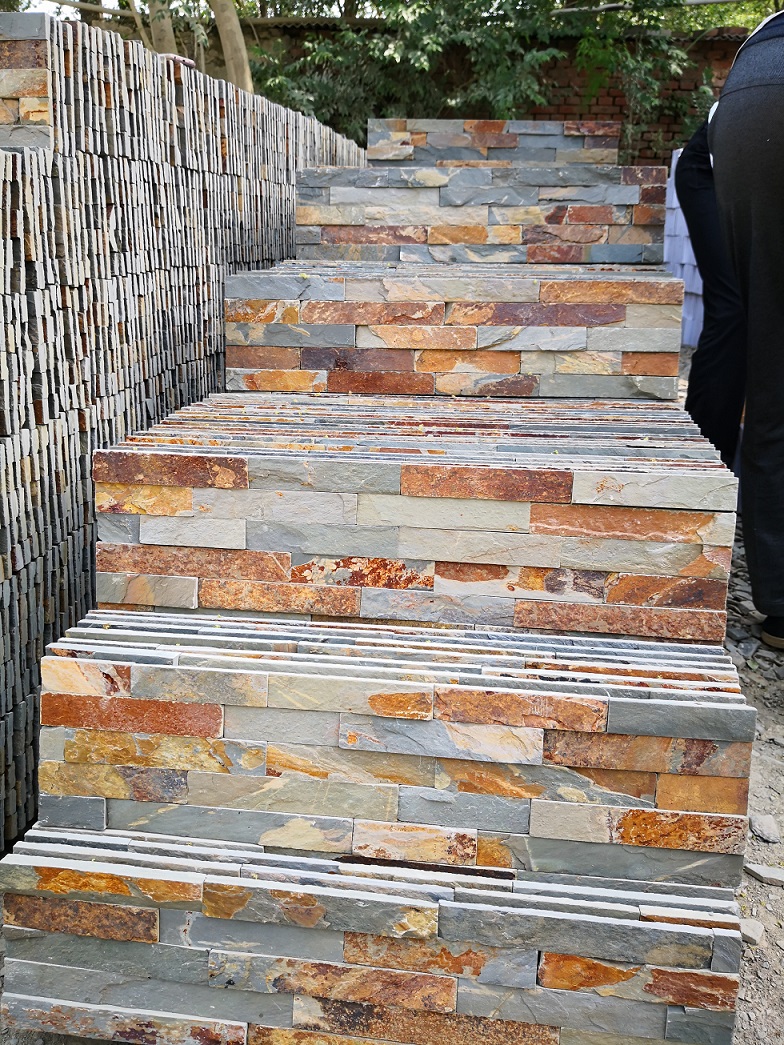
Erfolgreich installation relies on visual randomization. Pulling from a single crate often creates “Farbblockierung” where tonal clusters look unnatural. Mix inventory on the floor to see the full range of the natural stone before the mortar hits the substrate.
- Crate Blending: Draw panels from at least three different crates simultaneously to distribute subtle tonal shifts across the entire project surface.
- Nahtmanagement: Offset vertical seams between rows to break the modular grid and maintain a natürlich “stacked” aesthetic.
- Texture Distribution: Identify high-relief or outlier colors and spread them evenly to avoid heavy “Hotspots” or dark clusters.
- Tolerance Check: Confirm the interlock of Z-shape or Rectangle modules to ensure tight fits without gaps before applying mortar.
Batch Color Consistency and Pre-Shipment Verification
We reduce on-site labor through factory-level sorting. Our Quarry-to-Container model ensures color variation remains within predictable architectural parameters, saving installers hours of floor-layout time and reducing material waste.
- Factory Sorting: Use Top Source Stone’s batch color consistency protocols to prevent patchy wall results and ensure commercial-grade uniformity.
- Visual Verification: Review HD photos and videos from our Pre-Shipment Verification to plan layout and tonal distribution before the container reaches the site.
- Machine-Sawn Backing: Rely on gauged backing with +/- 2mm tolerances to maintain a level plane and ensure 100% mortar contact.
- Mineral Integrity: Wir Stein auswählen from deep-strata layers to maintain color vibrancy against UV exposure and extreme weathering through long-term cycles.
Cutting Secrets: Wet Saws vs. Angle Grinders for Clean Edges
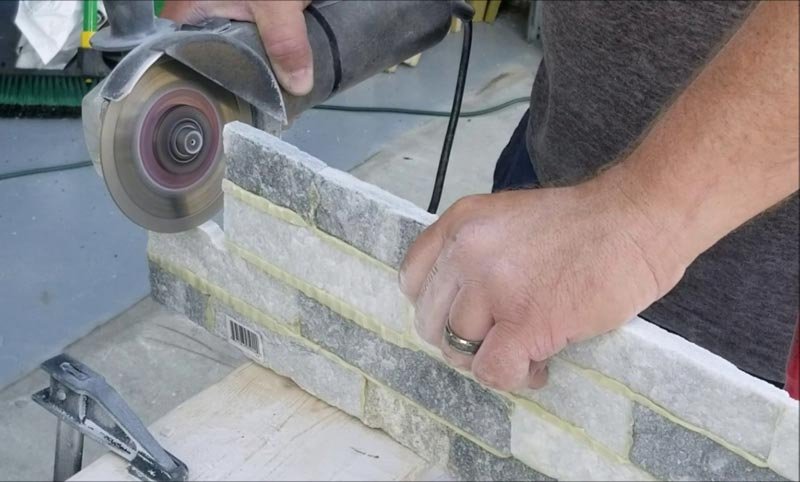
Wet saws provide precision for straight panels, while angle grinders handle cutouts. Prefabricated L-shaped corners eliminate 20% material waste and reduce on-site labor by 50%.
Choosing Between Precision Wet Saws and Versatile Grinders
Tool selection dictates the final aesthetic of a commercial installation. Diamond-blade wet saws produce the straightest edges for Z-shape and rectangle panels, effectively stopping the “Reißverschlusseffekt” where uneven gaps ruin the visual flow of a wall. This precision is mandatory for maintaining level rows across large-scale facades.
- Wet Saws: Best for 45-degree miter cuts and primary panel trimming.
- Angle Grinders: Necessary for masonry blades to manage circular cuts around plumbing or electrical boxes.
- Material Density: High-density stone from deep-strata quarry layers resists chipping during high-speed cutting better than porous alternatives.
- Joint Standards: Maintaining a 1/4-inch minimum joint thickness ensures the mortar bond meets ANSI A118.15 requirements.
We source stone with a non-porous crystalline structure to ensure edges remain crisp. This density prevents the spalling common in low-grade materials, which often leads to costly re-work and rejected batches on high-visibility projects.
L-Corner Efficiency to Eliminate Manual Miter Cutting
Manual miter cutting is the primary labor sink on any natural stone project. It is slow, creates significant dust, and carries a high risk of breakage. Utilizing prefabricated units transforms a complex masonry task into a simple modular assembly.
- Format: 6×12 + 6×12 inch factory-made L-shaped corner units.
- Adhesive: Marine-Grade Epoxy Resin prevents stone detachment during heavy-load transit or final wet saw adjustments.
- Tolerances: Machine-sawn gauged backing (+/- 2mm) ensures 100% mortar contact.
- ROI Metrics: Eliminates 20% material waste and reduces on-site labor requirements by 50%.
These corners provide a monolithic appearance on pillars and wall ends without the fragility of field-cut miters. The machine-sawn back removes air pockets, which protects the bond integrity in extreme freeze-thaw environments and ensures a 20-30 year lifespan.
Grouting vs. Dry Stack: Aesthetic and Maintenance Differences
Trocken stack installation uses self-aligning geometry to eliminate grout haze and maintenance, offering a high-relief architectural finish preferred for large-scale commercial facades.
Visual Depth and Shadow Play in Dry Stack Masonry
Dry stacking emphasizes the natural variation and cleft of stone by creating deep shadow lines. This method highlights the rugged textures of slate and quartzite, providing the 3D architectural finish popular in modern exterior design. Architects choose this look to avoid the flat, muted appearance that occurs when grout fills the natural recesses of the stone.
Maintenance for dry-stacked walls is significantly lower than grouted alternatives. Because there are no grout lines to crack, discolor, or harbor mold, the surface remains clean with only occasional dusting or low-pressure rinsing. For B2B projects, this translates to lower long-term facility management costs and a cleaner aesthetic that does not degrade over time.
Z-Shape Geometry for Seamless Grout-Free Interlocking
Top Source Stone Z-shape panels use self-aligning geometry to mask vertical seams. This modular interlock system removes the need for traditional grouting and prevents the “Reißverschlusseffekt” common in inferior rectangular panels. By eliminating the grouting phase, crews avoid mortar stains on the stone face, which often require expensive chemical cleaning post-installation.
- Machine-Sawn Backing: A gauged back with +/- 2mm tolerance ensures 100% mortar contact, eliminating air pockets that lead to delamination.
- Marine-Grade Epoxy: Stones are bonded with high-strength resin to withstand thermal expansion and heavy-load transit.
- Arbeitseffizienz: Pre-fabricated interlocking units reduce on-site labor hours by up to 50% compared to traditional hand-set masonry.
- Climate Resilience: Grout-free systems allow for natural movement, making them highly resistant to spalling in extreme freeze-thaw environments.
Wholesalers and retailers benefit from stocking these interlocking systems because they serve both high-end interior backsplashes and large-scale exterior cladding. The self-aligning nature of the Z-shape design ensures that even on massive commercial walls, the finish remains consistent without visible panel breaks or joint failures.
Post-Install Cleaning: Removing Efflorescence and Mortar Haze
Clean mortar residue immediately to stop haze. Select deep-strata, high-density stone to block moisture migration and salt deposits that cause efflorescence.
Identifying the Causes of Mortar Haze and Efflorescence
Mortar haze is not just dust; it is a cementitious residue that cures and bonds to the irregular textures of natural stone. If crews wait too long, the residue undergoes a chemical hardening process that makes removal difficult without risking damage to the stone face. Efflorescence manifests as white, powdery salt deposits. This happens when moisture moves through the mortar, reacts with alkaline salts, and evaporates on the surface.
Managing these issues requires strict adherence to installation timelines and material standards. Contractors must treat cleaning as a phase of the installation rather than a post-project afterthought.
- Cleaning Windows: Remove excess mortar in 8–10 sq ft batches to stay within the 20 to 60-minute pot life.
- Feuchtigkeitskontrolle: ASTM C270 standards for Type S mortar require precise water ratios to avoid activating the salts that cause surface staining.
- Chemical Triggers: Efflorescence typically occurs in high-moisture environments where external water activates internal mortar alkaloids.
Leveraging High-Density Minerals to Prevent Moisture Retention
Prevention is most effective at the quarry level. Top Quellstein sources materials exclusively from deep-strata layers. These minerals possess a high-density crystalline structure with near-zero water absorption. By providing stones that do not “sponge up” moisture, we cut off the primary transport mechanism for salts, significantly reducing the risk of efflorescence in exterior projects.
Our engineering process also addresses the bond line. We use specialized adhesives that leave no room for the voids where moisture and salts usually pool behind the veneer.
- Material Integrity: Low-porosity quartzite and slate panels naturally resist salt migration.
- Adhesive Standard: Marine-grade epoxy resin bonds eliminate internal voids between the stone and the backing.
- Maintenance Protocol: Use only soft brushes and pH-neutral cleaners to protect the stone finish and the adhesive bond.
- Climate Resilience: High-density minerals prevent spalling in coastal salt-air and freeze-thaw environments.
Protecting Your Project Margins
Opting for cheap, hand-split stone creates long-term liability through delamination and the “Reißverschlusseffekt” on high-visibility walls. Our machine-sawn gauged backing and marine-grade epoxy resin eliminate these risks by ensuring 100% mortar contact and structural stability in extreme climates. Investing in factory-verified technical standards protects your professional reputation and prevents the costly site remediation common with non-gauged alternatives.
Review our “Große 10” best-sellers like Alaska Gray or Glacier White to see how our modular Z-shape and linear rectangle systems streamline high-volume commercial installs. We provide full pre-shipment visual verification via HD photos and videos so you can approve batch color consistency before the container leaves our quarry. Contact our team to discuss your private label requirements or to calculate your landed cost savings using our 26.5-ton heavy-load shipping strategy.
Häufig gestellte Fragen
Can I install stacked stone veneer directly over an existing brick wall?
You can install panels over brick if the surface is clean, unpainted, and structurally sound. We recommend applying a 1/2-inch scratch coat of Type S mortar over wire lath to ensure adhesion. If the brick is painted or sealed, you must use mechanical fasteners and metal lath to prevent the stone from delaminating.
Is it possible to install natural stone ledger panels directly onto interior drywall?
Drywall cannot support the 8–13 lbs per square foot weight of natural stone. You must replace the drywall with a 1/2-inch cement backer board or install the backer board directly over the studs. Use a polymer-modified thinset meeting ANSI A118.15 standards. Our machine-sawn gauged backing ensures 100% mortar contact to eliminate air pockets during this process.
How do I cut the stone panels without causing the edges to chip or crack?
Use a wet tile saw with a diamond blade for all primary cuts. Continuous water flow reduces thermal stress, which prevents the brittle edges of slate and quartzite from snapping. While an angle grinder works for small notches, the wet saw remains the industry standard for clean, professional edges that maintain the panel’s interlocking integrity.
Should I leave a grout joint or gap between the modular stone panels?
No. Our Z-shape interlocking panels are designed for a tight-fit, dry-stack appearance. Butt the panels firmly against each other to mask vertical seams and create a seamless wall. Only leave a 1/2-inch gap at inside corners or transitions to different materials to accommodate natural building movement and thermal expansion.
Can Top Source Stone panels withstand high-heat areas like fireplace surrounds?
Yes. Our panels consist of 100% natural stone, making them naturally non-combustible. We use a high-strength, marine-grade epoxy resin to bond the individual stones. This adhesive ensures they remain attached to the panel even during the repeated thermal cycles common in residential and commercial fireplace applications.
How do I manage corner installations without performing complex miter cuts?
We provide prefabricated L-shaped corner units for our major collections, including Alaska Gray and Glacier White. These one-piece units eliminate the need for manual 45-degree miter cutting. Using these corners reduces material waste by 20% and helps contractors save roughly 50% on labor costs compared to site-fabricated corners.