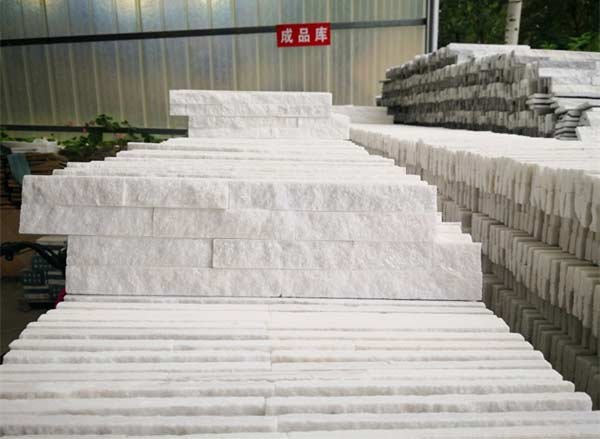
La pierre empilée d'audit d'usine est le premier point de contrôle que les acheteurs doivent verrouiller avant d'approuver un fournisseur, un budget ou un créneau de production. Vous disposez d’une liste restreinte d’usines et l’étape suivante est un audit d’usine pour votre commande de pierres empilées. La vraie question n’est pas de savoir si l’usine dispose d’un département de contrôle qualité – toutes les usines de pierre chinoises le prétendent. La question est de savoir si leur processus protégera votre conteneur de 15 000 $ d'un taux de défauts de 8 % qui efface votre marge avant que les palettes n'atteignent votre entrepôt. Cette liste de contrôle est conçue pour ce moment précis : l'audit de pré-approbation qui sépare un partenaire à long terme du casse-tête d'une seule expédition.
La plupart des distributeurs ignorent les contrôles stricts et s'appuient sur un échantillon de tableaux et une poignée de main. Cet échantillon a été sélectionné à partir des meilleurs morceaux de trois blocs de carrière différents. La poignée de main ne veut rien dire lorsque le conteneur arrive avec 12 % de panneaux hors tolérance et un changement de couleur qui ressemble à deux produits différents sur le mur. Un audit d'usine approprié pour les pierres empilées est un processus lourd de documentation et basé sur des données qui oblige le fournisseur à prouver que son système qualité fonctionne, et pas seulement à en parler. Les huit points ci-dessous sont les portes non négociables que votre inspecteur doit franchir avant d'approuver un seul cycle de production.

Cohérence des couleurs : contrôle de carrière à un seul bloc
La dérive des couleurs est la raison de rejet n°1 pour pierre empilée distributeurs. La solution ne consiste pas à mélanger les restes de pierre ; il impose un approvisionnement en lots uniques de blocs de 10 tonnes.
Vous l'avez déjà vu. La palette 1 ressemble à un charbon de bois chaud. La palette 2 ressemble à un gris ardoise froid. Sur un étage de salle d’exposition, séparés de vingt pieds, la différence est négligeable. Sur une façade extérieure de 1 500 pieds carrés exposée au soleil direct, la différence ressemble à un patchwork. Il s’agit d’une installation rejetée, d’une rétrofacturation de la part de votre entrepreneur et d’une réputation entachée.
La plupart des usines chinoises résolvent ce problème en “mélange.” Ils prennent les restes de différentes profondeurs de strates, de différents blocs de carrière et de différentes séries de production, puis les mélangent sur une palette. Cela masque l'incohérence en répartissant la variation sur une seule palette. Le problème apparaît lorsque vous ouvrez la deuxième palette. Les changements de teinte sont en bloc et évidents car chaque palette a été assemblée à partir d’un lot restant différent.
L’approche correcte consiste à s’approvisionner en un seul lot de blocs de 10 tonnes. Chaque panneau d'une palette doit provenir du même bloc de carrière, ou au maximum de blocs extraits de la même strate en une seule semaine. Cela élimine la variation géologique qui provoque la dérive des couleurs. Voici comment vérifier cela lors de votre audit d'usine pierre empilée:
- Vérification du spectrophotomètre : Exigez une lecture ΔE ≤ 2,0 sous un illuminant D65 pour chaque sous-lot de palette. N'acceptez pas une seule lecture moyenne pour l'ensemble de la commande. Un ΔE de 2,0 est le seuil auquel l’œil humain peut détecter une différence sous un éclairage standard. Si l'usine ne peut pas fournir de relevés par palette, elle n'effectue pas de suivi cohérence des couleurs.
- Maquette physique : Demandez une maquette à 4 panneaux construite à partir de pièces de production réelles, et non à partir d'échantillons d'exposition sélectionnés. La maquette doit inclure des panneaux du début, du milieu et de la fin du cycle de production. Placez-le sous la lumière naturelle. Si vous voyez un dégradé, rejetez le lot.
- Documentation sur la liste de colisage : La liste de colisage doit inclure le numéro de lot du bloc de carrière pour chaque palette. Si l’usine ne peut pas retracer une palette jusqu’à un bloc spécifique, elle procède au mélange. Ignorez cette vérification et vous importez une incompatibilité de couleur.
Lorsque vous demandez des échantillons pour cet audit, assurez-vous qu'ils proviennent du bloc de production réel et non d'un affichage organisé. Une usine qui hésite à fournir des échantillons correspondant à la production cache des incohérences. Il s’agit d’une porte difficile de réussite/échec dans tout Guide d'audit des usines de pierre chinoises.
Vérification de l'approvisionnement : tolérances dimensionnelles
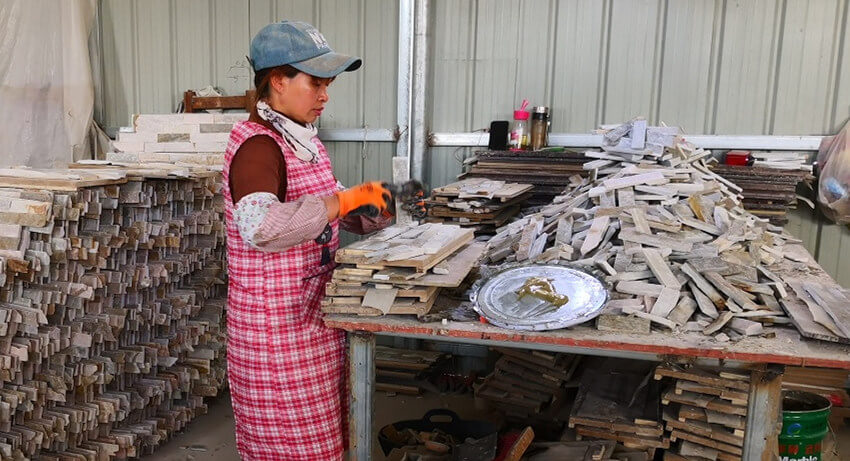
Les entrepreneurs rejetteront des caisses entières si les panneaux nécessitent un calage ou un meulage sur place. La vérification dimensionnelle nécessite des pieds à coulisse numériques sur le sol de préparation, et non une estimation visuelle.
La plupart des usines organisent une zone de contrôle de qualité spécifique pour les visiteurs, où les bords sont limés à la main à la perfection. Pour évaluer la véritable précision de fabrication de votre expédition, votre inspecteur doit contourner cette zone de vitrine et retirer au hasard 5 % des panneaux finis directement des lignes de préparation actives. Mesurez directement l'épaisseur, la longueur et l'équerrage de l'angle droit pour bloquer les écarts cumulatifs entre les rangées.
Notre suivi empirique sur le terrain démontre que la variance d'épaisseur doit rester étroitement liée à ± 1/16 de pouce (1,5 mm) sur 95 % des échantillons pour éviter une lèvre agressive sous une lumière rasante. Les écarts d'équerrage des coins ne peuvent pas dépasser 1/8 de pouce sur un profil de 24 pouces, sinon les panneaux décalés créeront des espaces en cascade dans les marches d'escalier lors de l'installation de maçonnerie à pile sèche. Si un fournisseur refuse à votre auditeur tiers un accès direct pour mesurer les palettes brutes avant le chargement, signalez-le immédiatement comme un risque de défaillance structurelle.
| Paramètre | Spécification | Méthode d'inspection | Seuil d'échec |
|---|---|---|---|
| Épaisseur du panneau | ±1/16 po (1,5 mm) | Pied à coulisse numérique sur 5 % de tirage aléatoire des palettes finies | >5% des échantillons hors tolérance |
| Carré (plus de 24 po) | ≤ 1/8 po (3,2 mm) | Carré en acier sur tirage aléatoire de 5 % à partir de palettes finies | >5% des échantillons hors tolérance |
| Planéité de la surface (sous la règle) | ≤ 1/16 po (1,5 mm) | Règle sur 5 % de tirage aléatoire des palettes finies | >5% des échantillons hors tolérance |
| Lieu d'échantillonnage | Étage de préparation (zone QC non organisée) | L'inspecteur sélectionne les palettes avant le chargement | L'usine refuse l'accès à l'étage de préparation |
Humidité & Tests de matériaux gel-dégel
Ignorez cette vérification et vous importez le délaminage de façade. Une usine qui ne peut pas prouver sa résistance au gel-dégel est un handicap, pas un fournisseur.
Vous achetez un produit qui restera dehors pendant une décennie. L'eau entre. La glace se dilate. Des éclats de pierre. C'est de la physique, pas une réclamation pour défaut. La seule chose qui empêche un conteneur de 15 000 $ de devenir un tas de décombres est un rapport vérifié ASTM C97 et C666.
Voici le piège dans lequel tombent la plupart des distributeurs : ils acceptent la photocopie d’un rapport de test. Un véritable rapport comporte un numéro d'accréditation de laboratoire spécifique, une date et la variété exacte de pierre répertoriée. De nombreuses sociétés commerciales tirent un document générique non daté qu’elles ont obtenu il y a des années pour un type de pierre différent. Vérifiez les informations d’identification du laboratoire de test en ligne. Si le laboratoire ne figure pas dans un répertoire international d’organismes d’accréditation, le rapport ne sert à rien.
- ASTM C97 (Absorption d'eau) : Doit être ≤3 %. Une absorption plus élevée signifie que la pierre agit comme une éponge. Un cycle de gel-dégel et vous obtenez des micro-fractures. Deux hivers et vous obtenez un effritement visible.
- ASTM C666 (Résistance au gel-dégel) : Doit passer 50 cycles sans fissuration ni effritement. Il s’agit de la norme pour les revêtements extérieurs dans les zones climatiques 4 et supérieures. Aucune exception.
- ASTM C170 (résistance à la compression) : Minimum 10 000 psi. Cela garantit que la pierre peut supporter la charge structurelle et les contraintes de manipulation lors de l'installation.
Une usine qui hésite à fournir des rapports de laboratoire originaux et datés sur la variété exacte de pierre de votre commande cache quelque chose. Passez. Le coût d’une expédition échouée en raison de dommages causés par l’humidité dépasse de loin le temps passé à vérifier un fournisseur conforme. Pour en savoir plus sur la manière dont l'humidité affecte les pierres empilées dans des applications spécifiques telles que les margelles de piscine ou le revêtement extérieur, lisez l'article sur Pierre empilée dans les zones humides.
| Paramètre de test | Spécification | Risque d'échec |
|---|---|---|
| Absorption d'eau (ASTM C97) | ≤ 3% | Écaillage, efflorescence, faiblesse structurelle dans les climats humides |
| Résistance au gel-dégel (ASTM C666) | 50 cycles, zéro fissuration ou écaillage | Délaminage des façades en 2 hivers en zones de gel |
| Résistance à la compression (ASTM C170) | Un minimum de 10 000 PSI | Fissuration sous charge, dangereuse pour le revêtement structurel |
| Vérification du rapport | Numéro d'accréditation du laboratoire & date requise | Rapport faux ou générique provenant d'un type de pierre différent |
Emballage & Protocole de chargement des conteneurs
La casse du transport est la fuite de marge la plus silencieuse. Le processus d’emballage d’une usine doit être audité pour survivre intact aux expéditions transpacifiques de produits bruts.
L’audit d’emballage constitue votre protection de base contre les fractures de transit. Votre inspecteur sur place doit vérifier que les panneaux individuels sont bien emballés dans de lourdes boîtes en carton à triple paroi mesurant 1,5 mm à 2 mm d'épaisseur, dotées de revêtements imperméables défensifs. Un film de papier fin générique permettra de déplacer les surfaces en pierre pour gratter et ébrécher les coins lors des manœuvres de transit maritime.
De plus, vérifiez la construction de la caisse en bois. Les palettes doivent utiliser du bois solide traité thermiquement, conforme aux directives de la NIMP-15 pour éviter les goulots d'étranglement de quarantaine personnalisés. Chaque palette finie doit être étroitement emballée pour protéger les couches de pierre de l'humidité ambiante du sel océanique. Pour une logistique de charge utile maximale des conteneurs, votre inspecteur doit surveiller la porte de chargement finale pour garantir que les caisses sont structurellement renforcées et équilibrées, empêchant ainsi le déplacement de poids au cours de voyages maritimes de plusieurs semaines.

Visite d'usine ou audit vidéo à distance
Évitez le billet d'avion à 1 500 $. Un audit vidéo structuré de 45 minutes peut qualifier un fournisseur pour un coût inférieur de 40 %.
Vous n’avez pas besoin de vous rendre au Hebei pour examiner chaque usine présélectionnée. Un audit vidéo à distance avec une visite guidée structurée peut réduire les coûts initiaux qualification des fournisseurs des coûts jusqu'à 40 % par rapport à une visite sur place. Cela représente une économie de 600 $ par usine, que vous pouvez réinvestir dans une inspection tierce avant expédition du premier conteneur.
L'audit vidéo doit inclure une présentation en direct de toutes les étapes de production : sciage, fendage, tri, emballage et une inspection en direct de la zone d'attente du contrôle qualité. Exigez que le caméraman s'arrête sur des palettes aléatoires sur l'étage de préparation, et non sur la zone d'exposition organisée. Une usine qui hésite à vous montrer la scène a quelque chose à cacher.
Voici la matrice de décision :
- Audit vidéo à distance : À utiliser pour la qualification initiale de 3 à 5 usines. Coût : 0 $ (auto-réalisé) à 200 $ (inspecteur tiers). Risque : Impossible de vérifier les mesures au pied à coulisse ou de saisir directement les documents.
- Visite sur place : À utiliser pour l'usine finale présélectionnée avant le premier sceau du conteneur. Coût : 1 500 $+ (vol, hôtel, traducteur). Avantage : vous tirez physiquement 5 % des palettes finies, mesurez l'épaisseur avec votre propre pied à coulisse numérique et inspectez le lot de blocs de carrière.
- Modèle hybride : Audit vidéo pour la qualification initiale, une visite sur site avant le plombage du premier conteneur. Il s’agit de la norme pour les distributeurs chevronnés gérant plus de 5 fournisseurs.
Lors de l'audit vidéo, demandez une lecture en direct du spectrophotomètre sur un sous-lot de palette aléatoire. Si l’usine ne peut pas produire un spectrophotomètre portable sur l’appareil photo, elle n’effectue pas de contrôles de cohérence des couleurs. Éloignez-vous.
Documents de conformité & Certifications
Une usine sans rapports ASTM auditables est une société commerciale. Exigez le numéro d’accréditation du laboratoire, pas une photocopie.
Vous n'achetez pas une pierre. Vous achetez un transfert de responsabilité. Si la pierre échoue à un test de résistance à la compression sur place, c'est l'entrepreneur général qui s'en prend à vous, et non l'usine du Hebei. Le seul bouclier est une certification vérifiable et datée qui correspond à la variété de pierre spécifique dans votre conteneur.
Voici la pile de documents non négociables pour un vente en gros contrôle de la qualité des pierres empilées audit:
- ASTM C170 (résistance à la compression) : Minimum 10 000 psi. C’est la base du revêtement structurel. Un chiffre en dessous signifie que la pierre se fissurera sous l'effet d'une charge de vent ou d'une dilatation thermique standard. Exigez le rapport de laboratoire spécifique, pas un résumé.
- ASTM C97 (Absorption d'eau) : Doit être ≤ 3 %. Tout ce qui dépasse 5 % est un échec de gel-dégel qui attend de se produire. Il s’agit du chiffre le plus important pour les applications extérieures dans les zones climatiques 4 et supérieures.
- ASTM C666 (Résistance au gel-dégel) : 50 cycles sans fissuration ni écaillage. Si l'usine ne peut pas produire ce rapport, n'expédiez pas vers un marché soumis au gel. Période.
- CE / EN 12057 (European Buyers): Obligatoire pour le dédouanement de l’UE. Une usine prétendant être conforme aux normes CE sans numéro d’organisme notifié ment. Vérifiez le numéro sur la base de données EU NANDO.
- Certificat d'origine : Requis pour le traitement tarifaire préférentiel dans le cadre des accords de libre-échange. Sans cela, vous payez le plein tarif.
Voici l’astuce d’initié qui manque à la plupart des distributeurs. Un véritable pierre empilée ASTM Agrément C170 aura un numéro d’accréditation de laboratoire spécifique (par exemple, CNAS LXXXX) et une date de délivrance. De nombreuses sociétés commerciales présentent un document générique non daté obtenu il y a des années pour un type de pierre complètement différent. Vous vérifiez cela en accédant au site Web du laboratoire de test et en recherchant le numéro du rapport. Si le rapport ne répertorie pas exactement la variété de pierre et le lot de carrière que vous commandez, il ne sert à rien.
Une usine qui ne peut pas produire ces documents sur demande n’est pas un fabricant. C'est un courtier. Et un courtier ne peut pas contrôler la qualité de la pierre qu’il ne taille pas. Pour une analyse plus approfondie de la façon dont ces certifications affectent le dédouanement, lisez notre guide sur le Code HS des pierres empilées.
Conclusion
Cette liste de contrôle en 8 points constitue votre document de diligence raisonnable. Sautez n'importe quelle étape : bloquez la traçabilité des lots, tolérance dimensionnelle vérification ou validation du rapport de test par un tiers – et vous acceptez un taux de défauts de 5 à 8 % qui érode votre marge sur chaque conteneur. Une usine qui hésite à vous laisser retirer 5 % des palettes finies de l'aire de préparation ou qui ne peut pas produire un rapport ASTM C666 avec un numéro d'accréditation de laboratoire vérifiable est un fournisseur que vous disqualifiez immédiatement.
Appliquez ce protocole à votre prochaine usine présélectionnée. Si le fournisseur réussit les huit contrôles, procédez à un audit vidéo à distance ou à une visite sur site pour sceller le premier conteneur en toute confiance. Examinez le cadre de contrôle de la qualité sur Top Source Ardoise pour voir comment un fabricant transparent documente chacune de ces normes avant de vous le demander.
Foire aux questions
Comment auditer une usine ?
Auditez une usine de pierre empilée en vérifiant la traçabilité des lots de blocs de carrière et en vérifiant la cohérence des couleurs et la tolérance des dimensions des palettes aléatoires. Concentrez-vous sur les 5 % de palettes finies retirées des zones de préparation actives. Utilisez une visite vidéo à distance de 45 minutes pour qualifier l’usine avant de vous engager.
Qu'est-ce qu'une liste de contrôle d'audit qualité ?
Une liste de contrôle d'audit de qualité pour les pierres empilées comprend la cohérence des couleurs (ΔE ≤ 2,0), la tolérance dimensionnelle (± 1/16 po) et les rapports de tests de gel-dégel. Il doit également vérifier que les échantillons proviennent de la production réelle plutôt que de salles d'exposition organisées. Demandez toujours une maquette à 4 panneaux du lot de production réel.
Quels sont les 5 C de l’audit ?
Les 5 C de l’audit sont la condition, les critères, la cause, la conséquence et l’action corrective. Pour la pierre empilée, la condition est la qualité réelle du produit, les critères sont la norme de spécification, la cause est la méthode de production, la conséquence est la perte de rejet et l'action corrective est le tri des fournisseurs. Appliquez les 5 C à chaque défaut constaté lors de l’inspection de la palette.
Quelles sont les 7 procédures d’audit ?
Les 7 procédures d'audit sont la planification, la réunion d'ouverture, l'examen des documents, l'inspection du site, l'échantillonnage, le rapport et la réunion de clôture. Pour les usines de pierre, l’inspection du site doit inclure un échantillonnage aléatoire des palettes et une validation gel-dégel. Sautez la réunion d’ouverture si l’usine ne peut pas montrer dès le départ la traçabilité des lots en bloc.
Qu'est-ce qu'une liste de contrôle d'audit de sécurité ?
Une liste de contrôle d'audit de sécurité pour une usine de pierre couvre la conformité des EPI, la protection des machines, le contrôle de la poussière et les sorties de secours. Vérifiez que l'usine dispose d'une ventilation adéquate pour la poussière de silice et que les travailleurs portent des masques homologués. Demandez une copie du récent rapport d’inspection de sécurité de l’usine avant de vous y rendre.