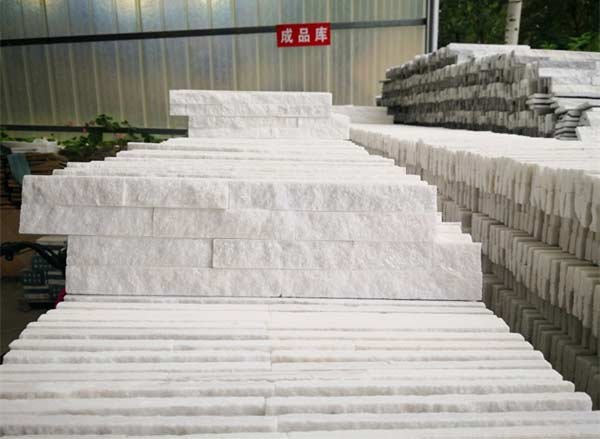
Der „Factory Audit Stacked Stone“ ist der erste Kontrollpunkt, den Käufer abschließen sollten, bevor sie einen Lieferanten, ein Budget oder einen Produktionsslot genehmigen. Sie haben eine Auswahlliste von Fabriken und der nächste Schritt ist eine Fabrikprüfung für Ihre Bestellung mit gestapelten Steinen. Die eigentliche Frage ist nicht, ob die Fabrik über eine Qualitätskontrollabteilung verfügt – das behauptet jede chinesische Steinfabrik. Die Frage ist, ob ihr Prozess Ihren 15.000-Dollar-Container vor einer Fehlerquote von 8 % schützt, die Ihre Marge vernichtet, bevor die Paletten Ihr Lager erreichen. Diese Checkliste ist für diesen besonderen Moment konzipiert: das Vorabgenehmigungsaudit, das einen langfristigen Partner von den Kopfschmerzen einer einzigen Lieferung befreit.
Die meisten Händler überspringen die harten Kontrollen und verlassen sich auf ein Musterbrett und einen Handschlag. Dieses Musterbrett wurde aus den besten Stücken von drei verschiedenen Steinbruchblöcken zusammengestellt. Der Händedruck hat keine Bedeutung, wenn der Container mit 12 % außerhalb der Toleranz liegenden Teilen und einer Farbverschiebung an der Wand ankommt, die wie zwei verschiedene Produkte aussieht. Ein ordnungsgemäßes Werksaudit für gestapelte Steine ist ein dokumentationsintensiver, datengesteuerter Prozess, der den Lieferanten dazu zwingt, nachzuweisen, dass sein Qualitätssystem funktioniert, und nicht nur darüber zu reden. Die folgenden acht Punkte sind die nicht verhandelbaren Tore, die Ihr Prüfer passieren muss, bevor Sie einen einzelnen Produktionslauf genehmigen.

Farbkonsistenz: Einzelblock-Steinbruchkontrolle
Farbdrift ist der häufigste Ablehnungsgrund gestapelter Stein Händler. Die Lösung besteht nicht darin, übriggebliebenen Stein zu vermischen; Es erzwingt die Beschaffung einzelner 10-Tonnen-Blockpartien.
Sie haben es schon einmal gesehen. Palette 1 sieht aus wie warme Holzkohle. Palette 2 sieht aus wie ein kaltes Schiefergrau. Auf einer Ausstellungsraumetage mit einem Abstand von 20 Fuß ist der Unterschied vernachlässigbar. Auf einer 1.500 Quadratmeter großen Außenfassade unter direkter Sonneneinstrahlung sieht der Unterschied wie ein Flickenteppich aus. Das bedeutet eine abgelehnte Installation, eine Rückbuchung durch Ihren Auftragnehmer und einen Rufschaden.
Die meisten chinesischen Fabriken lösen dieses Problem durch “Mischen.” Sie nehmen Reststücke aus unterschiedlichen Gesteinstiefen, unterschiedlichen Steinbruchblöcken und unterschiedlichen Produktionsläufen und mischen sie dann auf einer Palette zusammen. Dies maskiert Inkonsistenzen, indem die Variation auf eine einzige Palette verteilt wird. Das Problem tritt auf, wenn Sie die zweite Palette öffnen. Die Farbtonverschiebungen sind blockartig und offensichtlich, da jede Palette aus einer anderen Restcharge zusammengestellt wurde.
Der richtige Ansatz ist die Beschaffung einzelner 10-Tonnen-Blockpartien. Jede Platte auf einer Palette muss aus demselben Steinbruchblock oder höchstens aus Blöcken stammen, die innerhalb einer Woche aus derselben Schicht gewonnen wurden. Dadurch wird die geologische Variation eliminiert, die eine Farbdrift verursacht. So überprüfen Sie dies während Ihres Fabrikaudit gestapelter Stein:
- Überprüfung des Spektralfotometers: Fordern Sie für jede Palettenunterpartie einen ΔE-Wert von ≤ 2,0 unter D65-Lichtart. Akzeptieren Sie keinen einzigen Durchschnittswert für die gesamte Bestellung. Ein ΔE von 2,0 ist der Schwellenwert, ab dem das menschliche Auge bei Standardbeleuchtung einen Unterschied erkennen kann. Wenn das Werk keine Messwerte pro Palette bereitstellen kann, erfolgt keine Nachverfolgung Farbkonsistenz.
- Physisches Modell: Fordern Sie ein 4-Panel-Modell an, das aus tatsächlichen Produktionsstücken und nicht aus kuratierten Ausstellungsstücken erstellt wurde. Das Modell muss Panels vom Anfang, der Mitte und dem Ende des Produktionslaufs enthalten. Stellen Sie es unter natürliches Licht. Wenn Sie einen Farbverlauf sehen, lehnen Sie das Los ab.
- Dokumentation der Packliste: Die Packliste muss die Chargennummer der Steinbruchblöcke für jede Palette enthalten. Wenn die Fabrik eine Palette nicht zu einem bestimmten Block zurückverfolgen kann, erfolgt eine Vermischung. Wenn Sie diese Prüfung überspringen, importieren Sie eine Farbabweichung.
Wenn Sie Muster für dieses Audit anfordern, stellen Sie sicher, dass sie aus dem tatsächlichen Produktionsblock stammen und nicht aus einer kuratierten Ausstellung. Eine Fabrik, die zögert, produktionsgerechte Muster bereitzustellen, verbirgt Unstimmigkeiten. Dies ist im Ernstfall ein hartes Pass/Fail-Gate Audit-Leitfaden für chinesische Steinfabriken.
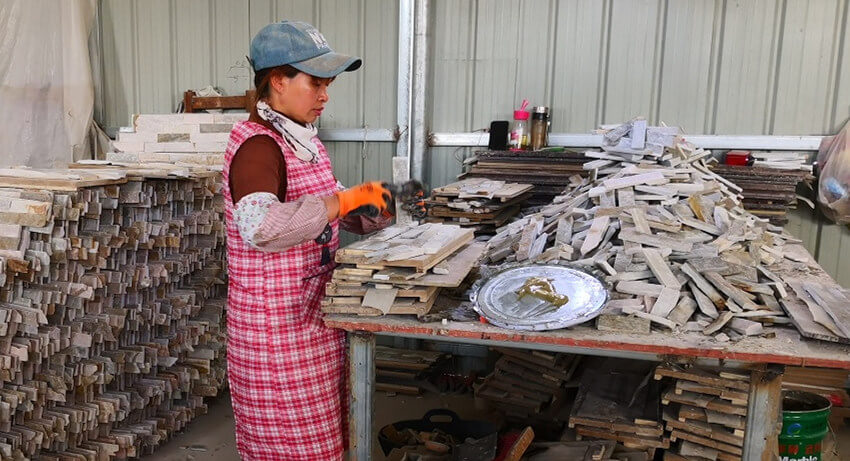
Beschaffungsüberprüfung: Maßtoleranzen
Auftragnehmer lehnen ganze Kisten ab, wenn die Platten vor Ort unterlegt oder geschliffen werden müssen. Für die Dimensionsüberprüfung sind digitale Messschieber auf dem Bereitstellungsboden und keine visuelle Schätzung erforderlich.
Die meisten Fabriken stellen für Besucher einen speziellen QC-Wartebereich bereit, in dem die Kanten von Hand bis zur Perfektion gefeilt werden. Um die tatsächliche Fertigungspräzision Ihrer Lieferung zu beurteilen, muss Ihr Inspektor diese Schaufensterzone umgehen und zufällig 5 % der fertigen Platten direkt von den aktiven Bereitstellungslinien am Boden entnehmen. Messen Sie Dicke, Länge und rechtwinklige Rechtwinkligkeit direkt, um kumulative Lücken zwischen den Reihen zu schließen.
Unsere empirische Feldverfolgung zeigt, dass die Dickenvarianz bei 95 % der Proben eng unter ±1/16 Zoll (1,5 mm) bleiben muss, um aggressives Lippage unter Streiflicht zu verhindern. Abweichungen von der Rechtwinkligkeit der Ecken dürfen bei einem 24-Zoll-Profil nicht mehr als 1/8 Zoll betragen, da die versetzten Paneele sonst bei der Installation von Trockenmauerwerk zu kaskadierenden Treppenstufenlücken führen. Wenn ein Lieferant Ihrem externen Prüfer den direkten Zugang zum Vermessen der Rohpaletten vor dem Verladen verweigert, kennzeichnen Sie dies sofort als Risiko eines strukturellen Versagens.
| Parameter | Spezifikation | Inspektionsmethode | Fehlerschwelle |
|---|---|---|---|
| Plattenstärke | ±1/16 Zoll (1,5 mm) | Digitaler Messschieber bei 5 % Zufallszug von fertigen Paletten | >5 % der Proben außerhalb der Toleranz |
| Rechtwinkligkeit (über 24 Zoll) | ≤ 1/8 Zoll (3,2 mm) | Stahlquadrat auf 5 % Zufallszug von fertigen Paletten | >5 % der Proben außerhalb der Toleranz |
| Oberflächenebenheit (unter Lineal) | ≤ 1/16 Zoll (1,5 mm) | Lineal bei 5 % Zufallszug von fertigen Paletten | >5 % der Proben außerhalb der Toleranz |
| Probenahmeort | Bereitstellungsbereich (nicht kuratierter QC-Bereich) | Der Inspektor wählt die Paletten vor dem Laden aus | Fabrik verweigert Zutritt zur Lagerhalle |
Feuchtigkeit & Gefrier-Tau-Materialtests
Wenn Sie diese Prüfung überspringen, importieren Sie Fassadenablösungen. Eine Fabrik, die keine Frost-Tausalz-Beständigkeit nachweisen kann, ist eine Haftung, kein Lieferant.
Sie kaufen ein Produkt, das ein Jahrzehnt lang draußen steht. Wasser dringt ein. Eis dehnt sich aus. Steinsplitter. Das ist Physik, keine Mängelrüge. Das Einzige, was verhindert, dass ein 15.000-Dollar-Container zu einem Trümmerhaufen wird, ist ein verifizierter ASTM C97- und C666-Bericht.
Hier tappen die meisten Händler in die Falle: Sie akzeptieren eine Fotokopie eines Testberichts. Ein echter Bericht enthält eine bestimmte Laborakkreditierungsnummer, ein Datum und die genaue aufgeführte Steinsorte. Viele Handelsunternehmen beziehen ein generisches, undatiertes Dokument, das sie vor Jahren für eine andere Steinart erhalten haben. Überprüfen Sie die Anmeldeinformationen des Testlabors online. Wenn das Labor nicht in einem Verzeichnis einer internationalen Akkreditierungsstelle aufgeführt ist, ist der Bericht wertlos.
- ASTM C97 (Wasseraufnahme): Muss ≤3 % sein. Durch die höhere Absorption wirkt der Stein wie ein Schwamm. Ein Frost-Tau-Wechsel und es entstehen Mikrofrakturen. Zwei Winter und es kommt zu sichtbaren Abplatzungen.
- ASTM C666 (Frost-Tau-Widerstand): Muss 50 Zyklen ohne Risse oder Abplatzungen überstehen. Dies ist der Standard für Außenverkleidungen in der Klimazone 4 und höher. Keine Ausnahmen.
- ASTM C170 (Druckfestigkeit): Mindestens 10.000 PSI. Dadurch wird sichergestellt, dass der Stein der strukturellen Belastung und den Beanspruchungen während der Installation standhält.
Eine Fabrik, die zögert, originale, datierte Laborberichte für die genaue Steinsorte in Ihrer Bestellung bereitzustellen, verbirgt etwas. Weitergehen. Die Kosten einer fehlgeschlagenen Lieferung aufgrund von Feuchtigkeitsschäden übersteigen bei weitem den Zeitaufwand für die Überprüfung eines konformen Lieferanten. Für einen tieferen Einblick in die Auswirkungen von Feuchtigkeit auf gestapelte Steine in bestimmten Anwendungen wie Poolumrandungen oder Außenverkleidungen lesen Sie den Artikel über Gestapelter Stein in Nassbereichen.
| Testparameter | Spezifikation | Risiko eines Ausfalls |
|---|---|---|
| Wasseraufnahme (ASTM C97) | ≤ 3 % | Abplatzungen, Ausblühungen, Strukturschwäche in feuchten Klimazonen |
| Frost-Tau-Widerstand (ASTM C666) | 50 Zyklen, keine Risse oder Abplatzungen | Fassadenablösung innerhalb von 2 Wintern in Frostzonen |
| Druckfestigkeit (ASTM C170) | Mindestens 10.000 PSI | Rissbildung unter Last, unsicher für Strukturverkleidungen |
| Berichtsüberprüfung | Akkreditierungsnummer des Labors & Datum erforderlich | Gefälschter oder generischer Bericht einer anderen Steinart |
Verpackung & Containerladeprotokoll
Der Transportbruch ist das leiseste Randleck. Der Verpackungsprozess einer Fabrik muss überprüft werden, um raue Transpazifik-Transporte unbeschadet zu überstehen.
Das Verpackungsaudit ist Ihre Grundvoraussetzung gegen Transportbrüche. Ihr Inspektor vor Ort muss sicherstellen, dass die einzelnen Paneele dicht in schweren, dreiwandigen Kartons mit einer Dicke von 1,5 mm bis 2 mm und mit schützenden wasserdichten Beschichtungen verpackt sind. Eine allgemeine dünne Papierfolie ermöglicht es, Steinoberflächen zu verschieben und bei Manövern im Seeverkehr Ecken abzukratzen und abzusplittern.
Überprüfen Sie außerdem die Konstruktion der Holzkisten. Paletten müssen aus massivem, wärmebehandeltem Holz bestehen, das den ISPM-15-Richtlinien entspricht, um kundenspezifische Quarantäneengpässe zu vermeiden. Jede fertige Palette sollte fest mit Stretchfolie umwickelt sein, um die Steinschichten vor der Meeressalzfeuchtigkeit in der Umgebung zu schützen. Für eine maximale Container-Nutzlastlogistik muss Ihr Inspektor das letzte Ladetor überwachen, um sicherzustellen, dass die Kisten strukturell versteift und ausbalanciert sind und Gewichtsverlagerungen bei mehrwöchigen Seereisen vermieden werden.

Werksbesuch vs. Remote-Video-Audit
Überspringen Sie das 1.500-Dollar-Flugticket. Ein strukturiertes 45-minütiges Videoaudit kann einen Lieferanten für 40 % geringere Kosten qualifizieren.
Sie müssen nicht nach Hebei fliegen, um jede Fabrik, die in die engere Auswahl kommt, zu überprüfen. Ein Remote-Video-Audit mit einer strukturierten Komplettlösung kann erste Einsparungen erzielen Lieferantenqualifizierung Kosten um bis zu 40 % im Vergleich zu einem Vor-Ort-Besuch. Das bedeutet eine Ersparnis von 600 US-Dollar pro Fabrik, die Sie in eine Inspektion des ersten Containers vor dem Versand durch Dritte reinvestieren können.
Das Videoaudit muss einen Live-Rundgang durch alle Produktionsschritte umfassen: Sägen, Teilen, Sortieren, Verpacken und eine Live-Inspektion des QC-Lagerbereichs. Fordern Sie den Kameramann auf, bei zufälligen Paletten auf der Bühnenfläche anzuhalten – nicht im kuratierten Ausstellungsbereich. Eine Fabrik, die zögert, Ihnen die Produktionshalle zu zeigen, hat etwas zu verbergen.
Hier ist die Entscheidungsmatrix:
- Remote-Video-Audit: Verwendung für die Erstqualifizierung von 3–5 Fabriken. Kosten: 0 $ (selbst durchgeführt) bis 200 $ (Drittprüfer). Risiko: Dickenmessungen können nicht überprüft oder Dokumente nicht direkt abgerufen werden.
- Besuch vor Ort: Verwendung für die endgültige Auswahl der Fabrik vor der Versiegelung des ersten Containers. Kosten: 1.500 $+ (Flug, Hotel, Übersetzer). Vorteil: Sie ziehen physisch 5 % der fertigen Paletten, messen die Dicke mit Ihrem eigenen digitalen Messschieber und inspizieren die Steinbruchblockpartie.
- Hybridmodell: Video-Audit zur Erstqualifizierung, ein Vor-Ort-Besuch vor der Versiegelung des ersten Containers. Dies ist der Standard für erfahrene Vertriebshändler, die mehr als 5 Lieferanten verwalten.
Bitten Sie während des Video-Audits um eine Live-Messung des Spektralfotometers auf einer zufällig ausgewählten Palettenunterpartie. Wenn das Werk kein Handspektralfotometer mit Kamera herstellen kann, führt es keine Farbkonsistenzprüfungen durch. Geh weg.
Compliance-Dokumentation & Zertifizierungen
Eine Fabrik ohne überprüfbare ASTM-Berichte ist ein Handelsunternehmen. Verlangen Sie die Akkreditierungsnummer des Labors, keine Fotokopie.
Sie kaufen keinen Stein. Sie erwerben eine Haftungsübertragung. Wenn der Stein den Druckfestigkeitstest vor Ort nicht besteht, kommt der Generalunternehmer auf Sie zu und nicht auf die Fabrik in Hebei. Der einzige Schutz ist eine nachweisbare, datierte Zertifizierung, die der spezifischen Steinsorte in Ihrem Behälter entspricht.
Hier ist der nicht verhandelbare Dokumentenstapel für a Qualitätskontrolle für gestapelte Steine im Großhandel Prüfung:
- ASTM C170 (Druckfestigkeit): Mindestens 10.000 PSI. Dies ist die Grundlage für die strukturelle Verkleidung. Eine Zahl darunter bedeutet, dass der Stein bei normaler Windlast oder Wärmeausdehnung reißt. Fordern Sie den spezifischen Laborbericht, keine Zusammenfassung.
- ASTM C97 (Wasseraufnahme): Muss ≤ 3 % sein. Alles über 5 % ist ein Frost-Tau-Fehler, der darauf wartet, einzutreten. Dies ist die wichtigste Zahl für Außenanwendungen in den Klimazonen 4 und höher.
- ASTM C666 (Frost-Tau-Widerstand): 50 Zyklen ohne Risse oder Abplatzungen. Wenn das Werk diesen Bericht nicht erstellen kann, versenden Sie nicht an einen Markt, auf dem es Frost gibt. Zeitraum.
- CE/EN 12057 (Europäische Käufer): Obligatorisch für die EU-Zollabfertigung. Eine Fabrik, die ohne eine Benannte-Stellen-Nummer die CE-Konformität behauptet, ist eine Lüge. Überprüfen Sie die Nummer in der EU-NANDO-Datenbank.
- Ursprungszeugnis: Erforderlich für die Zollpräferenzbehandlung im Rahmen von Freihandelsabkommen. Ohne sie zahlen Sie den vollen Zollsatz.
Hier ist der Insider-Trick, den die meisten Händler übersehen. Ein echter gestapelter Stein ASTM C170-Zertifizierung wird eine spezifische Laborakkreditierungsnummer (z. B. CNAS LXXXX) und ein Ausstellungsdatum haben. Viele Handelsunternehmen legen ein generisches, undatiertes Dokument vor, das sie vor Jahren für eine völlig andere Steinart erhalten haben. Sie überprüfen dies, indem Sie auf der Website des Testlabors nach der Berichtsnummer suchen. Wenn der Bericht nicht die genaue Steinsorte und Steinbruchpartie auflistet, die Sie bestellen, ist er wertlos.
Eine Fabrik, die diese Dokumente nicht auf Anfrage vorlegen kann, ist kein Hersteller. Es handelt sich um einen Makler. Und ein Makler kann die Qualität des Steins, den er nicht bearbeitet, nicht kontrollieren. Für eine detailliertere Aufschlüsselung darüber, wie sich diese Zertifizierungen auf die Zollabfertigung auswirken, lesen Sie unseren Leitfaden auf HS-Code für gestapelte Steine.
Abschluss
Diese 8-Punkte-Checkliste ist Ihr Due-Diligence-Dokument. Überspringen Sie jeden Schritt – blockieren Sie die Rückverfolgbarkeit von Chargen, Maßtoleranz Verifizierung oder Validierung von Testberichten durch Dritte – und Sie nehmen eine Fehlerquote von 5–8 % in Kauf, die Ihre Marge bei jedem Behälter schmälert. Eine Fabrik, die zögert, 5 % der fertigen Paletten von der Bereitstellungsebene holen zu lassen oder keinen ASTM C666-Bericht mit einer überprüfbaren Laborakkreditierungsnummer vorlegen kann, ist ein Lieferant, den Sie sofort disqualifizieren.
Wenden Sie dieses Protokoll auf Ihre nächste Fabrik an, die in die engere Auswahl kommt. Wenn der Lieferant alle acht Prüfungen besteht, führen Sie ein Remote-Videoaudit oder einen Vor-Ort-Besuch durch, um den ersten Behälter zuverlässig zu verschließen. Sehen Sie sich den Qualitätskontrollrahmen an Top-Source-Schiefer Bevor Sie nachfragen, erfahren Sie, wie ein transparenter Hersteller jeden dieser Standards dokumentiert.
Häufig gestellte Fragen
Wie auditiert man eine Fabrik?
Auditieren Sie eine Fabrik für gestapelte Steine, indem Sie die Rückverfolgbarkeit von Steinbruchblöcken überprüfen und zufällige Paletten auf Farbkonsistenz und Maßtoleranz prüfen. Konzentrieren Sie sich auf die 5 % der fertigen Paletten, die aus aktiven Bereitstellungsbereichen entnommen werden. Nutzen Sie einen 45-minütigen Remote-Video-Rundgang, um die Fabrik zu qualifizieren, bevor Sie sich verpflichten.
Was ist eine Qualitätsaudit-Checkliste?
Eine Qualitätsprüfungs-Checkliste für gestapelte Steine umfasst Farbkonsistenz (ΔE ≤ 2,0), Maßtoleranz (±1/16 Zoll) und Frost-Tau-Testberichte. Es muss außerdem sichergestellt werden, dass die Muster aus der tatsächlichen Produktion und nicht aus kuratierten Ausstellungsräumen stammen. Fordern Sie immer ein 4-Panel-Modell des tatsächlichen Produktionsloses an.
Was sind die 5 C’s der Wirtschaftsprüfung?
Die 5 C’s des Audits sind Bedingung, Kriterien, Ursache, Konsequenz und Korrekturmaßnahme. Bei gestapelten Steinen ist „Bedingung“ die tatsächliche Produktqualität, „Kriterium“ der Spezifikationsstandard, „Ursache“ die Produktionsmethode, „Konsequenz“ der Ausschussverlust und „Korrekturmaßnahme“ die Lieferantensortierung. Wenden Sie die 5 C’s auf jeden bei der Paletteninspektion festgestellten Fehler an.
Was sind die 7 Auditverfahren?
Die 7 Auditverfahren sind Planung, Eröffnungsbesprechung, Dokumentenprüfung, Inspektion vor Ort, Probenahme, Berichterstattung und Abschlussbesprechung. Bei Steinfabriken muss die Standortinspektion Stichproben von Paletten und eine Frost-Tau-Validierung umfassen. Überspringen Sie die Eröffnungsbesprechung, wenn die Fabrik die Rückverfolgbarkeit der Blockchargen nicht im Voraus nachweisen kann.
Was ist eine Sicherheitsaudit-Checkliste?
Eine Sicherheitsaudit-Checkliste für eine Steinfabrik umfasst die Einhaltung der PSA, Maschinenschutz, Staubkontrolle und Notausgänge. Stellen Sie sicher, dass die Fabrik über eine ausreichende Belüftung für Quarzstaub verfügt und dass die Arbeiter zugelassene Masken tragen. Fordern Sie vor Ihrem Besuch eine Kopie des aktuellen Sicherheitsinspektionsberichts des Werks an.