Full-Wall ROI & Design separates show-ready finishes from costly inspection delays, extended carrying costs, and appraisal write-downs that erode developer margins. Homeowners chase drama and perceived value, while builders and developers prioritize predictable budgets, quick closings, and resale lift; the choice between floor-to-ceiling stone and a partial wainscot shapes staging impact, schedule risk, and final sale price.
このガイドは実践的な SOP として機能します。床から天井までの天然石のステートメントウォールのドラマチックなドラマ、フルハイトの石が部屋の高さの知覚をどのように変えるか、腰板の暖炉が現代の農家の予算に適している理由、コスト/平方フィートの範囲とコンパクトな材料、労働力、タイムラインの比較を含むコアコスト分析をカバーしています。また、構造チェック、再販回収ベンチマーク、フルハイトに関連する FAQ も示します。 石の暖炉 コスト、部分的な石造りの暖炉の ROI、積み石の暖炉の高さ、石造りの暖炉の構造要件。
床から天井までの天然石ステートメントウォールのドラマ
フルハイト石は目に見える市場の上昇をもたらしますが、マージンとスケジュールを守るために、計画的なサポート、気候に応じた選択、厳重な物流が必要です。
Design Impact and Performance Criteria for Full‑Height Stone Walls
Floor-to-ceiling stone anchors open plans by creating a single vertical focal plane—use it behind seating, fireplaces, entry stairways, kitchen accents, or spa bathrooms to control sightlines and circulation. Choose textured split-face or dry-stack finishes where you want depth and shadow; plan directional lighting and sightlines to reduce high-contrast glare and keep perceived scale balanced.
Factor dead load early: flat panels add roughly 30–40 kg/m² and rough panels about 55 kg/m², so include those figures in acoustic and structural calculations. Specify stone grades for environment: select high-salinity, high-humidity rated stones for Gulf projects and freeze-thaw–resistant quartzite 北方気候向け。仕上げを組み合わせて視覚的な温度を制御する(温かみのある木材と温かみのある石、さわやかな白またはミニマルな表面と冷たい石)を組み合わせて、視覚的な過負荷を避け、素材の建築上の存在感を維持します。
垂直連続設置のための材料の選択と製品仕様
色調、質感、耐久性に基づいて石を選択します: 珪岩、粘板岩、砂岩、 ナチュラルスタック (ledgestone) ほとんどの仕様をカバーしています。垂直方向の継ぎ目を隠し、連続的な質感を維持するには、連動する Z 字型または S 字型のオス/メス システムを長い垂直方向に使用します。インターロックパネルの CNC ダイヤモンドブレードの精度により、一貫した縫い目とオス/メスのしっかりとしたフィット感が保証されます。
- 標準パネルサイズ:150×600mm(6枚)″×24″)または150×550mm(6″×22″)。
- Thickness: standard 10–25 mm; rough/premium up to 35 mm.
- Weight for load calculations: flat panels ≈ 30–40 kg/m² (8–12 lbs/ft²); rough panels ≈ 55 kg/m².
- Corners: order matching preformed L‑corners for clean 90° transitions and continuous texture.
- Color control: same‑batch quarry sourcing yields ~95% hue uniformity across large walls.
- Import/export classification: use HS codes Slate 6803.00.90 and Quartzite 6802.93.11 for customs paperwork.
Installation Constraints, On‑Site Procedures and Sourcing Logistics
調達前に死荷重をサポートできる基板とバックアップを確認します。デフォルト値として、フラット パネルの場合は 30 ~ 40 kg/m²、粗いパネルの場合は 55 kg/m² を使用して設計します。高い壁の場合は、ポリマー改質シンセットに加えて機械的アンカーが必要です。壁の高さが 2.5 m を超える場合、または地方条例で二次固定が必要な場合は、機械的バックアップを指定してください。可能であれば、コンクリート石積みのバックアップを使用してください。コンクリートのバックアップによりアンカー力が分散され、より剛性が高く、より長寿命のアセンブリが提供されるからです。大型、細長い、または剛性の異なるパネルには有限要素解析 (FEA) が必要です。
- Fixing: polymer‑modified thinset for typical interiors plus mechanical anchors for tall or rough panels; design anchors with a 4:1 safety factor and start with anchors at the quarter points top and bottom for long pieces.
- Thermal/movement: detail movement joints and use flexible, UV-stable sealants per local code to accommodate expansion across full-height runs.
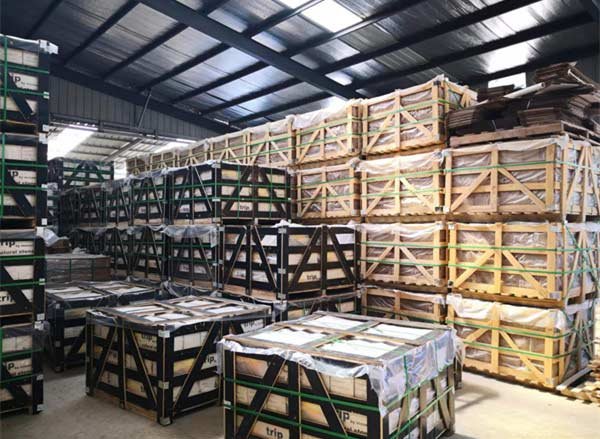
- Handling/packaging: cartons contain 7 pcs (0.63 m²) or 8 pcs (0.72 m²); rough panels 5 pcs/box (0.45 m²); plywood crate gross weight ~900–1000 kg—plan crane or forklift access for unloading.
- Logistics: set MOQ and trial order at 300 m² (mix & match allowed). Pallet options: 48 or 60 boxes; 20GP container capacity ~750–860 m² for standard panels (480–540 m² for rough panels).
- Commercial terms: in‑stock dispatch 10–15 days to port; production 20–25 days for a 20GP; payment T/T 30% deposit, 70% before shipment with pre‑shipment photo/video verification.
- On‑site layout: stage panels to minimize visible seams, install matching L‑corners first when wrap continuity matters, and choose dry‑stack or minimal grout to match the intended aesthetic.

How Full-Height Stone Impacts the Perceived Height of a Room
フルハイトの石は目を上に引き上げて再販の魅力を高めますが、垂直錯視を保護するために設計されたアンカー、下地の検証、およびパネル計画が必要です。
垂直方向の連続性: 床から天井までの石材を使用した視覚的高さの増加の計算
フルハイトの石は途切れることのない垂直面を作り出し、視線を上に引き寄せます。知覚される天井の高さと建築上の影響を最大化するために、主焦点壁に床から天井までの範囲を配置します。デザイナーは、リビングルームの焦点壁、暖炉、階段の踊り場にこのテクニックを使用しています。途切れることのない自然な質感が空間を固定し、居住者や購入者にとってさらなる高さとして認識されるからです。
Plan seams using standard panel lengths (150 × 600 mm or 150 × 550 mm). Fewer horizontal seams across the vertical span reduce visual breaks: for example, a 3.00 m (9’10”) ceiling accepts five 600 mm courses (600 × 5 = 3,000 mm) with no narrow top course; a 2.70 m (8’10”) ceiling delivers four full 600 mm courses and a 300 mm remainder, so cut a cropped top panel or specify a custom length to avoid a thin top band that compresses perceived height. Account for dead load when sizing anchors and backup: flat panels weigh ≈ 30–40 kg/m²; rough panels ≈ 55 kg/m²—verify substrate and fixings against those loads before you commit to floor-to-ceiling coverage.
- Use 150×600 mm or 150×550 mm modules as the basis for course counts and seam placement.
- Calculate courses: total wall height (mm) ÷ panel length (mm) → plan cropped or custom panel when remainder < one full course.
- Design anchors and backup for 30–55 kg/m² depending on panel profile; confirm substrate capacity before ordering.
Material and Texture Choices That Enhance Perceived Height
垂直方向の知覚を優先するように石と仕上げを選択します。珪岩とスレートは鮮明な線状のテクスチャを与え、垂直に整列した静脈とうまく機能します。また、スプリットフェイスまたはシームレス仕上げは影の深さを制御します。意図した視覚効果によってパネルの厚さを指定します。トップ ソース パネルは、スリムで洗練された平面の場合は 10 ~ 25 mm (1.0 ~ 2.5 cm)、より深いレリーフの場合は最大 35 mm (3.5 cm) です。厚いテクスチャは垂直方向の読み取りを妨げ、リフティング効果を減少させる可能性があるため、深いレリーフは控えめに使用してください。
視覚的に天井を持ち上げるために、より明るく、コントラストの低い色調または垂直縞模様のある石をターゲットにし、垂直方向の流れを壊す斑点状の色の変化を避けるために、設置全体で同じバッチの採石場の一貫性 (約 95% の色相均一性) を主張します。広い水平方向の帯よりも、狭い流れと垂直方向に並んだ関節を優先して、目が壁の上に途切れることのない垂直方向のリズムを追うようにします。
- 推奨される材料: 線状テクスチャの場合は珪岩、スレート。仕上げ: 自然な裂け目、分割面、シームレス。
- 厚さの目安: スリムプレーンの場合は 10 ~ 25 mm。より深いレリーフの場合は最大 35 mm - 主な垂直壁の重いレリーフを制限します。
- カラーコントロール: 床から天井までの施工には同一バッチの採石場調達 (~95% の色相均一性) が必要です。
- ジョイント戦略: 狭い垂直ジョイントまたは千鳥状の垂直コーシングを使用します。視軸を短くする広い水平帯を避けてください。
高さを強調する設置の詳細: 向き、連動、コーナー、照明
垂直のラインを強調するようにパネルとジョイントの向きを調整します。オスとメスの接続を備えた Z 字型または S 字型のインターロッキング パネルを指定して、継ぎ目をカモフラージュし、長い垂直方向の実行を通じて連続したテクスチャを維持します。移行部でのしっかりとしたフィットを実現するには、CNC ダイヤモンドブレードの高精度エッジと、それに合わせた事前に製造された L コーナーが必要です。これらの要素は、コーナーで目に見える中断を取り除き、きれいな垂直面を維持します。
Design mechanical and adhesive fixings for actual panel weight (30–55 kg/m²) and confirm substrate strength. Use anchors with a conservative safety factor (design anchors at 4:1; analyze stone stress with a 5:1 factor when sizing anchor layouts). Prefer solid backups such as concrete masonry for large, full-wall installations because they distribute anchor forces and increase stiffness; use finite element analysis for complex or differential-stiffness conditions. Integrate top-grazing or concealed ceiling-mounted LED strips to accent upward shadowing, and sequence on-site checks: verify same-batch delivery, dry-lay critical vertical runs, and align course terminations before final fixing to protect the vertical illusion.
- Interlock spec: Z-shape/S-shape male–female panels with CNC diamond-blade edges and matching L-corners.
- Anchor & backup: size anchors for 30–55 kg/m² loads; use 4:1 safety factor for anchors and consider 5:1 for stone stress analysis; prefer concrete/masonry backup for full-height runs.
- Lighting: specify concealed top-grazing LED strips to create upward shadowing and enhance perceived height.
- Site sequence checklist: confirm same-batch crates on arrival, dry-lay critical vertical courses, adjust panel cropping to avoid narrow top courses, then set final anchors and adhesive per engineered layout.
プレミアムスタックストーン - より速いインストール
Why Wainscot Fireplaces Are Perfect for Modern Farmhouse Budgets
Thin-panel 自然の積み石 with interlocking profiles reduces freight, cutting, and finishing costs while preserving authentic farmhouse aesthetics.
Choose stone type and panel specifications to match budget and authenticity
Pick stone by durability and installed cost: quartzite or slate give the best long-term performance and resist freeze-thaw and UV exposure, while sandstone delivers the textured farmhouse look at lower material cost. Insist on same-batch quarry consistency (トップソースストーン reports ~95% hue uniformity) to avoid visible color shifts across multiple fireplace runs.
Specify panel geometry and thickness to control labor. Use standard rectangles (150 x 600 mm or 150 x 550 mm) for dry-stack layouts, and choose Z- or S-shape interlocking panels when you need hidden vertical joints and reduced finishing labor. Standard thicknesses run 1.0–2.5 cm at roughly 30–40 kg/m²; rough or premium faces up to 3.5 cm weigh ~55 kg/m²—factor that into substrate design and freight calculations.
- Panel sizes: 150 x 600 mm (6″ ×24″) or 150 x 550 mm (6″ ×22″)。
- Thickness/weight: 1.0–2.5 cm ≈ 30–40 kg/m²; up to 3.5 cm ≈ 55 kg/m².
- Finish options: natural cleft/split-face for tactile depth; interlocking seamless finish to minimize visible joints and finishing labor.
- Order matching L-corners to avoid on-site mitering and color mismatches.
Calculate material quantities and logistics to control project cost
Convert measured wainscot face area into boxes using box coverage rules: standard cartons ship 7 pcs = 0.63 m² or 8 pcs = 0.72 m²; rough stacked boxes ship 5 pcs = 0.45 m². Measure the face area, add 7–10% waste for cuts and reveals, then divide by chosen box coverage to get box count; include matching L-corners and transition pieces in the total.
Plan pallets and containers to minimize per-unit freight: Option A pallets (48 boxes) cover ≈ 30.24 m²; Option B (60 boxes) ≈ 37.80 m². A 20GP container can load 25–30 pallets and deliver roughly 750–860 m² of standard panels. Watch weight limits—U.S. ports commonly limit to ~17.5 tons without special approvals—and align pallet planning to avoid weight penalties. Follow Top Source Stone commercial rules: trial/private-label MOQ = 300 m², in-stock dispatch 10–15 days, production 20–25 days for 20GP.
- Box coverage: 7 pcs = 0.63 m²; 8 pcs = 0.72 m²; rough boxes 5 pcs = 0.45 m².
- Pallet options: 48 boxes ≈ 30.24 m²; 60 boxes ≈ 37.80 m².
- 20GP capacity: ~25–30 pallets; max coverage ~750–860 m² (standard panels).
- MOQ & lead time: 300 m² trial/private-label; in-stock 10–15 days; production 20–25 days.
- Payment & verification: T/T 30% deposit, 70% before shipment; request pre-shipment photos/videos of finished crates.
Optimize installation methods to reduce labor and structural costs
Specify interlocking Z- or S-shape panels with CNC diamond-blade precision to hide vertical joints, speed alignment, and cut onsite finishing time. Use matching pre-fab L-corners to eliminate マイターカット and maintain continuous texture around wrap-around fireplaces; that reduces skilled labor hours and lowers touch-up costs.
Design substrate and fasteners for expected static loads: plan for 30–40 kg/m² with standard 1–2.5 cm panels and up to 55 kg/m² for rough/premium faces. Verify that backing, anchors, and adhesives match those loads and consult a structural engineer when spanning over 10 feet or when installing on upper floors. Favor dry-stack or thin-set methods with thinner panels to avoid major structural reinforcement and keep installation hours down. Bundle same-batch quarry material and Project-Ready Full Solution components to reduce site rework and guarantee color and texture continuity across multiple fireplaces.
- Use interlocking Z/S profiles and CNC-cut edges to hide joints and speed field fit-up.
- Install pre-fab L-corners to remove mitering and save labor on wrap details.
- Design for loads: 30–40 kg/m² (standard); up to 55 kg/m² (rough). Verify anchors, adhesives, and backup system accordingly.
- Prefer dry-stack or thin-set with 1–2.5 cm panels to avoid structural reinforcement and reduce labor hours.
- Order same-batch stone and Project-Ready components to avoid onsite color mismatch and rework.

Cost Analysis: Material and Labor Delta for Partial vs. Full Walls
Quantify material, logistics and labor deltas early to lock pricing, set MOQ-driven procurement, and identify the break-even between partial and full-wall builds.
Define scope, measurement basis and technical assumptions
Measure and record every surface precisely in m², and treat partial-wall elements (height × width) separately from continuous full-wall runs. List all openings, returns and reveals as separate line items so takeoff and waste calculations capture perimeter trimming and corner losses rather than averaging them into a single area figure.
Specify panel format and thickness up front: use 150 × 600 mm (6″ ×24″)または150×550mm(6″ ×22″) panels, standard thickness class 1.0–2.5 cm, and up to 3.5 cm for rough/premium profiles. Record substrate type and verify allowable dead load against panel mass (flat panels ≈ 30–40 kg/m²; rough panels ≈ 55 kg/m²). Define finish and edge conditions (straight-edge rectangle, Z/S interlock, matching L-corners) and lock project constraints: same-batch quarry consistency, freeze-thaw and high-salinity exposure, delivery window and MOQ (300 m²).
- Measurement basis: net m² for field coverage; list partial extents and all openings separately.
- Panel specs: 150×600 or 150×550 mm; thickness 1–2.5 cm standard; up to 3.5 cm for rough.
- Structural check: use panel weight ~30–55 kg/m² to confirm dead-load limits and anchor strategy.
- Project constraints: same-batch sourcing, exposure class, delivery window, MOQ 300 m².
Material takeoff, packing and logistics calculus
Convert net m² into cartons using box coverage: 0.63 m² (7 pcs/box) or 0.72 m² (8 pcs/box). Calculate boxes required = ceil(required_m² ÷ box_coverage) and then translate boxes to pallets using pallet configurations (48 boxes ≈ 30.24 m² standard; 60 boxes ≈ 37.80 m² standard). Plan container loads based on 20GP capacity of roughly 750–860 m² for standard panels, and adjust if you specify rough panels (lower coverage per container).
Add cutting/waste allowance explicitly by elevation: baseline full walls 5–10% waste; cut-intensive partial walls use 8–15% and document the rationale. Allocate freight and handling per m² using gross pallet weight (~900–1,000 kg) and destination 重量制限 (USA port standard 17.5 tons); divide total freight by loaded m² to get freight/m². Apply HS codes (Slate 6803.00.90; Quartzite 6802.93.11) for duties and include crate type (fumigation-free plywood or solid wood) in landed-cost. Use the checklist below to capture conversions and costs.
- Cartons = ceil(required_m² ÷ 0.63 or 0.72).
- Pallets = ceil(cartons ÷ pallet_box_count); pallet options: 48 or 60 boxes.
- Container capacity (20GP) ≈ 750–860 m² standard; adjust for rough panels.
- Freight allocation = (total freight for container ÷ loaded m²) + handling surcharge; use pallet gross weight ~900–1,000 kg for port calculations.
- Import cost line: product_cost + freight_alloc + duties (use HS code) + crate surcharge (plywood/fumigation-free wood).
Labor estimation framework and productivity tracking
Break labor into discrete tasks and estimate hours per m² for each: substrate preparation, scaffold/MEWP erection, layout and dry-fit, adhesive/mortar application, panel placement, corner/trim fitting, pointing/grout and cleanup. Capture crew mix and tools explicitly—installers, foreman, scaffolders and mechanical lifters—and plan mechanical lifting whenever panels or assemblies exceed ~30 kg/m² or when handling rough 55 kg/m² panels.
Use a time-allocation model where installer-hours = Σ(task_time_per_m² × area). Apply different task_time multipliers for full walls (continuous vertical runs, fewer edge cuts) versus partial walls (edge trimming, custom cuts). Run a one-day mock install to measure actual m²/crew and update rates. Apply risk multipliers to the model: working at height +10–25% labor; extensive edge work on partial walls +15–40% per linear metre of exposed perimeter. Track realized hours per task at closeout to improve future bids.
- Typical tasks: substrate prep, scaffold, layout, adhesive, placement, trim, pointing, cleanup.
- Crew: installers, foreman, scaffolders, lifters; require mechanical lifting >30 kg/m² panels.
- Model: installer-hours = Σ(task_time_per_m² × area) with multipliers for partial vs full walls.
- Calibration: run a mock day; update m²/hour and task times; save actual hours per task at closeout.
Installation method selection and its direct cost impacts
選ぶ panel systems to control on-site labor and waste. Rectangle panels require more trimming and produce visible vertical joints, which increases alignment and pointing time. Z/S interlocking panels use a male-female fit that reduces vertical joint finishing and substrate exposure, cutting alignment and pointing labor. Specify matching L-corners to eliminate mitre cutting at returns and reduce waste and finishing time on corners.
Account for thickness and weight: thicker or rough panels increase adhesive/mortar consumption, require heavier anchors or mechanical fixings, and raise handling labor. Leverage CNC diamond-blade precision for pre-cut interlocks and L-corners; expect meaningful reductions in on-site cutting labor and scrap—typical improvements range from 15–35% lower cutting time and 10–20% less scrap depending on project complexity. Balance any incremental material premium for interlocking or pre-fabricated corners against the measurable labor savings and waste reduction to choose the most cost-effective panel type for your crew productivity profile.
- Rectangle: more trimming, visible vertical joints, higher pointing time.
- Z/S interlock: reduces alignment and finishing time; hides substrate exposure.
- L-corners: reduce mitre labor and on-site coping; improves color/texture match at returns.
- CNC edges: cut on-site adjustment time ~15–35% and lower scrap ~10–20% (project dependent).
Cost model, sensitivity analysis and verification checkpoints
Use a transparent base formula and populate it with supplier and logistics data: total_project_cost = material_cost + freight + import_duties + domestic_handling + labor_cost + access_equipment + contingency (recommend 5–15%). Compute material_cost from supplier unit price/m², cartons required, pallet and load costs, and freight allocation per m² using pallet weights and container loading factors.
Run sensitivity scenarios to expose breakeven thresholds: vary material price ±10–20%, labor rate ±15–30%, and waste bands for partial (8–15%) versus full walls (5–10%). Implement verification checkpoints: pre-shipment visual verification (photos/videos), on-site mockup panel, and a QA checklist for joint alignment, flatness, and color uniformity (target 95% hue uniformity within a batch). At closeout capture as-built quantities and actual labor hours per task and compute the realized cost delta between partial and full-wall scenarios for lessons learned and future bids.
- Base formula: total_project_cost = material + freight + duties + handling + labor + access + contingency (5–15%).
- Populate material_cost: supplier $/m² × required_m² + pallets/carton overhead + freight_alloc/m².
- Sensitivity: material ±10–20%, labor ±15–30%, waste bands per wall-type to find breakeven.
- Verification: pre-shipment photos/video, on-site mockup, QA checklist (alignment, flatness, 95% hue uniformity, anchor/load checks).
- Closeout: record as-built quantities, actual labor hours by task, and compute realized cost delta for future estimates.

Structural Considerations for Supporting Massive Stone Walls
Massive 石の壁 change structural demands; get the loads, anchors and moisture path right up front to protect schedule, margin and long-term performance.
Load Analysis and Support Capacity
まずは正確な死荷重数値から始めます。標準的な平積み石パネルの重量は約 30 ~ 40 kg/m² (8 ~ 12 lb/ft²) ですが、ラフ/プレミアム パネルは 55 kg/m² に近づきます。総壁荷重をパネル死荷重 × 壁面積として計算し、アンカー、グラウト、仕上げの許容値を追加します。非地震地域では最小安全係数 1.5 を適用し、耐震設計が適用される地域では 2.0 を適用します。アンカーがシステムを制御する場合は、約 4:1 のアンカー安全率に設計し、長くて細い石、または混合剛性の石について有限要素チェックを実行します。
- 可能な限り、分散荷重を支える下地 (コンクリートまたは鉄筋石造) を使用してください。
- Upgrade framed walls: provide engineered backing or continuous plywood/OSB sheathing sized for veneer loads when attaching to timber studs.
- Do not rely on adhesive-only systems for floor-to-ceiling walls or long uninterrupted spans—plan a vertical load transfer to primary structure (steel angle ledger or reinforced concrete shelf).
- Engage a structural engineer for any wall using >10 m² of rough panels, cantilevered sections, or when you alter the building’s lateral-resisting elements.
Attachment Methods, Fasteners and Anchor Layout
Specify mechanical anchors designed for heavy veneer and local corrosion risk: use AISI 316 stainless steel for coastal or Gulf projects and hot-dipped galvanized steel for lower-corrosion sites. Place anchors to create a continuous load path from veneer into the backup, and reduce spacing where panels are rough-textured or thicker than 3.0 cm (Top Source Stone rough panels go up to ~3.5 cm).
- Typical spacing: vertical ≤300 mm (12 in), horizontal ≤600 mm (24 in); tighten spacing for rough panels or large pieces.
- Minimum embedment: 50 mm into concrete or full-thickness penetration with nut and washer into steel framing; use only manufacturer-approved epoxy anchors in hollow substrates.
- Combine adhesion with mechanical retention on interior floor-to-ceiling walls: use a polymer-modified thinset or cementitious adhesive compatible with 天然石, and install through-mechanical anchors at the specified spacing.
- For interlocking Z- or S-shape panels, use the male–female fit to reduce shear demand on anchors but still locate anchors at panel edges and corners; always specify matching L-corners to preserve the load path at wall transitions.
Movement, Moisture Management and Detailing
Control moisture and movement before you set stone. Provide a drainage/ventilation cavity—10–20 mm air gap—with flashing and weep holes at the base to remove water. Place movement joints where the system meets different substrates and at regular intervals: vertical joints every 3–4 m and horizontal joints at floor lines or each story; size joint width per manufacturer and anticipated movement and back them with a bonded backer rod and flexible sealant to accommodate thermal and hygric expansion.
- Terminate water with stainless-steel drip edges, sill pans and through-flashing at windows, floor junctions and changes in plane.
- Specify cement backer board or reinforced masonry as preferred substrates where humidity and stone weight are concerns; add a vapor barrier if local code or room use requires it.
- Allow perimeter clearance to accommodate thermal movement and seal control joints with a neutral-cure, stone-compatible elastomeric sealant.
- For complex or long spans, verify detailing with FEA or shop drawings that show flashing, cavity air path, anchor locations and joint sizes before fabrication and shipment.
Why a Full-Wall Stone Fireplace Recovers 90% of its Cost on Resale
When specified and engineered to ASTM durability and correct structural loads, floor-to-ceiling 天然石 functions as a value anchor that preserves roughly 90% of installed cost.
Material performance metrics that sustain long-term value
Choose quartzite or slate for locations that face freeze‑thaw cycles or abrasive exposure; these materials show superior hardness and abrasion resistance compared with softer sandstones. Specify stone that meets ASTM freeze‑thaw resistance tests, and require inherent UV stability plus high salinity/humidity resistance for Gulf or coastal climates to avoid long‑term degradation and visible failure. For consistent large‑wall appearance, source from the same quarry vein and insist on same‑batch quarry consistency to keep hue uniformity above 95% across the install area.
- Panel sizes: 150 x 600 mm (6″ ×24″) or 150 x 550 mm (6″ ×22″) — specify module early in drawings.
- Thickness: 10–25 mm standard; up to 35 mm for premium rough pieces; select thickness by structural capacity and desired depth.
- Weight: ~30–40 kg/m² for flat panels (~8–12 lb/ft²); ~55 kg/m² for rough stacked assemblies — use these numbers in structural load calculations.
Design specifications that maximize buyer appeal and appraisal value
A floor‑to‑ceiling full‑wall stone fireplace creates a clear architectural focal point that buyers value and appraisers recognize when comparing similar listings. Control vertical visual seams by specifying interlocking Z‑Shape or S‑Shape panels and matching pre‑fabricated L‑corners; the male‑female interlock camouflages joints and preserves a continuous, high‑end appearance without extra on‑site shaping. Define coursing with 6″ ×24″ or 6″ ×22″ modules and choose surface texture (natural cleft, split‑face or seamless finish) that aligns with the target market’s aesthetic.
- Specify interlocking series and pre‑matched L‑corners on contract drawings to avoid site substitutions.
- Pick from the Big 10 palette (for example: Alaska Gray, Carbon Black, Golden Honey) to match regional buyer expectations and accelerate approval in design reviews.
Installation and lifecycle practices that protect resale recovery
Treat the fireplace as a structural element during bidding: calculate the surface dead load using 30–55 kg/m² ranges and confirm substrate or backup framing reinforcement before placing orders. Use CNC diamond‑blade precision edges and male‑female interlock systems to reduce field cutting, minimize visible steps between panels, and limit rework. Protect long‑term value by enforcing manufacturer MOQ and lead times, requesting pre‑shipment visual verification (high‑definition photos/videos), and specifying plywood or fumigation‑free crates to prevent crate damage in transit.
- Require certified installers and document installer credentials in the contract; retain installation photos for appraisers and buyers.
- Specify non‑combustible backer board and approved high‑temperature adhesives/mortars for fireplace surrounds; call out clear clearance and manufacturer installation methods in the submittals.
- Document same‑batch sourcing and obtain pre‑shipment verification from the supplier before releasing final payment; include crate specs and pallet loading details on the PO.
結論
適切な取り付け and wiring ensure occupant safety, meet regulatory requirements (including OSHA guidelines for workplace installs), and protect the stone assembly and mechanical systems from premature failure. Following engineered mounting, correct substrate preparation, and specified fasteners reduces repair needs and preserves finish longevity. That technical attention also minimizes liability and supports predictable resale value.
Review your current installation standards and on-site setup, or contact us for a certified lighting catalog/sample. Our technical sales team can advise on specification details, weight and load calculations, and lead-time options for トップソースストーンパネル to keep your projects on budget and on schedule.
よくある質問
How high should stacked stone go on a fireplace wall for best ROI?
For best ROI, extend stacked stone to the ceiling when the fireplace is a primary focal wall or in open‑concept spaces—floor‑to‑ceiling installations create immediate visual impact and a strong design anchor preferred by designers. In smaller or secondary rooms, stopping at the mantel or creating a balanced partial surround can be cost‑effective and appropriate. 天然石 increases material and labor costs; faux stone panels are a lighter, lower‑cost alternative that still read as full‑height without structural work.
Is a full-wall stone fireplace too heavy for a standard floor?
Natural full‑wall stone can be heavy and may require structural evaluation or reinforcement; designers note that genuine stone offers unmatched depth but adds load. If structural capacity or budget is a concern, lightweight faux 石台帳パネル replicate the look without requiring structural reinforcement and lower installation complexity.
How much more does a floor-to-ceiling stone wall cost?
A floor‑to‑ceiling stone wall generally carries a clear cost premium over a partial surround because of additional material, labor, and potential access/scaffolding needs. The premium varies by material (quartzite, slate, sandstone, or 自然の積み石) and finish; faux panels are a cost‑conscious alternative that reduce both material and labor expense while keeping the visual impact.
Does a partial stone fireplace look “unfinished”?
A partial stone fireplace does not have to look “unfinished” if the termination is intentional and well‑balanced with complementary materials. Designers pair partial stone with wood trim, crisp white walls, and minimalist furnishings to create a cohesive look; however, in larger or open spaces a full‑height installation is often preferred to avoid a truncated appearance.
Best layout for a small living room fireplace?
小さなリビングルームの場合、規模が重要です。控えめな石のエリア(積み重ねられた台帳のアクセントやフレームの周囲など)を使用し、スペースを圧迫しないように、ミニマルな家具、さわやかな白い壁、または温かみのある木のアクセントと組み合わせます。床から天井までの石材は、慎重に比率を調整すれば機能しますが、人工パネルを使用すると、重量とコストを抑えて視覚的な質感を得ることができます。