Het vinden van een Chinese fabrikant van gestapelde stenen die zijn eigen steengroeve en fabriek bezit, is het eerste echte filter voor importeurs. Te veel leveranciersprofielen beweren ‘fabrieksdirect’’ maar besteed het snijden stilletjes uit aan werkplaatsen van derden, waarbij u overgebleven steen uit verschillende bronnen mengt. Het resultaat? Kleurmismatch tussen pallets dat vernietigt uw marge wanneer klanten de installatie afwijzen.
Het verschil tussen een handelsbedrijf en een echte fabrikant blijkt uit de cijfers. Een fabriek die 220 containers per jaar naar meer dan twintig landen exporteert, voert drie afzonderlijke kwaliteitscontroles uit: sortering van ruwe steen, post-infrarood snij-inspectie en een eindcontrole vóór het verpakken. In die derde fase worden gebreken opgespoord die goedkope leveranciers over het hoofd zien. Gecombineerd met infraroodsnijden dat houdt ±1 mm nauwkeurigheidelimineert u het handmatig slijpen van de randen, waardoor lijmuitbloedingen en installatiegaten ontstaan.
Risico's van fabriek versus handelsbedrijf
Door directe inkoop in de fabriek wordt de hoofdoorzaak van kleurmismatch en maatafwijking geëlimineerd: batchmenging uit meerdere steengroeven en handmatig kantenslijpen.
Waarom steengroevebezit het kleurrisico elimineert
Handelsbedrijven kopen overgebleven steen uit meerdere steengroeven en mengen deze vervolgens in één bestelling. Het resultaat? Kleurvariatie van pallet tot pallet waardoor uw installateur de stukken ter plekke moet uitkiezen, waardoor 10-15% van het materiaal wordt verspild. Een fabriek met een eigen steengroeve, zoals de kwartsietbron die wordt gebruikt voor onze Rustic Gold Rush-panelen, put uit één enkele naad. Elke plaat in een bestelling van 6 x 24 inch grootboekpanelen komt uit dezelfde geochemische laag, waardoor batch-uniformiteit over 24 panelen per krat wordt gegarandeerd. Geen jacht op bijpassende stukken, geen retourzendingen.
Infraroodsnijden versus handmatig kantenslijpen
De meeste handelsbedrijven besteden het snijden uit aan kleine werkplaatsen die afhankelijk zijn van handmatig slijpen. Handmatig slijpen laat ongelijkmatige randen achter, creëert microscheurtjes en dwingt een secundaire lijmtoepassing af om gaten op te vullen. Die lijm bloedt op het stenen oppervlak en verpest de textuur van het gespleten oppervlak. Installateurs moeten dan elk paneel schrapen, of de helft van de krat afkeuren.
Infraroodsnijden levert een maatnauwkeurigheid van ±1 mm over gehele productieruns. We snijden in één keer de exacte afmetingen van 6×24 inch of 60×15 cm. Geen lijm nodig, geen randuitloop en geen naslijpen. Elk paneel past zonder opvulstukken of bijsnijdingen ter plaatse.
De driestaps-QC die uw claimpercentage verlaagt
De “QC” van een handelsbedrijf is meestal een snelle visuele inspectie in het magazijn. De kwaliteitscontrole van een fabrikant is ingebed in de productielijn. Ons driestapsprotocol verwijdert 99% van de defecten voordat ze een krat bereiken:
- Sortering van ruwe steen: Verwijder nerven, scheuren en inconsistente kleurbanden op het steengroeveterrein voordat u met het maaien begint.
- Inspectie na het snijden: Controleer elk paneel op maatnauwkeurigheid, oppervlakteafwerking en lijmresten. Elk paneel buiten ±1 mm wordt gesloopt.
- Eindcontrole voorverpakken: Controleer de kleuruniformiteit over de gehele batch. Een klant in Duitsland rapporteerde onlangs een claimpercentage van 0,3% op een jaarlijks volume van 220 containers – een direct gevolg van dit protocol.
Vergelijk dat eens met de industrienorm: nieuwe importeurs die bij handelsbedrijven kopen, zien een claimpercentage van 5 tot 8% als gevolg van kleurmismatch, afgebroken randen en dimensionale afwijkingen. Elke claim tast de marge aan en het duurt weken om deze op te lossen.
Verpakking: het verschil tussen 0,5% en 5% breuk
Handelsbedrijven verzenden steen vaak in standaard kartonnen dozen of los verpakte pallets met minimale omsnoering. Tijdens het transport van containers verschuiven, wrijven en barsten de panelen. De gemiddelde breukgraad in de sector voor gestapelde steenzendingen zonder krat is 3-5%.
Versterkte multiplexkratten met interne draadomsnoering verminderen de beweging tot minder dan 2 mm tijdens zeevracht. Uit onze interne gegevens blijkt dat het breukpercentage consistent onder de 0,5% ligt voor 220 containers die jaarlijks naar meer dan 20 landen worden verzonden. Voor een 20ft container met daarin 150 vierkante meter gestapelde stenen grootboekpanelen betekent dit dat je minder dan één paneel verliest in plaats van vijf tot zeven. Bij een FOB-bestelling van $ 15.000 is dat $ 75 aan schade in plaats van $ 750, waardoor uw landkosten per vierkante meter direct worden beschermd.
OEM-aanpassing: verpakking & Maatvoering
Aangepaste verpakkingsspecificaties geleverd binnen 3 dagen. Runs met een laag volume worden geaccepteerd. Geen MOQ-barrières voor importeurs die unieke SKU's bouwen.
Aangepaste doosbranding en private label-inzetstukken
Uw merk is wat u onderscheidt van de volgende groothandelaar in de partij. Veel fabrieken stoppen je steen in een gewone kist en noemen het daarmee klaar. Die aanpak doodt uw opslagpotentieel voor de detailhandel. De interne standaard hier is het leveren van op maat bedrukte dozen met uw logo, product-SKU en installatie-QR-codes, niet alleen een generieke bruine doos. We leveren ook private label-bijlagen (onderhoudsbladen, garantiekaarten, kleurmatchcertificaten) voor elk paneel. Dit is geen premium add-on die één keer per kwartaal wordt aangevraagd; het is de basislijn voor elke OEM-leverancier van gestapelde stenen voor Amerikaanse importeurs die vanaf dag één een kant-en-klaar product nodig hebben.
Op maat gemaakte paneelafmetingen: 60×15 cm, 55×15 cm, 6×24 inch
Gestandaardiseerde afmetingen klinken handig, maar komen zelden overeen met de bestaande omlijsting of regionale verwachtingen van uw klant. Een formaat van 60×15 cm past perfect bij Europese gevelmodules, terwijl 55×15 cm gebruikelijk is voor dunnere richeltoepassingen. 6×24 inch is de Noord-Amerikaanse standaard die aannemers verwachten voor open haarden. We zagen tot ±1 mm met behulp van infraroodzagen, geen handmatige slijpmachines. Dat betekent dat uw installateur geen tijd verspilt met het opvullen of op maat snijden, en dat uw particuliere klant geen lijm ziet uitlopen bij ongelijke randen. Als je 36×10 cm nodig hebt voor een specifieke narrow-stack-look, is dat een standaard productieoptie, geen maatwerk dat extra kost.
Snelle monsterdoorlooptijd: 3 dagen voor meer dan 18 jaar productie-ervaring
Snelheid is van belang bij het sluiten van de bestelling van een aannemer. Een monster dat drie weken nodig heeft om vanuit China te worden verzonden, maakt de deal kapot. Met meer dan 18 jaar ervaring in het verwerken van kwartsiet, marmer en leisteen in dezelfde fabriek, houden we voorgesneden stukken materiaal uit actieve steengroeveblokken klaar voor gebruik. Wanneer u een aangepaste kleur of afwerking aanvraagt, wordt de productie uit die batch gehaald, gesneden, verpakt en binnen 3 werkdagen verzonden. Dit is geen belofte om er goed uit te zien op een landingspagina; het wordt vastgelegd in de voorbeeldverzendingsrecords voor 220 containers per jaar. Voor een beginnende importeur elimineert deze ommekeer de onzekerheid die uw downstream-betrouwbaarheid ondermijnt.
Kostenbesparingen voor distributeurs: unieke SKU's voor Amerikaanse/EU-markten
De standaard MOQ voor een uniek OEM-formaat is laag: 1 vierkante meter voor voorraadreferenties, volledige container voor aangepaste kleuren. Die flexibiliteit is zeldzaam bij het MOQ 1-containerbeleid van de Chinese steenfabrikant. Wat betekent dat voor uw marge? Als u onder uw eigen merk een 20ft container van 6×24 in splitface panelen bestelt, dalen uw kosten per eenheid ongeveer 25% vergeleken met LCL (less-than-container load). Ook vermijdt u de verborgen kosten van meerdere zendingen. Wat nog belangrijker is, u bent eigenaar van de SKU. Geen enkele andere distributeur in uw regio verkoopt dezelfde doos. Dankzij die exclusiviteit kunt u een hogere prijs hanteren zonder dat u wordt ondermijnd door een concurrent die hetzelfde merkloze product op Amazon aanbiedt. De versterkte kratten met interne draadband zorgen ervoor dat de breuk tijdens het transport onder de 0,5% blijft, zodat het vulpercentage van uw containers hoog blijft en uw claimpercentage laag, waardoor uw herhaalbestellingenpercentage direct wordt beschermd.
Logistiek & Veilige verpakking
Transportschade is een verborgen margemoordenaar. Versterkte kratten verlagen het breukpercentage tot minder dan 0,5%, waardoor claims direct worden verminderd en de landkosten worden beschermd.
1. Verpakkingsmethoden: houten kratten, multiplexkratten en palletversterking
Het verschil tussen een betrouwbare verzending en een container die veel claims in beslag neemt, komt vaak neer op de manier waarop de steen wordt vastgezet voordat deze de fabrieksvloer verlaat. Voor een groothandel in gestapelde stenen in China gaat het bij verpakken niet alleen om het verpakken van producten; het gaat ook om het ontwerpen van de lading die bestand is tegen zeevracht, vorkheftruckbehandeling en havenopslag.
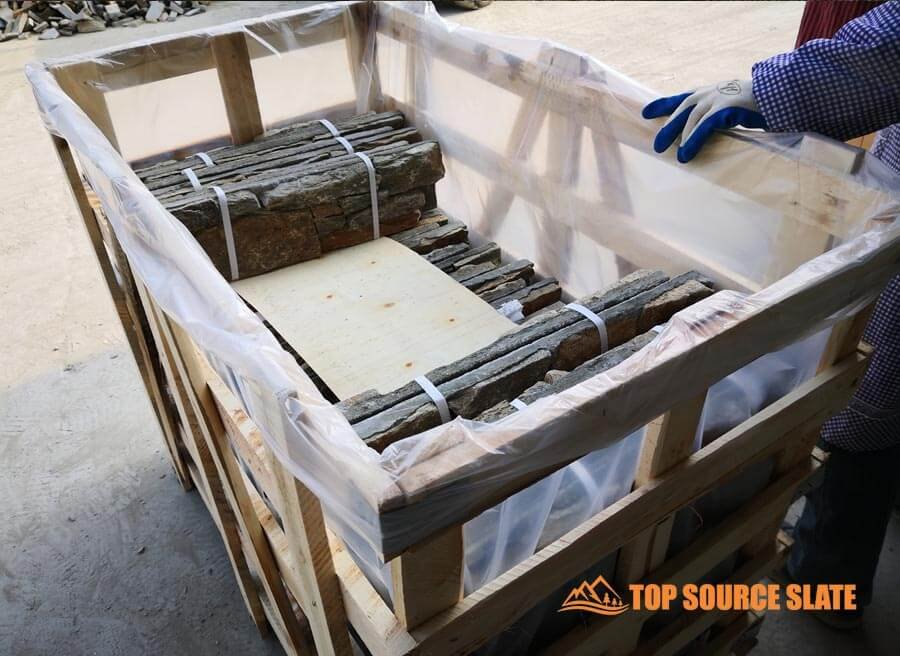
Standaardverpakkingen bij Top Source Slate gebruiken een gelaagde aanpak, afhankelijk van de steendichtheid. Kwartsiet grootboekpanelen, die zwaarder zijn, worden verzonden in versterkte houten kisten met interne versteviging. Leisteen- en marmerpanelen worden verpakt in multiplexkratten. Elke pallet is omsnoerd met interne draadversterking en voorzien van airbags om zijdelings verschuiven tijdens het transport te voorkomen.
Het sectorgemiddelde voor breuk in ongekraste of slecht verpakte natuursteenzendingen ligt tussen de 3% en 5%. Interne productiegegevens, gebaseerd op de verzending van 220 containers per jaar naar meer dan twintig landen, laten dat zien versterkte kratten met interne draadomsnoering vermindert het aantal containerbewegingen tot minder dan 0,5%.
2. Ervaring: 220+ containers per jaar
Volume creëert gegevens. Door meer dan 220 containers per jaar te verzenden, beschikt het logistieke team over echte cijfers om de laadconfiguraties van containers, de gewichtsverdeling en de palletafmetingen te optimaliseren. Het resultaat is een consistent hoog vulpercentage van containers en minder verrassingen aan de haven.
Veel handelsbedrijven die gestapelde stenen grootboekpanelen naar de groothandel in China verzenden, verzenden slechts een handvol containers per jaar en leren het verpakken op de harde manier: door gebroken materiaal op hun dollar te vervangen. Een fabriek die volume verwerkt, heeft deze fouten al achter zich gelaten. Verzekeraars erkennen dit trackrecord ook, wat zich vertaalt in gunstiger vrachtverzekeringspremies voor de koper en lagere havengelden als gevolg van overgewicht of onevenwichtige containervlaggen.
3. Doorlooptijd: 18-25 dagen vanaf bestelling tot vulling van de container
De voorspelbaarheid van de doorlooptijd heeft een directe invloed op de voorraadkosten. De standaard productieperiode vanaf de orderbevestiging tot het vullen van de container bedraagt 18 tot 25 dagen.
In tegenstelling tot handelaars die afgewerkte voorraad aanhouden, kan a fabrikant van natuursteenfineer in China produceert op bestelling. De doorlooptijd van 18 tot 25 dagen omvat de selectie van ruwe stenen, infraroodsnijden, oppervlakteafwerking, kwaliteitscontrole en verpakking. In dit venster kunnen importeurs stroomafwaartse leveringsschema's voor de detailhandel of projecten plannen zonder kapitaal vast te leggen in onnodige opslag.
4. Foto's vóór verzending voor vertrouwen van de koper
Eén enkele foto voor vertrek kan wekenlang onenigheid bij aankomst voorkomen. Fotosets vóór verzending zijn standaard voor elke container die de fabriek in Hebei verlaat. De set documenteert de geladen container, verzegelde kratlabels, batchnummers en het uiterlijk van het oppervlak van de toplaagpanelen.
Voor de importeur bieden deze foto's drie dingen: verifieerbaar kwaliteitscontrolebewijs vóór betaling, documentatie voor douane-inklaring en een basisregistratie voor eventuele verzekeringsclaims. Het is een stap die weinig moeite kost en elimineert “hij-zei-zij-zei” dynamiek die relaties met nieuwe kopers vaak ondermijnt. Als OEM-leverancier van gestapelde stenen voor Amerikaanse importeurs nemen we de plaatsing van merklabels op in de fotorecords om te bevestigen dat de verpakking voldoet.

Kwaliteitscontrole die de marges beschermt
Een afwijking van 2 mm in de afmetingen of een pallet met gemengde kleuren kan het vertrouwen van uw installateur en uw marge binnen 10 minuten na installatie vernietigen.
De drie defecten die uw winst verbranden
Wanneer je een container met gestapelde stenen opent, veranderen drie specifieke defecten een winstgevende bestelling in een claimnachtmerrie. De meest voorkomende is dat lijmresten over het gespleten vlak uitlopen. Handmatig kantenslijpen, dat nog steeds door veel kleine fabrieken wordt gebruikt, duwt lijm in de natuurlijke scheuren van de steen. Eenmaal uitgehard, is dat residu onmogelijk te verwijderen zonder de textuur te beschadigen. Uw installateur accepteert het esthetische verlies of besteedt extra arbeid aan het schrapen van elk paneel; arbeid waarvoor u betaalt.
Maatafwijking groter dan 2 mm is de tweede margemoordenaar. Panelen die in lengte of hoogte variëren, dwingen uw team om elke verbinding aan te passen, waardoor de installatietijd bij een gemiddeld project met 30-40% toeneemt. Het derde defect is een ongelijkmatige kleur tussen pallets. Dit gebeurt wanneer handelsbedrijven overgebleven steen uit verschillende steengroeveblokken mengen. De ene pallet oogt warmgrijs, de andere heeft een koude blauwe tint. Aan de muur is die mismatch onmiddellijk en duidelijk zichtbaar. Uw particuliere klant wijst de zending af en u bent eigenaar van de retourvracht.
Infraroodsnijden: over de ±1 mm-norm kan niet worden onderhandeld
Infrarood snijden is geen premiumoptie op deze markt; het is de minimumstandaard voor het beschermen van uw installatiemarge. De snijlijn van Top Source Slate heeft een maattolerantie van ± 1 mm over elke 6×Grootboekpaneel van kwartsiet, marmer en leisteen van 24 inch. Dit elimineert de gaten die handmatig opvulstukken of kitvulling ter plaatse vereisen. Het elimineert ook de noodzaak van het slijpen van de randen, waardoor het hierboven beschreven probleem met het uitlekken van lijm direct wordt voorkomen. Als een leverancier ±1 mm niet schriftelijk kan garanderen, geldt voor elk paneel dat u importeert een verborgen arbeidsboete.
Dubbele inspectie en een afwijzingspercentage van 99% vóór verpakking
Een kwaliteitscontrole in 3 stappen is het verschil tussen een betrouwbare verzending en een mix van verkoopbare en onverkoopbare steen. De volgorde is: het sorteren van ruwe steen in de steengroeve om de consistentie van één blok te garanderen, inspectie na het snijden voor maatnauwkeurigheid en een laatste controle vóór het verpakken. Die laatste stap verwijdert 99% van de defecten – afwijkende kleuren, afgebroken randen en panelen met zichtbare lijmvervuiling – voordat ze de krat bereiken. Voor een groothandel gestapelde steenfabrikant China Net zoals Top Source Slate jaarlijks 220 containers naar meer dan 20 landen exporteert, vangt dit systeem grofweg 2% van de productie op als intern afval. Die 2% wordt nooit verzonden. Het wordt op de fabrieksvloer weggegooid of opnieuw verwerkt en niet aan u doorgegeven.
CE- en ASTM-certificeringen: Inklaringsverzekering
Ontbrekende certificeringsdocumentatie is een directe route naar havenvertragingen en opslagkosten. CE-markering is verplicht voor elk natuursteenproduct dat op de Europese markt komt onder de Bouwproductenverordening (CPR). ASTM C1670 en C1671 zijn de relevante normen voor dimensionaal fineersteen op de Amerikaanse markt. Een fabrikant die beide in zijn bezit heeft, kan bij elke zending een conformiteitscertificaat overleggen. Zonder dit kunnen de douaneautoriteiten de container vasthouden voor testen door derden, wat 10 tot 14 dagen en $500-$1.500 aan kosten met zich meebrengt; kosten die uw marge op de landkosten direct verlagen. Top Source Slate behoudt standaard de CE- en ASTM-certificering op alle gestapelde stenen grootboekpanelen en gespleten wandtegels, en is geen aanvullende service.
Regionale trends: voorraad wat verkoopt
Als u de verkeerde regionale kleuren op voorraad heeft, wordt uw container in een magazijn vergrendeld. Ken de specificaties die daadwerkelijk bewegen.
Noord-Amerika: vries-dooibestendig en doe-het-zelfvriendelijke panelen
Elke importeur die naar Canada of het noorden van de VS verzendt, moet de vries-dooiprestaties verifiëren. Natuurlijk kwartsiet met een waterabsorptie van minder dan 0,5% voldoet betrouwbaar aan de ASTM C1670-cycli – leisteen en marmer kunnen variëren. Onze eigen steengroeve test elk blok op interne breuken voordat het wordt gesneden. Infraroodsnijden met een tolerantie van ±1 mm elimineert zwakke randen die afbreken tijdens vriescycli. Diezelfde precisie maakt panelen doe-het-zelfvriendelijk: installateurs hoeven geen opvulstukken of trimmen te doen, en voorgelijmde 6×24 inch grootboekpanelen met Z-clip-systemen vervangen het mortelbedwerk. Rustieke Gold Rush-kwartsietpanelen bewegen het snelst in deze regio omdat de warme bruingouden tinten passen bij zowel de moderne boerderij- als de rustieke lodge-esthetiek. Het opslaan van een volle container van 20 voet met Rustic Gold Rush 6×24 panelen zal sneller opruimen dan welke eclectische mix dan ook.
Europa: CE-conforme Mini Ledgestone
Europese kopers eisen CE-markering onder EN 1469 voor dimensionele steenbekleding. Dat vereist gedocumenteerde mechanische sterkte, slipweerstand en classificatie op basis van brandgedrag. We zijn CE-gecertificeerd voor onze kwartsiet- en leisteenpanelen; niet elke Chinese fabriek heeft dat. De markt wil mini-ledgestone-formaten (doorgaans 55×15 cm of 60×15 cm) voor stedelijke renovaties waarbij dun fineer in strakke raamkozijnen en smalle muren moet passen. Fast mover hier is een grijsgetinte splitface met een compacte, consistente hoogte. Het mengen van bronnen uit steengroeven zorgt voor een kleurafwijking van 3 tot 5% over de pallets, wat Europese inspecteurs signaleren. Door in te kopen in één steengroeve (onze standaard) wordt dat risico geëlimineerd. Begin bij een eerste Europese bestelling met Alaska grijs in mini-ledgestone – het loopt gestaag door Duitse, Franse en Nederlandse projecten.
Oceanië: UV- en zoutbestendigheid
Australië en Nieuw-Zeeland zijn kustmarkten; blootstelling aan UV en zoutnevel zijn de twee doodsoorzaken. Natuursteen kan beide beter verwerken dan gefabriceerd fineer, maar niet alle stenen zijn gelijk. Kwartsiet en dichte leisteen vertonen een verwaarloosbare kleurvervaging na tien jaar directe zon, terwijl sommige kalksteen binnen twee seizoenen wit wordt. Zoutsproeicorrosie tast poreuze steen aan door middel van randafvoer. Onze zout-mistkamertests bevestigen dat kwartsietpanelen bestand zijn tegen meer dan 200 uur zoutnevel zonder aantasting van het oppervlak. De winnende kleur in Oceanië is Alaska Grey; de neutrale grijs-buff tinten reflecteren de hitte en passen bij kustlandschappen. Voor importeurs van bulkgestapelde stenen muurbekleding versterken we de kratten met interne draadband en voegen we airbags toe om de breuk tijdens de lange zeereis onder de 0,5% te houden. Dat is een directe margebesparing als de landkosten per vierkante meter ertoe doen.
Snel bewegende kleuren: Rustiek Gold Rush en Alaska Grey
Het vervoeren van dode voorraad is de snelste manier om uw magazijnbudget te verbranden. Uit onze exportgegevens over meer dan twintig landen blijkt dat twee kleurfamilies 70% van de herbestellingen genereren: warme aardetinten (Rustic Gold Rush) en koele neutrale kleuren (Alaska Gray). Rustic Gold Rush werkt voor Noord-Amerikaanse interieurs en Europese accentmuren; Alaska Grey domineert de buitenkant van Oceanië en Scandinavië. De valstrik is het bestellen van nichemengsels of contrastrijke stenen in volledige containerhoeveelheden zonder voorverkoop. Gebruik de MOQ van 1 m² voor voorraadartikelen om een nieuwe kleur in uw markt te testen voordat u besluit een container van 20 voet te gebruiken. Als u volledige runs bestelt, dring dan aan op inkoop uit één steengroeve; niet-overeenkomende batches uit gemengde steengroeven zorgen voor retourpercentages die uw marge opvreten. Dankzij consistente productie en infraroodsnijden krijgt u keer op keer herhaalbare kleuren en afmetingen, waardoor uw wederverkoopcontracten worden beschermd.
Conclusie
Elke andere inkoopgids vertelt je dat je naar een fabriek moet zoeken. Deze liet je zien waarom een fabriek die eigenaar is van zijn steengroeve, infraroodsnijden gebruikt en verpakt in versterkte kratten, de enige fabriek is die jouw containerruimte waard is. Het verschil tussen een breukpercentage van 3% en een breukpercentage van 0,5% is niet de verpakking, maar het hele productiesysteem erachter.
Bekijk de huidige catalogus om steenkleuren en -afwerkingen te vergelijken. Stuur uw projectspecificaties voor een raming van de logistieke kosten met de uitsplitsing van de regelitems die uw marge beschermt.
Veelgestelde vragen
Wat zijn de nadelen van gestapelde steen?
De belangrijkste nadelen zijn kleurafwijkingen bij gemengde steengroevebronnen, breuk tot 3-5% bij slechte verpakking en zichtbare lijmresten op gespleten randen als het snijden niet nauwkeurig is. Door samen te werken met een fabrikant die gebruikmaakt van inkoop uit één steengroeve, infrarood snijden en versterkte kratten, worden de meeste van deze problemen geëlimineerd. Kies een fabrikant die uit één steengroeve komt en versterkte kratten heeft om deze risico's te minimaliseren.
Wat is het verschil tussen gestapelde steen en ledgestone?
Gestapelde steen verwijst naar dunne stenen fineerstukken die zijn gerangschikt met verspringende, gestapelde verbindingen om een gestructureerd muuroppervlak te creëren. Ledgestone is een stijl binnen die categorie die de nadruk legt op horizontale, richelachtige lagen, vaak met meer uitgesproken lineaire lijnen en diepere schaduwen. Beide worden gebruikt voor bekleding, maar ledgestone geeft een meer rustiek, natuurlijk uiterlijk van de richel. Bevestig de specifieke stijl en paneelafmetingen bij uw leverancier voordat u bestelt.
Hoeveel kost het om gestapelde stenen op een open haard te plaatsen?
De totale kosten variëren per steensoort, arbeidskosten en locatie, maar de materialen alleen al variëren doorgaans van €8 tot €15 per vierkante meter voor gestapelde natuursteen van een directe fabrikant. De volledige installatie, inclusief arbeid, lijm en afdichting, kost gemiddeld €15 – €30 per vierkante meter. Ontvang een prijsopgave van de fabriek en vergelijk de tarieven van lokale installateurs voor een nauwkeurig budget. Vraag een fabrieksofferte aan en controleer de lokale installateurstarieven voor een nauwkeurig resultaat.
Wat zijn de verschillende soorten stapelstenen?
Veel voorkomende typen zijn kwartsiet, marmer en leisteen, verkrijgbaar in afwerkingen zoals splitface, natuurlijk gespleten en gezoet. Standaardformaten zijn 6×24 inch, 60×15 cm en 55×15 cm. Een fabrikant als Top Source Slate biedt deze aan met infraroodsnijden voor een nauwkeurigheid van ± 1 mm en kleurconsistentie voor één steengroeve. Bevestig de beschikbaarheid van materialen en afwerkingen bij uw leverancier voor specifieke projectbehoeften.
Hoe lang gaat een gestapelde steen mee?
Gestapelde natuursteen kan, mits op de juiste manier geïnstalleerd en onderhouden, 50 tot 100 jaar of langer meegaan. De duurzaamheid hangt af van de steensoort – kwartsiet en leisteen zijn extreem hard – en van factoren als klimaat, afdichting en installatiekwaliteit. Zorg bij gebruik buitenshuis voor een goede waterdichtheid en vorst-dooibestendige materialen. Controleer altijd de vries-dooiwaarden en afdichtingsaanbevelingen voor uw klimaat.