Inkoop fabrikant van gestapelde stenen bij bulkimport gaat het om meer dan het vergelijken van eenheidsprijzen. Top Source Slate, een speciale fabriek in Hebei, verzorgt de productie, verpakking en levering in eigen huis. Dat verticale integratie is van belang wanneer u consistente kleuren in meerdere containers en private-label-branding op winkelklare dozen nodig heeft. De echte kostendrijvers staan niet altijd op de prijslijst.
A aanvoerlijn met één oorsprong kan de logistieke kosten met 5 tot 15% verlagen in vergelijking met het combineren van leveranciers. Vrachttoeslagen en cross-dockingkosten worden vaak verborgen in de vrachtofferte. Gefabriceerd steenfineer kost $ 8 - $ 12,50 per vierkante voet. Natuursteen kost tussen de €35 en €50. De kloof wordt kleiner als je rekening houdt met OEM-matrijskosten ($250-$1.500) en aangepaste verpakkingen boven een minimum van 3000 vierkante meter. De verborgen variabele? Batch-kleurcontrole. Dring aan op één steengroeve of één partij panelen voor grote series. Dat is beter dan het telkens najagen van consistente kleuren in gesplitste zendingen.
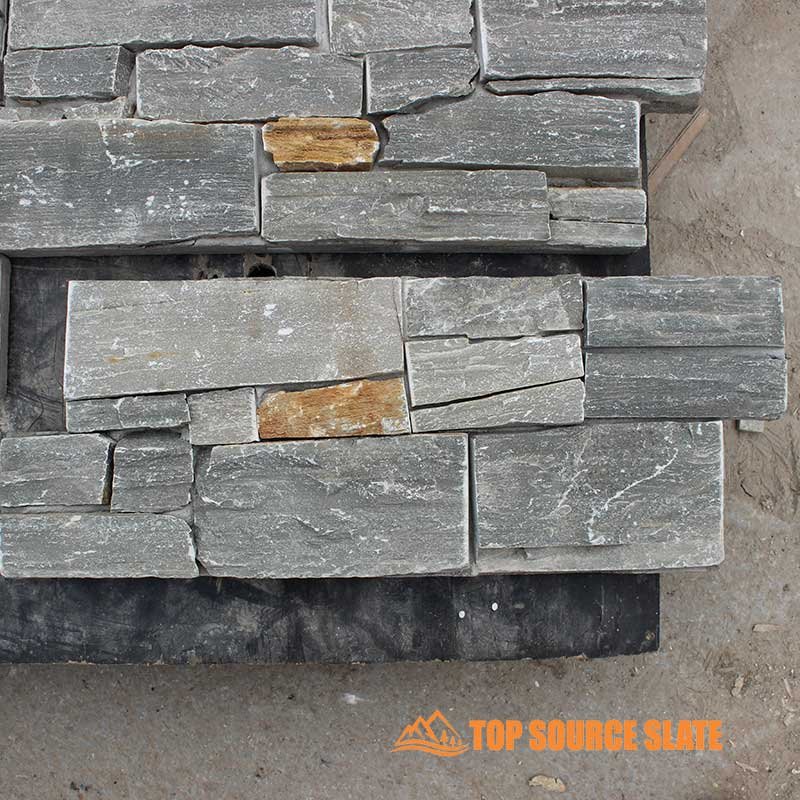
Groothandelsprijzen voor panelen
Negeer oppervlakkige aanhalingstekens. De kosten voor herkomst van vracht en crossdocking verhogen de vrachtkosten met 5 tot 15%; een aanvoerlijn met één herkomst is vaak beter dan een mix van twee tot drie leveranciers op het gebied van de totale kosten.
Typische prijsklassen
Groothandelsprijzen splitsen zich netjes af tussen vervaardigd en natuurlijk materiaal. Gefabriceerd steenfineer – het product dat de meeste importeurs bestellen voor residentiële en licht commerciële projecten – wordt gebruikt $ 8 - $ 12,50 per vierkante meter. Die band dekt standaard split-face afwerkingen in de meest voorkomende paneelformaten (6×24 inch, 8×24 inch, 12×24 inch) bij een dikte van 0,75–1,0 inch. Natuursteen vraagt om een andere beugel: $ 35 - $ 50 per vierkante meter, veroorzaakt door schaarste aan steengroeven, opbrengstverlies tijdens het kappen en het gewichtsverlies dat de vrachtkosten vermenigvuldigt. Gesinterde steenafwerkingen, een premiumcategorie, beginnen bij $ 40 en gaan tot $ 70 per vierkante meter. Voor een B2B-koper die containervolumes verplaatst, is de vervaardigde band waar de margeberekening het beste werkt - ervan uitgaande dat de leverancier consistente kleuren en afwerkingen over de hele partij levert.
Wat feitelijk de prijs drijft
Drie variabelen onderscheiden een goed citaat van een misleidend citaat. Maak de complexiteit af beweegt de naald eerst: standaard matte of gespleten texturen vallen binnen het basisbereik, maar een gepolijste, gevlamde of leerachtige afwerking voegt hieraan toe $ 5 - $ 15 per vierkante meter. Randprofielen – afgerond, afgeschuind, afgeschuind – op elkaar plakken $10–$30 per lineaire voet. Herkomst van vracht is de variabele die de meeste beginnende kopers onderschatten. Een leverancier die ruw blok uit twee verschillende steengroeven betrekt, moet drie logistieke trajecten coördineren, en elke overdracht brengt toeslagen met zich mee: kosten voor cross-docking, huur van chassis op overlaadpunten en brandstofroltrappen. Een toeleveringsketen met één steengroeve elimineert die wrijving en kan de landkosten met 5 tot 15% verlagen vergeleken met een mix van twee tot drie leveranciers. OEM- en verpakkingsaanpassing Voeg 10 tot 30% extra kosten toe aan de eenheidsprijs, maar die investering ontgrendelt private label SKU-flexibiliteit voor detailhandelaren en distributeurs – een afweging die zich terugbetaalt in de aanwezigheid in het schap en de differentiatie van de marges.
Vergelijking van benchmarkcitaten
Wanneer u de offertes van leveranciers vergelijkt, overschrijd dan de FOB-eenheidsprijs. Een leverancier die $ 9,50/sq ft voor gefabriceerd fineer prijst, kan er concurrerend uitzien totdat je rekening houdt met de prototypekosten ($ 20 - $ 200 per eenheid), matrijskosten ($ 250 - $ 1.500 voor een aangepast profiel) en doorlooptijden variërend van 3 dagen tot 6 weken, afhankelijk van of de mal al bestaat. Een andere leverancier die $ 8,30/m² prijsgeeft, gebruikt mogelijk meerdere steengroevebronnen, wat kleurvariatie tussen batches introduceert – het grootste verborgen risico bij bulkinkoop. De echte benchmark stelt drie vragen: Wat is de oorsprong van de steengroeve uit één bron? Zijn de malkosten inbegrepen of apart? En wat is de garantie op kleurconsistentie in een oplage van meer dan 3000 vierkante meter? Een hogere eenheidsprijs van een leverancier die deze drie controles doorstaat, levert vaak lagere totale eigendomskosten op dan de goedkoopste offerte in uw inbox.
OEM-verpakking & Privélabel
Private label-verpakkingen verschuiven gestapelde stenen van commodity naar merk-SKU. De meeste fabrieken beperken maatwerk tot bestellingen van meer dan 3.000 vierkante meter.
Private Label-verpakkingen en merkmogelijkheden
Voor een groothandelaar is het verschil tussen een generieke steenpallet en een merkproductlijn de verpakking. Private label-opties omvatten doorgaans het bedrukken van op maat gemaakte dozen met uw logo, op kleur afgestemde labels, SKU-specifieke barcodes en krimpfolie met merklogo. De extra kosten liggen 10-30% boven de standaard neutrale verpakking, afhankelijk van de printcomplexiteit en het volume.
De kosten voor matrijzen en prototypen zijn eenmalige kosten vooraf: $ 250 - $ 1.500 voor een op maat gemaakte mal en $ 20 - $ 200 per prototype-eenheid. De doorlooptijd voor de ontwikkeling van prototypen varieert van 3 dagen voor eenvoudige kleurmatchingsmonsters tot 6 weken voor geheel nieuwe paneelprofielen of afwerkingen. Door vroeg in de leveranciersrelatie een private label-optie veilig te stellen, krijgt u SKU-flexibiliteit die concurrenten met een neutrale verpakking niet kunnen repliceren: uw retailklanten zien een consistent merkschap, geen warenbak.
MOQ's en vereisten voor ordergroottes
De standaard minimale bestelhoeveelheden voor OEM-verpakkingen bedragen ongeveer 3.000 vierkante meter per SKU. Onder die drempel draaien de meeste fabrieken standaardproductielijnen met uitsluitend generieke verpakkingen. Een enkele bestelling van 3.000 vierkante meter omvat ongeveer 500 tot 750 panelen op de gebruikelijke 6×24 inch formaat, afhankelijk van exacte afmetingen.
Bestelgroottes schalen in duidelijke niveaus:
- Voorbeeldbestellingen: Minder dan 50 vierkante meter: alleen neutrale verpakking, geen merkvermelding. Levertijd 3-7 dagen.
- Kleine bulk: 500–2.999 vierkante meter — neutrale verpakking met optionele barcodelabels, indien vooraf afgesproken. Levertijd 2-3 weken.
- OEM-minimum: 3.000 tot 5.000 vierkante meter – volledige private-labelverpakking, toegang tot matrijzen op maat en batchcontrole met kleurvergrendeling vanuit één enkele steengroevepartij. Levertijd 3-6 weken.
- Volume production: 10,000+ sq ft — tiered pricing, dedicated production line, and priority container loading. Lead time negotiable down to 2 weeks.
The common mistake novice buyers make is assuming MOQ applies uniformly. It does not: MOQ for private-label packaging is distinct from the MOQ for standard production. If your supplier quotes a single MOQ figure, ask whether that covers branded packaging or just bare panels. A factory that separates these numbers is giving you honest pricing.
Tiered Packaging Options by Order Size
Packaging is not one-size-fits-all. Factories that handle volume production offer three distinct tiers based on order value and destination requirements:
Base tier (under 3,000 sq ft): Standard corrugated cartons with generic product labeling. No logo, no barcode, no branded tape. Panels are stacked face-to-face with foam interleaving. This tier is functional for distributors who break bulk and repack locally, but it offers zero retail shelf differentiation.
Mid tier (3,000–10,000 sq ft): Custom-printed cartons with your brand name, product code, and handling instructions. Barcode labels per box. Optional color-matched corner protectors and branded strapping. This tier allows you to ship directly to retail or project sites without relabeling — a 2–3 day time save per container at the warehouse.
Premium tier (10,000+ sq ft): Volledige merkonderdompeling. Op maat gemaakte doosafbeeldingen, logo's in reliëf, QR-codes die verwijzen naar uw installatievideo of specificatieblad, en pallethoezen met merkverpakking in krimpfolie. Sommige fabrieken brengen uw merk ook op het stenen oppervlak aan via lasergeëtste hoekmarkeringen (subtiel, maar effectief voor merkherinnering bij geïnstalleerde projecten). Bij dit volume worden de matrijs- en prototypekosten vaak in de eenheidsprijs opgenomen.
One insider detail worth acting on: insist on a single quarry lot for any order over 5,000 sq ft. Multiple quarry lots in the same shipment increase color variance risk by roughly 40% based on production records. A single-lot batch, combined with tiered packaging, gives you a color-consistent, ready-to-sell branded product that competitors sourcing from fragmented suppliers cannot match.
Kleurconsistentie & Opties voltooien
Single-quarry sourcing isn’t a premium upgrade—it’s the standard for eliminating batch rejection on large installations.
Color Variation Risks from Multi-Quarry Blending
The most common hidden risk in bulk stacked stone procurement is assuming a single factory visit guarantees color consistency across multiple shipments. Quarries naturally shift in mineral composition across extraction seams. A factory pulling stone from different faces without a formal blending and quarantine protocol will produce panels where the base hue drifts by 10-15% between batches. For a wholesaler receiving a container, this means one pallet matches the sample but the next does not—forcing the contractor to blend boxes during installation or face a patchy wall. The standard QC check of “visual inspection at loading” misses this entirely. The operational fix is to require quarry lot IDs on the packing list and confirm the entire run pulls from a single extraction block.
Finish Selection: Matte, Split-Face, and Textured Trade-offs
Finish choice directly impacts production scrap rates, installed appearance, and your retail margin. The data for bulk buyers breaks down as follows:
- Matte (Standard): Baseline finish. Easiest to batch-match across large volumes. Lowest production scrap. Price anchor sits at $8-$12.50 per sq ft. Best for general wholesale distribution where margin predictability outweighs aesthetic premium.
- Split-Face (Premium): Requires skilled labor to cleave the stone consistently. Production scrap rate is roughly 10-15% higher, which drives the additional $5-$15 per sq ft premium. The texture commands higher shelf price, but you must calibrate expectations with installers—variation in cleft depth is a feature, not a defect.
- Textured (Specialty): Engineered surface that masks minor color shifts and surface voids. Useful for commercial projects with varied lighting conditions. Production yield sits between matte and split-face, making it a reliable middle-ground SKU for B2B catalogs.
For a wholesaler, locking in a single finish across the entire MOQ—typically 3000 sq ft—avoids the logistical cost of sorting mixed finishes at the warehouse and eliminates finish-based pricing disputes on the invoice.
Single-Origin Batch Control for Bulk Consistency
De “batch color control hack” that experienced importers use is deceptively simple: insist on a single material lot for the entire order. When a factory combines leftover inventory from different months to hit a lower price, the color variance risk spikes. A single-origin production line—where the whole run of 3000 sq ft comes from one quarry block—cuts that variance by an order of magnitude. It also simplifies logistics: one lot means one inspection protocol, one set of samples, and no cross-batch blending instructions for the installer. This approach directly reduces the total cost of ownership (TCO) by eliminating rework, returns, and site delays.

Doorlooptijd & Logistiek
Hidden freight surcharges can add 5–15% to landed cost. A single-origin supply line often cuts logistics costs more than a 2–3 vendor mix.
Standard Order Lead Times
Voor bulkgestapelde steenpanelen uit een Chinese fabriek bedragen de standaardproductietijden 2 tot 6 weken vanaf de orderbevestiging. Dit assortiment omvat materiaalvoorbereiding, gieten, uitharden (voor vervaardigd fineer), afwerking en kwaliteitscontrole. Bestellingen in de buurt van de MOQ van ongeveer 3.000 vierkante meter vallen doorgaans aan de kortere kant (ongeveer 2 tot 3 weken), terwijl grotere volumes of private-labelverpakkingen de levering tot 5 tot 6 weken kunnen opdrijven. Kleurconsistentieverzoeken waarvoor a enkele steengroevepartij kan een extra week toevoegen voor materiaaltoewijzing.
Express Prototyping en OEM-matrijstijdlijnen
When you need custom profiles, finishes, or private-label samples, the prototyping window ranges from 3 days to 6 weeks depending on complexity. Simple split-face or matte finishes with existing molds can ship samples in 3–5 days. For new OEM molds or unique edge profiles, expect 2–4 weeks for tooling and first articles. Mold development fees run $250–$1,500 per design, and each prototype unit costs $20–$200. Ordering prototypes early—before committing to a full container—lets you verify color match and texture alignment against production lots.
Freight and Port Handling Impact on Total Landed Cost
Sea freight from Hebei, China, to major U.S. West Coast ports typically represents 20–30% of totale landkosten for stacked stone panels, but hidden surcharges can inflate that number by an additional 5–15%. Common additive charges include port congestion fees, container fumigation certificates, and cross-docking fees at the destination terminal. A single-origin supply chain—where all panels come from one quarry and one factory—reduces these costs because it avoids consolidating multiple partial containers from different vendors. That consolidation alone can add $500–$1,200 per container in cross-dock handling and drayage overlap.
Importers should also factor in the weight of the panels: at 6–12 kg per panel, a standard 20-ft container holds roughly 2,500–3,000 sq ft of stacked stone. Overweight containers trigger extra penalties at origin and destination, so confirming container weight limits with the forwarder before booking is standard practice. A supplier who can guarantee consistent block-stacking and pallet dimensions helps you maximize cube utilization and keep per-unit freight rates predictable.
Installation Considerations
Weight, Substrate, and Handling Implications
Each panel in the standard size range—6×24, 8×24, 12×24 inch – weegt tussen 6 en 12 kg. Bij een dikte van 0,75 tot 1,0 inch overschrijdt een pallet van 300 vierkante meter de 400 kg. Dat gewicht vereist een structureel substraat dat de eigen last kan dragen; standaard gipsplaat of dun multiplex is onvoldoende. Voor bulkimporten uit a groothandel gestapelde steenfabrikant China, palletconfiguraties en omsnoeringszaken. Slecht gebandeerde pallets verschuiven in de container, waardoor hoekbeschadiging en meer afval op de locatie ontstaan. Kies voor hoekbeschermers en rekfolie die geschikt zijn voor maritiem transport.
Het verplaatsen op locatie betekent het plannen van mechanisch hijsen voor opdrachten van meer dan 20 m². Het met de hand dragen van individuele panelen van 10 kg voor twee verdiepingen vermenigvuldigt de arbeidsuren. Houd rekening met minimaal twee arbeidskrachten per installatie van 1000 vierkante meter om knelpunten in de workflow te voorkomen. Voorbereiding van de ondergrond – schoon, vlak en voorzien van primer – voegt 15–30% toe aan de totale arbeidstijd, afhankelijk van de toestand van de bestaande muur. Kleurconsequente panelen uit één enkele batch steengroeve verminderen de noodzaak om op de bouwplaats op kleur te sorteren, waardoor niet-productieve verwerkingstijd wordt verkort.
Mortel versus droge stapelmethoden
Bij de meeste gestapelde steeninstallaties wordt een traditioneel mortelbed gebruikt, omdat dit de variatie in paneeldikte compenseert. Panelen met een diktetolerantie van ±2 mm maken een droge stapelmethode mogelijk met alleen constructielijm. Dry-stack verkort de uithardingswachttijd met meer dan 24 uur en elimineert mortel opruimen, maar het vereist panelen met een consistente dikte en platte ruggen. Veel importeurs van kleurconsistente gestapelde stenen panelen in bulk Ontdek dat dry-stack 1 à 2 uur per 100 vierkante meter bespaart ten opzichte van mortel.
Mortel blijft de veiligere keuze voor buitengevels die worden blootgesteld aan vries-dooicycli. Met mortel gekleefde systemen zijn beter bestand tegen uitzetting en vochtmigratie dan lijmverbindingen. De wisselwerking: het aanbrengen, mengen en schoonmaken van het gereedschap kost ongeveer 0,8 uur per 100 vierkante meter. Voor grote projecten (meer dan 5.000 vierkante meter) moet de keuze tussen mortel en droge stapel worden vergrendeld voordat de doorlooptijd gestapelde stenen panelen China fabriek begint met de productie, omdat de achterkant van het paneel en het randprofiel verschillen tussen de twee methoden.
Impact van afwerking en paneelgrootte op arbeidsuren en verspilling
Het afwerkingstype heeft een directe invloed op de installatiesnelheid. Standaard split-face of matte afwerkingen vereisen geen speciale snijtechniek. Eersteklas afwerkingen (gepolijst, gevlamd, leer) voegen $ 5 tot $ 15 per vierkante meter aan materiaalkosten toe en vereisen watergekoelde bladen om brandplekken te voorkomen, waardoor het zagen met 20 tot 30% wordt vertraagd.
Paneelgrootte is een hefboom voor arbeid. Een 12×24 inch paneel beslaat 2 vierkante meter per eenheid; een 6×24 bestrijkt slechts 1 vierkante meter. Het gebruik van het grotere paneel vermindert het aantal te hanteren stukken met de helft, waardoor de installatietijd met ongeveer 15% per 100 vierkante meter wordt verkort. Het addertje onder het gras: de verspilling door het zagen rond ramen en hoeken neemt toe met grotere panelen. Voor een muur met 15% openingen: 12×24 panelen genereren 8-10% afval, tegenover 5-6% voor 6×24 panelen. Bestellen bulk gestapelde stenen prijs per vierkante voet groothandel zou rekening moeten houden met deze afvalvariantie; de netto dekking verschilt tot 5% tussen de paneelformaten.
Arbeidsuren per vierkante meter voor een standaard split-face, 8×24 panelen duren ongeveer 1,2 à 1,5 uur voor een bemanning van twee personen. Overstappen naar een premium afwerking of een niet-standaard maat zoals 4×24 brengt dat op 1,8–2,0 uur. Voor een project van 10.000 vierkante meter is het verschil gelijk aan 3.000 tot 5.000 extra arbeidsuren. Inkoop bij een fabriek die biedt gestapelde stenen panelen OEM-verpakkingsoptiesMet panelen die al op tint zijn gesorteerd en voorzien zijn van een etiket voor kamerzones, kan bij sorteren en inspectie alleen al 0,2 uur per vierkante meter worden terugverdiend.
Conclusie
De prijzen voor gestapelde stenen zijn onderverdeeld in materiaaltype, afwerking en vracht, maar de verborgen kosten zijn dat wel kleurconsistentie over batches. Door vast te houden aan één leverancier worden zowel vrachttoeslagen als het mismatch-risico verlaagd, vaak nog meer dan het verdelen van bestellingen over leveranciers. Voor iedereen die bulk koopt, heeft die ene beslissing invloed op de landkosten en de aantrekkelijkheid van de winkelschappen.
Bekijk de productpagina voor paneelformaten, afwerkingsopties en private-labelverpakkingsmogelijkheden om te vergelijken met uw projectvereisten. De prijsniveaus en MOQ-details worden daar vermeld.
Veelgestelde vragen
Wat is het verschil tussen gestapelde steen en Ledgestone?
Gestapelde steen is een algemene term voor stenen panelen die in een gestapeld patroon zijn gerangschikt, terwijl Ledgestone een specifieke stijl is die onregelmatige, richelachtige vormen met verschillende lengtes nabootst. Bij groothandelsaankopen worden de termen vaak door elkaar gebruikt, maar Ledgestone impliceert meestal een rustiek, onregelmatig profiel. Vraag bij uw leverancier na of deze “grootboek paneel” volgt de Ledgestone-stijl of een uniform gestapeld steenpatroon. Bevestig het exacte profiel bij uw leverancier voordat u bestelt.
Wat zijn de nadelen van gestapelde steen?
De belangrijkste nadelen zijn het gewicht (panelen wegen doorgaans 6 tot 12 kg per stuk) en het risico op kleurvariatie tussen batches als ze niet uit één enkele steengroeve afkomstig zijn. Voor de installatie zijn ook ervaren metselaars nodig voor een goede uitlijning en waterdichtheid. Voor bulkimporteurs zijn kleurinconsistentie tussen zendingen de meest voorkomende verborgen kosten. Zorg voor een levering van één oorsprong en formele kwaliteitscontrole om kleurmismatch te minimaliseren.
Hoeveel gestapelde steen heb ik nodig?
Meet de totale vierkante meters van het te bedekken muuroppervlak en voeg 10-15% toe voor afval en bezuinigingen. Standaardpanelen zijn verkrijgbaar in maten zoals 6×24 inch of 12×24 inch, dus deel de totale oppervlakte door de dekking per doos (doorgaans 8-10 vierkante meter). Voor grote bulkbestellingen dient u uw leverancier de exacte afmetingen te verstrekken om de juiste hoeveelheid en verpakking te verkrijgen. Bestel altijd extra voor breuk en toekomstige reparaties.
Is Stack Stone verouderd?
Gestapelde steen is niet ouderwets; het blijft populair voor accentmuren, open haarden en gevels in zowel moderne als rustieke ontwerpen. Moderne afwerkingen zoals mat, split-face en textuur houden de look actueel, en gefabriceerd steenfineer biedt kosteneffectieve alternatieven voor natuursteen. Voor groothandelimporteurs blijft de vraag naar zowel residentiële als commerciële projecten bestaan. Controleer de huidige designtrends in uw doelmarkt voordat u zich aan een specifieke afwerking wijdt.
Wat zijn de vier soorten stenen?
Het artikel vermeldt geen vier specifieke steensoorten, maar in de gestapelde steenindustrie zijn de gebruikelijke categorieën natuursteen, gefabriceerd steenfineer, cultuursteen en gesinterde steen. Bij import is het belangrijkste prijsverschil tussen gefabriceerd ($8–12,50/m²) en natuursteen ($35–50/m²). Concentreer u op het type dat past bij uw projectbudget en esthetische vereisten. Informeer bij uw leverancier welke steensoort zij produceren.